Build a “Data Product” in Days: Reusable Pipeline Playbooks
📝 Did you know? According to industry research, over 75% of the enterprise data budget is swallowed by repetitive data integration tasks. Rather than delivering high-value analytical models, engineers spend the majority of their time building the same structural boilerplate over and over again.
What are reusable pipeline playbooks?
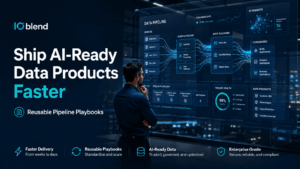
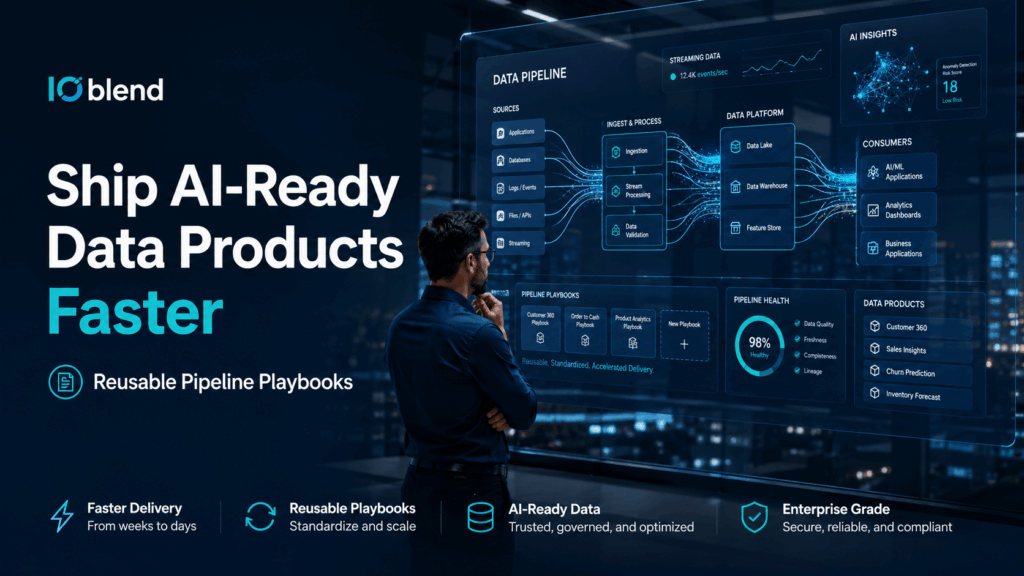
A data product treats data as a curated, standalone asset designed for immediate business consumption. Historically, shipping a new data product meant writing bespoke, monolithic Extract, Transform, Load (ETL) code. Reusable pipeline playbooks flip this model. They decouple infrastructure and orchestration from business rules by storing dataflows as modular, metadata-driven configuration files (like JSON). This means you can standardise ingestion, cleaning, and delivery into plug-and-play templates. Data teams can instantiate a robust, production-grade data product in days by simply feeding new schemas or parameters into an existing playbook.
Common architectural bottlenecks
Most enterprises suffer from brittle, hand-coded pipelines that cannot scale. When a source schema changes unexpectedly, downstream systems break silently, causing data drift chaos.
Consider a financial services firm trying to create an emergency risk-analytics data product. The engineering team has to stitch together historical batch databases and real-time streaming feeds. They spend weeks writing complex Apache Spark™ logic, managing Slowly Changing Dimensions (SCD), tracking record-level lineage, and tuning infrastructure. By the time the code is tested and deployed, the business opportunity has passed, and the team is trapped under a mountain of maintenance technical debt.
Accelerating data products with IOblend
This is precisely where IOblend eliminates friction. IOblend standardises production data pipelines on Spark as portable, lightweight JSON playbooks. It provides a low-code, drag-and-drop interface that abstracts the engineering complexity while autogenerating highly optimised distributed compute code behind the scenes.
- Seamless Kappa Architecture: Easily mix real-time streaming and batch sources dynamically without writing disparate pipelines.
- Built-in DataOps & Governance: Out-of-the-box features automatically handle Change Data Capture (CDC), Type I and II SCD regressions, deduplication, and record-level lineage.
- Resilience to Drift: Schema evolution is managed safely via strong data contracts, ensuring pipelines never fail quietly.
With IOblend, you build your core dataflow logic once and run it anywhere, across multi-cloud, on-prem, or hybrid environments.
Stop wasting quarters hand-coding brittle pipelines; accelerate your modern data estate and ship production-ready data products in days with IOblend.

Streaming Predictive MX: Drift-Aware Inference
Predictive Maintenance 2.0: Feeding real-time sensor drifts directly into inference models using streaming engine 🔩 Did you know? The cost of unplanned downtime for industrial manufacturers is estimated at nearly £400 billion annually. Predictive Maintenance 2.0: The Real-Time Evolution Predictive Maintenance 2.0 represents a paradigm shift from batch-processed diagnostics to live, autonomous synchronisation. In the traditional 1.0

Beyond Micro-Batching: Continuous Streaming for AI
Beyond Micro-batching: Why Continuous Streaming Engine is the Future of “Fresh Data” for AI 💻 Did you know? Most modern “real-time” AI applications are actually running on data that is already several minutes old. Traditional micro-batching collects data into small chunks before processing it, introducing a “latency tax” that can render predictive models obsolete before they

ERP Cloud Migration With Live Data Sync
Seamless Core System Migration: The Move of Large-Scale Banking and Insurance ERP Data to a Modern Cloud Architecture ⛅ Did you know that core system migrations in large financial institutions, which typically rely on manual data mapping and validation, often require parallel runs lasting over 18 months? The Core Challenge The migration of multi-terabyte ERP and

Legacy ERP Integration to Modern Data Fabric
Warehouse Automation Efficiency: Migrating and Integrating Legacy ERP Data into a Modern Big Data Ecosystem 📦 Did you know? Analysts estimate that warehouses leveraging robust, real-time data integration see inventory accuracy improvements of up to 99%. The Convergence of WMS and Big Data Data professionals in logistics face a profound challenge extracting mission-critical operational data such

Dynamic Pricing with Agentic AI
The Agentic Edge: Real-Time Dynamic Pricing through AI-Driven Cloud Data Integration 📊 Did You Know? The most sophisticated dynamic pricing systems can process and react to market signals in under 100 milliseconds. The Evolution of Value Optimisation Dynamic Pricing and Revenue Management (DPRM) is a complex computational science. At its core, DPRM aims to sell the right

Smarter Quality Control with Cloud + IOblend
Quality Control Reimagined: Cloud, the Fusion of Legacy Data and Vision AI 🏭 Did You Know? Over 80% of manufacturing and quality data is considered ‘dark’ inaccessible or siloed within legacy on-premises systems, dramatically hindering the deployment of real-time, predictive Quality Control (QC) systems like Vision AI. Quality Control Reimagined The core concept of modern quality