
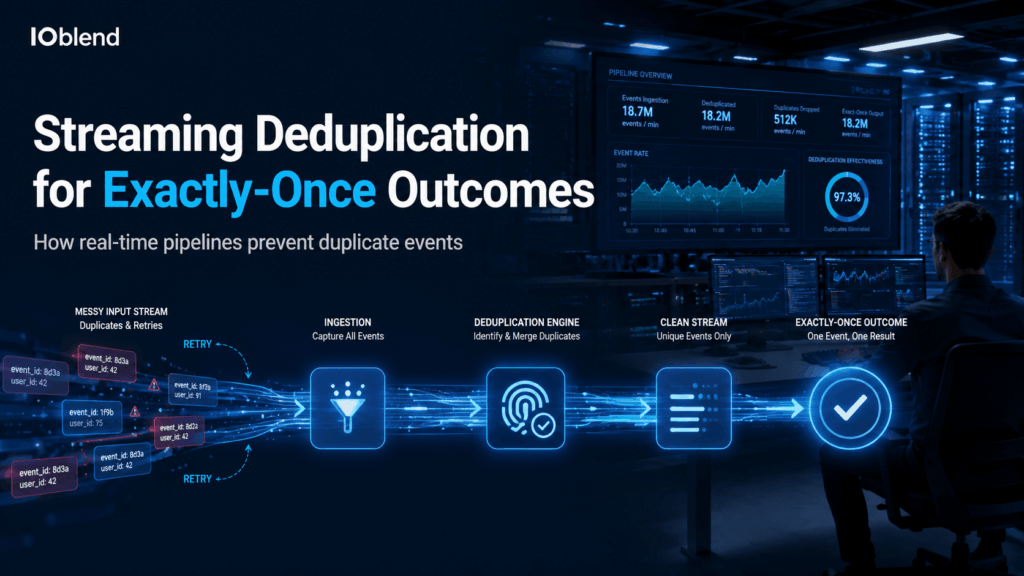

Deduplicate Streaming Events: Exact-Once Outcomes in Real Life
📋 Did you know? In high-velocity streaming environments, network retries and transient worker failures cause up to 20% of event streams to contain duplicate payloads.
Understanding exact-once outcomes
In real-time data engineering, achieving “exactly-once” outcomes does not mean a message is transported across the wire only once, distributed networks make physical delivery guarantees at the wire level impossible. Instead, it means that despite network timeouts, retries, and consumer restarts, the end result of processing a message is committed to your target system precisely once. Stateful deduplication is the engine behind idempotency, transforming an unruly “at-least-once” stream into crisp, deterministic data states.
The painful business cost of duplicate streams
When organisations rely on streaming architectures for real-time analytics or operational automation, duplicate records create severe operational friction:
- Financial and transactional distortion: Consider a fintech payment gateway processing thousands of transactions per second. If a network glitch triggers a producer retry and the pipeline lacks stateful deduplication, a payment event is processed twice, leading to duplicate debits, compliance breaches, and customer churn.
- Corrupted analytics and AI models: In IoT fleet management or airline logistics, duplicated telemetry events distort windowed aggregations. A safety monitoring system reading doubled sensor pings might falsely trigger emergency alerts or corrupt real-time ML feature stores, degrading decision quality.
- Engineering complexity and infrastructure bloat: Building custom deduplication logic in native Apache Spark or Flink requires managing state stores, handling late-arriving data, and writing complex windowing boilerplate.
Solved: Seamless deduplication with IOblend
To achieve true exactly-once processing without drowning in custom code, modern data teams rely on IOblend. Designed around a high-performance Kappa architecture powered by Apache Spark, IOblend abstracts away the heavy lifting of stateful streaming pipelines.
- In-built, zero-code deduplication: IOblend provides automated, record-level de-duping, full-spectrum Change Data Capture (CDC), and real-time upserts out of the box. Engineers no longer need to write complex Spark code or maintain custom state managers.
- Ultra-low latency at scale: Operating seamlessly in-memory on modest hardware or existing Spark infrastructure (such as Databricks or cloud EMR), IOblend processes over 1,000,000 transactions per second at P99 ultra-low latencies.
- Unified stream and batch DataOps: By defining portable playbooks, IOblend unifies streaming and batch workloads while managing schema drift and record-level lineage automatically.
Blend precision into your real-time data pipelines with IOblend.

Data Plumbing Essentials: Production Pipelines
The creation of production data pipelines is an exercise in precision engineering, meticulous planning, robust construction, and continuous maintenance.

Breaking Down the Walls: Overcoming Data Silos
All enterprise data should be discoverable, catalogued and made available for analytics. But the reality is quite different. Data silos are a persistent issue.

Complex World of Enterprise Data Estates
Large enterprises data estates are complex and costly to run and maintain. IOblend enables simplified data integration capabilities that alleviates complexities
Advanced data integration solutions: IOblend vs Pentaho
IOblend and Hitachi Pentaho are advanced data integration tools catering to the data needs of businesses. They differ in architecture design, features and cost.
Advanced data integration solutions: IOblend vs Fivetran
IOblend and Fivetran are both advanced data integration platforms that cater to the growing needs of businesses.
Advanced data integration solutions: IOblend vs Matillion
IOblend and Matillion are both advanced data integration platforms that cater to the growing needs of businesses.