AW-10865990051

Smart Meter Data: Billing to Forecasting

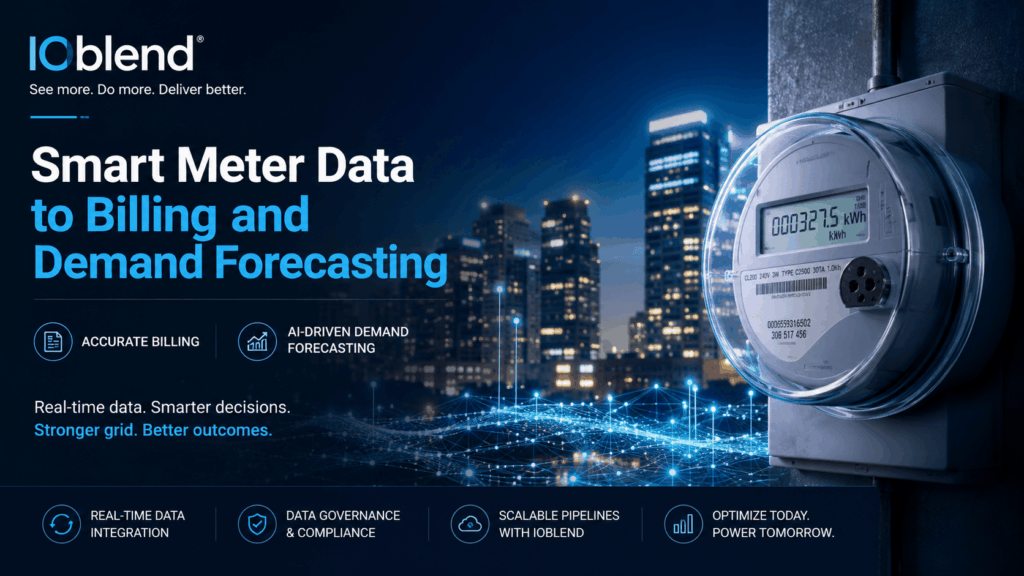
Smart meter billing and AI forecasting with IOblend

Utilities: Smart Meter Data to Billing and Demand Forecasting 

📋 Did You Know? The global roll-out of smart meters generates more data in a single day than most utility companies used to collect in an entire decade. While traditional meters were read once a month, or even once a quarter, smart meters transmit data at intervals as frequent as every 15 minutes, creating a granular “digital heartbeat” of the power grid. 

The Concept: From Pulse to Profit 

Smart meter data integration is the process of transforming raw telemetric pulses into actionable financial and operational intelligence. At its core, this involves capturing high-frequency interval data, validating it for “missing” periods, and routing it into two critical streams. The first is Billing, where consumption data is mapped against complex tariff structures. The second is Demand Forecasting, which uses historical patterns and environmental variables to predict future load, ensuring grid stability and efficient energy procurement. 

The Data Silo Trap 

For data experts in the utility sector, the primary challenge is not the volume of data, but its velocity and variety. Legacy Meter Data Management (MDM) systems often struggle to sync with modern cloud-based billing platforms, leading to “data lag.” When billing engines receive delayed or corrupted data, it results in estimated bills, a leading cause of customer dissatisfaction and regulatory fines. 
 

Furthermore, demand forecasting requires merging smart meter telemetry with external datasets like weather feeds and demographic shifts. Traditional ETL (Extract, Transform, Load) pipelines are often too rigid to handle these schema-on-read requirements, resulting in “stale” forecasts that fail to predict peak load events, costing utilities millions in emergency energy purchases. 

Solving the Pipeline Crisis with IOblend 

This is where IOblend redefines the utility data landscape. By moving away from brittle, code-heavy ETL and embracing a high-performance, metadata-driven approach, IOblend allows data engineers to build resilient, API-to-Spark pipelines in a fraction of the time. 

  • Automated Data Masking & Governance: IOblend ensures that sensitive customer consumption patterns are masked during the forecasting phase, maintaining strict GDPR and industry compliance without slowing down the data flow. 
  • Real-Time CDC: IOblend’s Change Data Capture capabilities allow utilities to sync their MDM systems with billing engines in real-time, eliminating estimated billing and ensuring financial accuracy. 
  • Low-Code Complexity: Using the IOblend Designer, experts can integrate disparate sources, from legacy SQL databases to modern IoT streams, into a unified data lake for advanced AI-driven forecasting. 

Stop fighting your data and start fuelling your grid, supercharge your utility pipelines with the power of IOblend. 

IOblend: See more. Do more. Deliver better.

Smart meter billing and AI forecasting with IOblend
AI
admin

Smart Meter Data: Billing to Forecasting

Utilities: Smart Meter Data to Billing and Demand Forecasting  📋 Did You Know? The global roll-out of smart meters generates more data in a single day than most utility companies used to collect in an entire decade. While traditional meters were read once a month, or even once a quarter, smart meters transmit data at intervals

Read More »
SCADA streams with IOblend
AI
admin

SCADA Streams to Reliability Analytics

Energy: SCADA Streams to Reliability Analytics  🔌 Did you know? The average modern wind turbine or smart substation generates roughly 1 to 2 terabytes of data every month. However, historically, less than 5% of that sensor data was actually used for decision-making. Most of it was simply discarded or “siloed” in SCADA systems, serving as a

Read More »
Logistics operator at a workstation using a tablet with holographic screens showing live ETA, weather, and a route map at a busy distribution hub.
AI
admin

Building Live ETA Pipelines for Fleet Operations

Logistics: Live ETA Prediction Pipelines from Fleet + Orders  🚚 Did you know? The “Last Mile” is famously the most expensive and inefficient part of the supply chain, often accounting for up to 53% of total shipping costs.  The Evolution of Real-Time Logistics  Live ETA (Estimated Time of Arrival) prediction pipelines represent the shift from reactive

Read More »
DB2-to-Lakehouse-with-CDC-IOblend
AI
admin

DB2 CDC to Lakehouse Without Re-Platforming

From DB2 to Lakehouse: Real-Time CDC Without Re-Platforming  💻 Did you know? Mainframe systems like DB2 still process approximately 30 billion business transactions every single day. Despite the rush toward modern cloud architectures, the world’s most critical financial and logistical data often resides in these “legacy” environments, making them the silent engines of the global economy. 

Read More »
Real-time-data-processing-with-deduplication
AI
admin

Real-Time Upserts: Deduping and Idempotency

Streaming Upserts Done Right: Deduping and Idempotency at Scale  💻 Did you know? In many high-velocity streaming environments, the “same” event can be sent or processed multiple times due to network retries or distributed system failures.  The Art of the Upsert  At its core, a streaming upsert (a portmanteau of “update” and “insert”) is the process of synchronising incoming data with an existing

Read More »
Optimising-data-streams-and-analytics-with-IOblend
AI
admin

Streaming Data Quality That Won’t Break Pipelines

Streaming Without the Sting: Data Quality Rules That Never Break the Flow  💻 Did you know? A single minute of downtime in a high-velocity streaming environment can result in the loss of millions of data points, potentially costing a business thousands of pounds in missed opportunities or regulatory fines. —  Defining Resilient Streaming Quality  Data quality in

Read More »
Scroll to Top