
10x less effort on production data integration.
Not by removing engineering. By removing repeated engineering. IOblend combines pipeline development, Spark execution, testing, debugging, data quality, lineage, exception handling, deployment and reusable integration logic in one production layer.
The 10x proposition is a delivery target and published IOblend positioning, not a guaranteed result for every workload. Actual impact depends on architecture, reuse, complexity and existing engineering practices.
The expensive part is rarely writing one transformation.
Production data work accumulates effort around the transformation: environment setup, repeated connectors, testing, deployment, data-quality handling, schema change, debugging and operations. IOblend reduces effort by collapsing more of that lifecycle into the pipeline itself.
Build the pattern once. Stop rebuilding the plumbing for every source.
Many enterprise integration programmes repeat the same transformations, quality rules and delivery logic across similar systems, regions, customers or business units. IOblend playbooks let teams reuse the production pattern and vary the configuration around it.
Illustrative reusable integration family
Find pipeline problems while you are building, not after deployment.
IOblend integrates validation and visual debugging into pipeline development. Invalid logic and SQL or Python syntax can be caught before the pipeline is treated as production-ready, reducing the separate testing code and debugging loops teams often create around the dataflow.
Integrated development gates
Data quality that protects the pipeline, not just the report.
Enterprise data integration becomes expensive when every bad record turns into a pipeline incident. IOblend brings data quality, schema validation, exception quarantine and record-level lineage into the production dataflow itself. Healthy records can continue where the workflow permits, while problematic data keeps the context engineers need to investigate, repair and replay it.
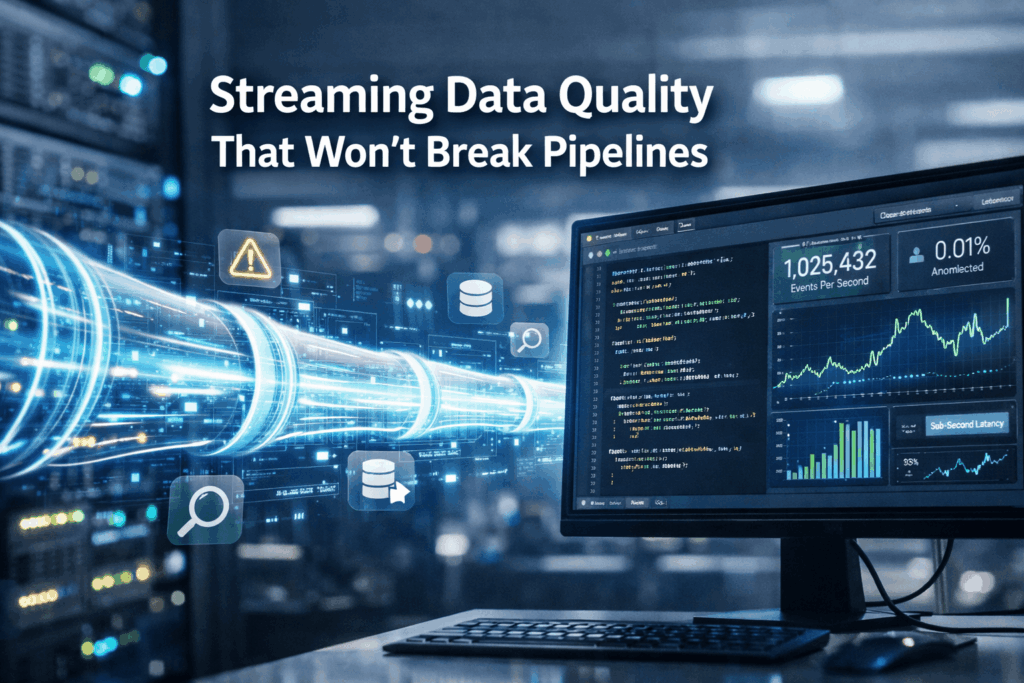
Streaming data quality without stopping the healthy flow.
Validation and exception handling matter most when the pipeline has to keep moving. The same operating principle applies to CDC, batch integration, migration and continuously changing enterprise data.
Quality, lineage and streaming are production disciplines.
These independent references provide useful context around the engineering disciplines IOblend brings together. They are included as technical references, not as certification or partnership claims.
Spark provides a unified distributed processing model for streaming and batch workloads, including stateful processing and fault-tolerant execution.
Apache Spark documentation ↗OpenLineage provides an open framework for collecting metadata about datasets, jobs and runs, illustrating why traceability matters in production data estates.
Explore OpenLineage ↗Great Expectations is a widely used open-source data quality framework centred on explicit expectations and validation, useful context for modern data-quality engineering.
Explore Great Expectations ↗Do not build a new operating stack every time data moves differently.
Batch, CDC and streaming projects often become separate engineering disciplines with different frameworks, deployment patterns and support models. IOblend is designed to handle these movement types within the same production environment so teams can reuse the surrounding controls and skills.
Different movement, one production layer
Reduce data integration effort by standardising the production work around every pipeline.
The benefit is not simply writing a transformation faster. It is removing repeated engineering around connectivity, CDC, validation, lineage, schema handling, exception management and deployment. IOblend's published delivery examples show what that operating model can mean when applied to real enterprise integration and migration work.
Real-time production pipelines with one engineer.
A single engineer synced an operational system with the ERP in two days, including transformation, data quality and governance - all ready for production.
See IOblend customer results →A complex migration scope compressed into weeks.
Data migration example that showcases a complex legacy and streaming integration originally scoped at nine months and delivered in six weeks.
Explore the migration approach →Reusable production logic changes the delivery model.
A leading digital consultancy accelerated client pipeline development with IOblend from weeks to minutes, illustrating the value of reusable production patterns rather than repeated custom plumbing.
See services and customer results →These are IOblend-published customer and project examples, not universal performance guarantees. Delivery time depends on source systems, scope, data quality, infrastructure, governance requirements and project complexity.
Watch a production pipeline come together.
The IOblend video curriculum walks through project configuration, building the first production-grade pipeline, testing source and engine logic, adding transformations, creating sinks, streaming events and JDBC delivery.
Open the full documentation →Faster delivery still needs controlled migration engineering.
IOblend's migration approach fits established enterprise principles: choose a workload-appropriate migration strategy, automate repeatable work, maintain business continuity and prove the target before cutover. These links provide independent context from major cloud and processing platforms.
AWS guidance emphasises migration planning, automation, repeatable processes and coordinated execution when moving enterprise workloads at scale.
AWS migration guidance ↗Microsoft distinguishes rehost, replatform, refactor, rebuild, replace, retain and retire patterns rather than treating every migration as the same technical problem.
Microsoft migration strategy ↗Apache Spark provides the distributed processing foundation used by IOblend for scalable transformation and production data workloads.
Apache Spark ↗Automation helps most when the organisation is repeating expensive integration work.
The value is not uniform across every task. IOblend is strongest where production integration has repetition, operational controls and multiple systems. A tiny one-off data movement may not need an enterprise production layer.
Effort compounds here
Do not force the platform
What the claim does and does not mean.
The useful question is not whether every task is exactly ten times faster. It is which categories of repeated production engineering can be removed from the project.
Does IOblend guarantee a 10x reduction in data integration effort?
No. The 10x figure is IOblend's published benefits positioning and a target for suitable workloads, not a contractual guarantee. Actual impact depends on the existing architecture, complexity, degree of reuse and engineering practices.
Where does the effort reduction come from?
It comes from combining pipeline construction, Spark execution, testing, debugging, quality controls, exception handling, lineage, deployment and reusable playbooks in one production workflow.
Is the benefit only from low-code development?
No. Visual development reduces construction effort, but the larger effect comes from reducing the surrounding production work that normally has to be implemented and maintained separately.
Does IOblend still support custom SQL and Python?
Yes. Teams can use SQL and Python where custom logic is required while keeping the wider pipeline lifecycle inside the IOblend environment.
How does reuse reduce engineering effort?
Portable playbooks let a tested integration pattern be applied to additional sources or environments through configuration rather than rebuilding the entire flow and its operational controls.
How does built-in testing reduce effort?
IOblend validates pipeline components during construction, blocks invalid logic and supports visual debugging before deployment, reducing separate test scaffolding and repeated debugging cycles.
How does data quality affect the 10x proposition?
Quality handling often becomes a large operational cost after a pipeline is live. In-flight validation, exception quarantine and record-level lineage make those controls part of the production pattern instead of a separate clean-up workflow.
Which projects are most likely to see large productivity gains?
Multi-system integration, migration factories, repeated source onboarding, real-time integration, system synchronisation and production AI pipelines tend to have the greatest amount of repeatable engineering around the core transformation.
Should IOblend be used for every data movement?
No. A trivial one-off transfer may not need an enterprise production layer. IOblend is most valuable when the pipeline must be reliable, reusable, governed or operated over time.
Show us one integration workload. We can map where the effort is actually going.
Bring a representative pipeline, migration pattern or multi-system integration. The useful exercise is to separate the business logic you need from the repeated engineering that should not have to be rebuilt.