
Cloud data migration without the big-bang cutover.
IOblend is enterprise cloud data migration software for moving data and business logic from legacy, on-premises and existing cloud systems into modern cloud platforms. Move history in bulk, capture live changes with CDC, transform and validate data in flight, run old and new systems in parallel, reconcile the result and cut over when the target is ready—not when the migration tool forces you to.
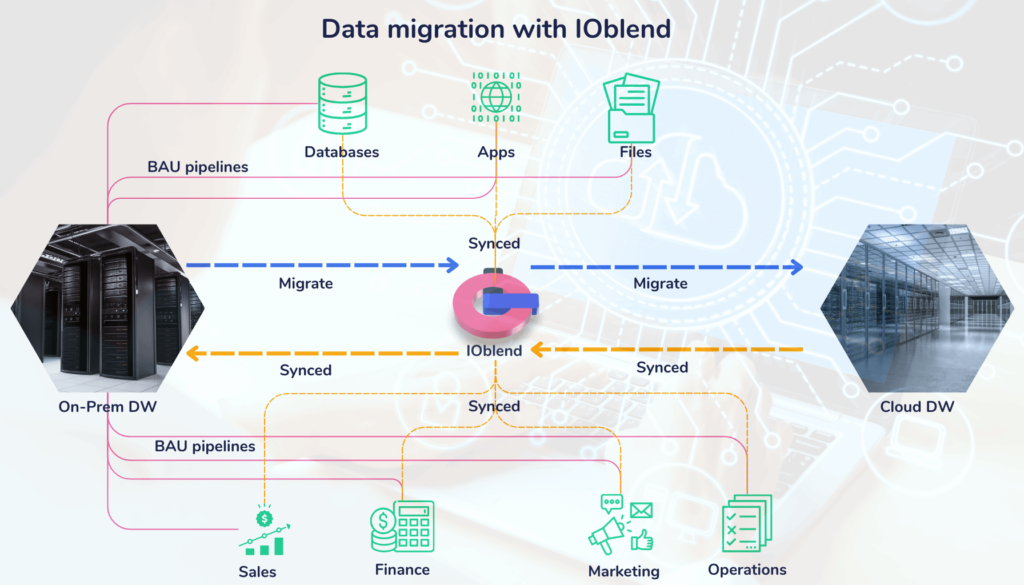
Cloud migration is not one pattern.
The target architecture should determine the migration method. IOblend supports straightforward data movement, transformation-heavy modernisation and phased synchronisation without forcing every workload through the same technical route.
Move data with minimal change
Replicate structures and move historical data when the priority is relocating workloads quickly with limited transformation.
Best when target semantics remain similar.Move and adapt
Change formats, structures or delivery logic to fit a modern warehouse, lakehouse or cloud database while preserving business meaning.
Best when the target works differently.Rebuild the data flow—not the business rule
Extract business logic from ageing ETL and re-express it as portable SQL, Python and IOblend playbooks for the new environment.
Best for legacy ETL replacement.Run source and target together
Move history, then use CDC to keep environments aligned while users, workloads and controls are validated before cutover.
Best for lower-risk phased migration.Move the history once. Keep capturing what changes.
A phased enterprise cloud migration works best when the historical move and the live change stream are treated as one controlled lifecycle rather than separate projects.
Assess
Identify sources, schemas, dependencies, business rules and success criteria.
Bulk history
Move the historical dataset into the target efficiently.
Transform
Convert formats, rebuild logic and apply cloud-target rules in flight.
CDC tail
Capture inserts, updates and deletes that occur after the bulk extract.
Reconcile
Compare counts, checksums, schemas and record-level differences.
Parallel run
Keep source and target aligned while workloads are validated.
Cut over
Switch consumers when the target has met the agreed migration criteria.
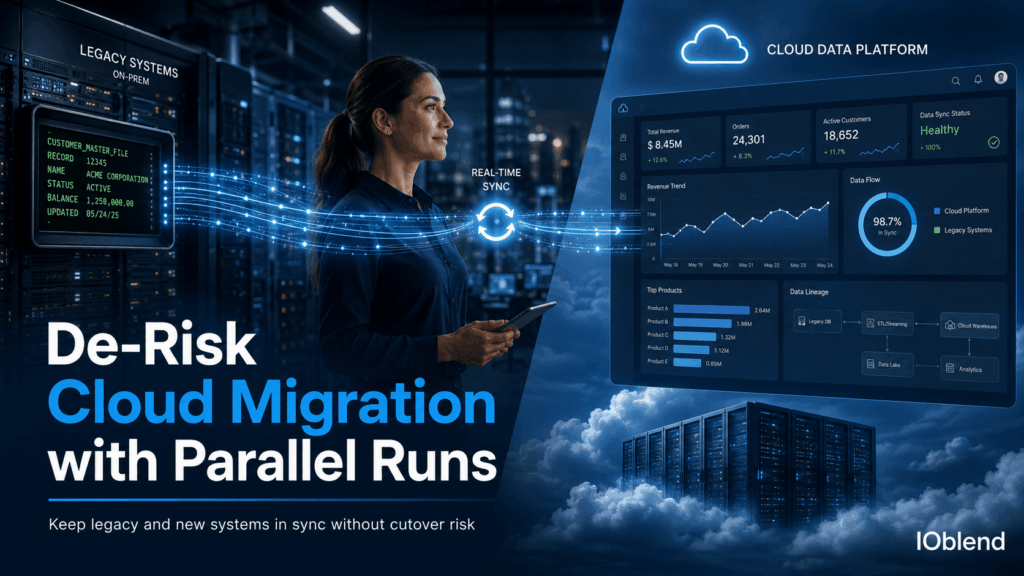
Run legacy and cloud in parallel until the evidence says switch.
A parallel run keeps the source environment operational while the target receives the same changing business data. That creates time to validate data parity, performance and downstream behaviour under real conditions instead of relying on a single migration weekend.
Do not carry legacy ETL architecture into the cloud by accident.
The difficult part of cloud migration is often not moving bytes. It is preserving decades of joins, filters, mappings, calculations and exception rules while changing the execution environment. IOblend separates pipeline intent from infrastructure so business logic can be rebuilt as portable metadata, SQL and Python rather than recreated as another generation of tightly coupled ETL.
runtime: customer-controlled Spark infrastructure
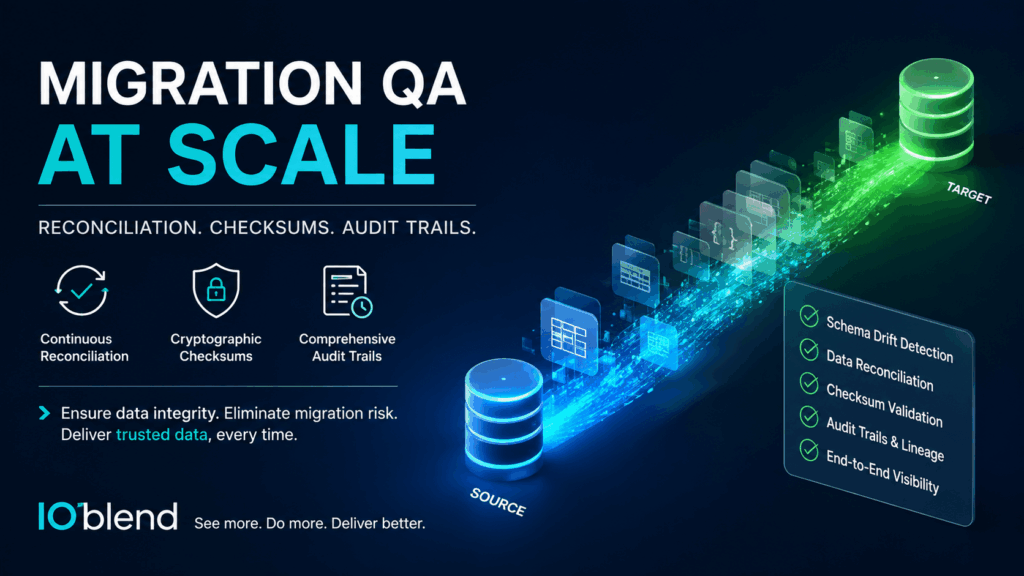
“It loaded” is not the same as “it migrated correctly.”
Enterprise migration QA has to prove volume, structure and data integrity across source and target. IOblend can run reconciliation, custom checksum logic, schema comparisons, lineage and exception analysis as part of the migration pipeline rather than leaving validation until after cutover.
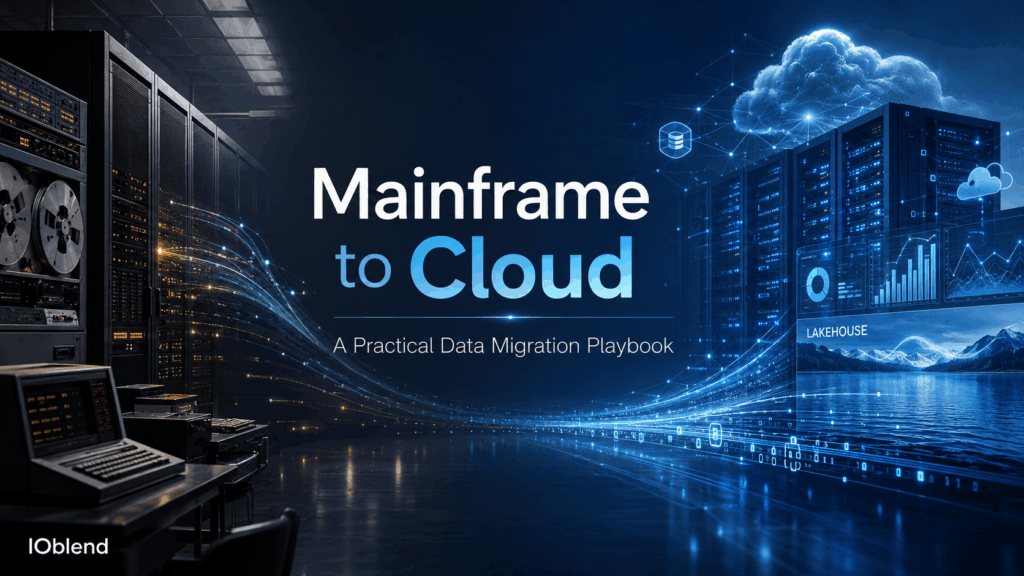
When the source is older than the cloud architecture itself.
Mainframe and long-lived enterprise migrations add format conversion, opaque dependencies, legacy encodings and strict operational constraints to the normal migration problem. IOblend provides a modern Spark execution layer around those constraints without requiring the source system to become cloud-native before migration can begin.
Some migrations contain documents, emails and text—not just tables.
Agentic AI can be useful inside a migration pipeline when legacy information has to be extracted from unstructured sources before it can be validated and merged with structured target data. IOblend can embed Python, model or agent logic into the wider production migration flow rather than turning document extraction into a separate disconnected project.
Migrate to the cloud platform that fits the workload.
IOblend is the migration and production data layer, not the destination. That keeps migration logic portable across cloud providers, warehouses, lakehouses and enterprise data platforms instead of baking the migration into one vendor’s orchestration model.
Do not cut over because the calendar says the migration is finished.
A cloud migration should have explicit exit criteria. The target becomes production when the data, logic, consumers and recovery path have been proven—not merely because the bulk copy completed.
Questions migration architects ask before the cutover plan is approved.
These answers focus on enterprise data migration rather than generic cloud infrastructure: how data moves, stays current, is validated and reaches the target without losing business meaning.
What is enterprise cloud data migration?
Enterprise cloud data migration is the controlled movement and modernisation of operational data, historical data and business logic from legacy, on-premises or existing cloud environments into a target cloud platform. A production migration usually includes extraction, transformation, CDC, validation, reconciliation, parallel operation and cutover—not simply copying files or database tables.
How does IOblend reduce cloud migration cutover risk?
IOblend can move the historical dataset first, then use Change Data Capture to keep source and target aligned while the new environment is validated. This supports a parallel-run approach where the legacy system can remain operational until data parity, business logic and downstream consumers have been proven.
What is the bulk-history + CDC-tail migration pattern?
The bulk-history phase moves the existing dataset into the target. The CDC tail then captures inserts, updates and deletes that happen after the bulk extract began. Reconciliation proves that the target has caught up before cutover. This pattern reduces reliance on long source-system freezes.
Can IOblend migrate data while transforming it?
Yes. Data can be mapped, cleansed, enriched, aggregated, deduplicated and validated in flight. SQL, Python and IOblend metadata-driven playbooks allow migration teams to adapt legacy structures and business rules to the target rather than performing a raw copy followed by a separate transformation project.
How does IOblend validate a cloud migration?
IOblend can support source-to-target reconciliation, record counts, custom checksum logic, schema comparisons, data-quality rules, audit information and record-level lineage. Exceptions can be isolated and replayed rather than forcing the entire migration to be restarted.
Can IOblend migrate mainframe or other legacy data?
Yes. IOblend can connect to legacy sources where appropriate drivers or interfaces are available, process historical and live changes, transform formats and business logic, and deliver into modern cloud targets. See the mainframe-to-cloud migration example →
Does IOblend only support lift-and-shift migrations?
No. IOblend can support rehost, replatform, transformation-heavy modernisation, data-warehouse rebuilds, system consolidation and synchronised parallel migrations. The pipeline design can reflect the target architecture rather than being constrained to a single migration methodology.
Which cloud platforms can IOblend migrate data to?
IOblend is target-platform neutral. It can deliver into cloud databases, warehouses, lakehouses and other supported destinations across platforms such as Microsoft Azure, AWS, Google Cloud, Databricks and Snowflake, depending on the connectivity and target architecture.
What happens to IOblend after the migration is complete?
The same production pipeline model can continue as the integration layer after cutover. Instead of throwing away migration scripts, teams can retain the transformation, quality, lineage and CDC logic for ongoing synchronisation, analytics or operational data movement.
Can AI be used inside a cloud migration pipeline?
Yes, where it is useful. IOblend can incorporate Python, model or agent logic into the flow—for example, extracting structured information from documents, classifying legacy text or validating unstructured migration content before it is combined with normal structured data.
Bring us the source, target, business logic and cutover constraint.
We can map the migration into historical load, CDC, transformation, validation, parallel-run and cutover stages—then identify where IOblend can remove custom engineering and reduce operational risk.
