Real-time data integration without a separate engineering stack.
IOblend builds production real-time data pipelines from Change Data Capture, event streams, IoT, transactional systems and live application data. Combine streaming and batch data in the same pipeline, transform and validate records in memory, maintain state, handle schema change and deliver trusted data into analytics, AI, applications and operational systems using customer-controlled Apache Spark infrastructure.
Move data when the business event happen, not when the batch window opens.
Real-time data integration continuously captures, transforms and delivers data as operational events occur. The source might be a database change, machine signal, application event, API message or transaction. The important architectural difference is that the pipeline remains active and maintains the state required to process an ongoing stream rather than repeatedly rebuilding a static dataset.
CDC
Capture inserts, updates and deletes without continuously re-reading the full source table.
Events
Process business events as applications, services and users generate them.
IoT + telemetry
Ingest machine, sensor, location and device data as an ongoing operational stream.
Stream + batch
Enrich live data with reference, historical and master data inside the same pipeline.
Capture change at the source. Transform it before it becomes downstream work.
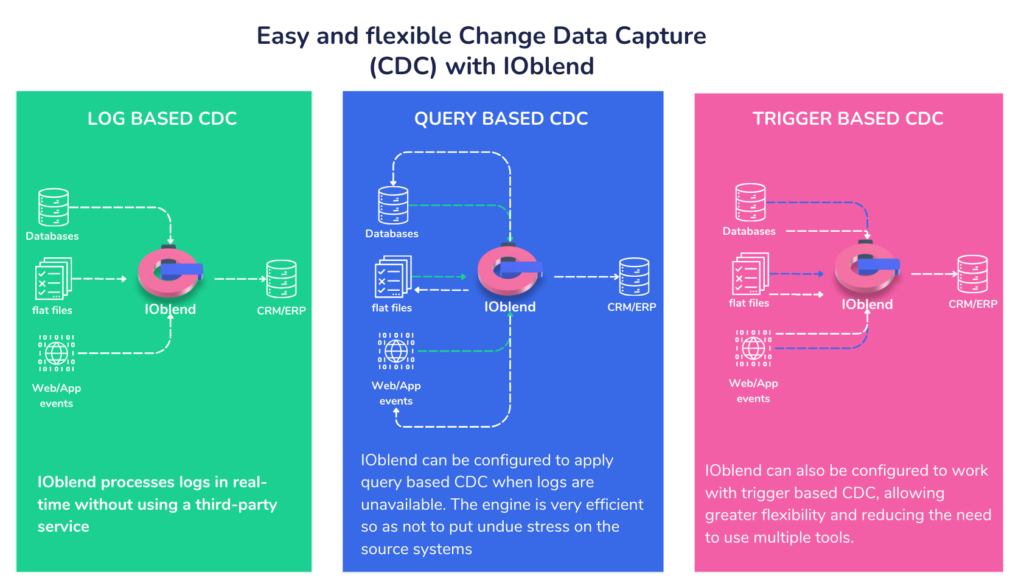
IOblend supports multiple CDC patterns because enterprise systems do not expose change in the same way. Log-based CDC can be efficient where database logs are accessible; trigger-based CDC can suit controlled database environments; query-based CDC can provide a practical alternative where log access is unavailable. Events, files, APIs and message streams can enter the same production flow.
One live flow from event to trusted outcome.
A production streaming pipeline has to do more than receive messages quickly. It has to understand state, transform records, validate them, handle exceptions and deliver the right result without forcing those responsibilities into separate tools.
Capture
Read CDC, events, telemetry or messages as data changes.
Parse
Normalise schemas, formats and message structures.
Enrich
Join live events with reference, historical or master data.
Maintain state
Track windows, latest values, deduplication keys and event context.
Validate
Apply schema, quality, contract and business rules in flight.
Route
Send healthy records forward and exceptions to controlled paths.
Act
Feed analytics, AI, applications or operational systems immediately.
Bad records should not become a reason to stop good data.
Batch jobs can often fail and wait for investigation. Live operational streams usually cannot. IOblend can apply validation and schema rules record by record, isolate exceptions and allow valid records to continue through the pipeline while retaining enough lineage to repair and replay the failed path.
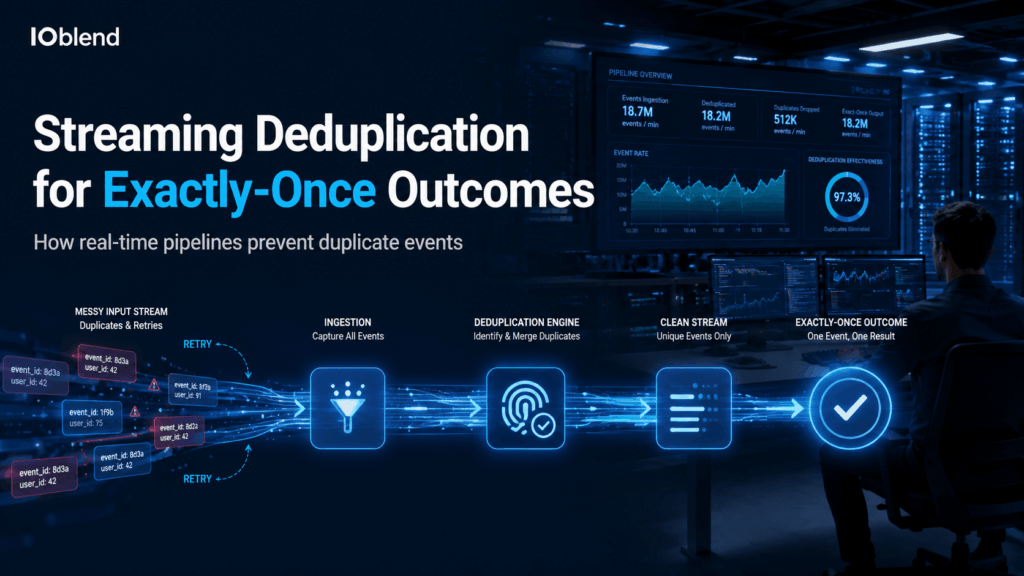
Real-time pipelines have to remember what happened before this event.
Many streaming problems are not stateless transformations. Fraud detection, sessionisation, operational monitoring, rolling metrics and live customer context depend on windows, previous values and out-of-order events. IOblend manages those production patterns as part of the pipeline model.
Rolling aggregation
Calculate counts, sums, averages or other metrics over moving event windows.
Latest known value
Maintain the most recent valid state for entities, devices, customers or transactions.
Late-arriving events
Handle records that arrive after the event that logically followed them.
Stream + historical joins
Enrich live events with static, master or previously stored business context.
Exactly-once business outcomes matter more than pretending the network delivers every event once.
Retries, consumer restarts and network failures can cause the same event to be delivered more than once. IOblend can maintain state and deduplication keys so repeated delivery does not automatically become repeated business action at the target.
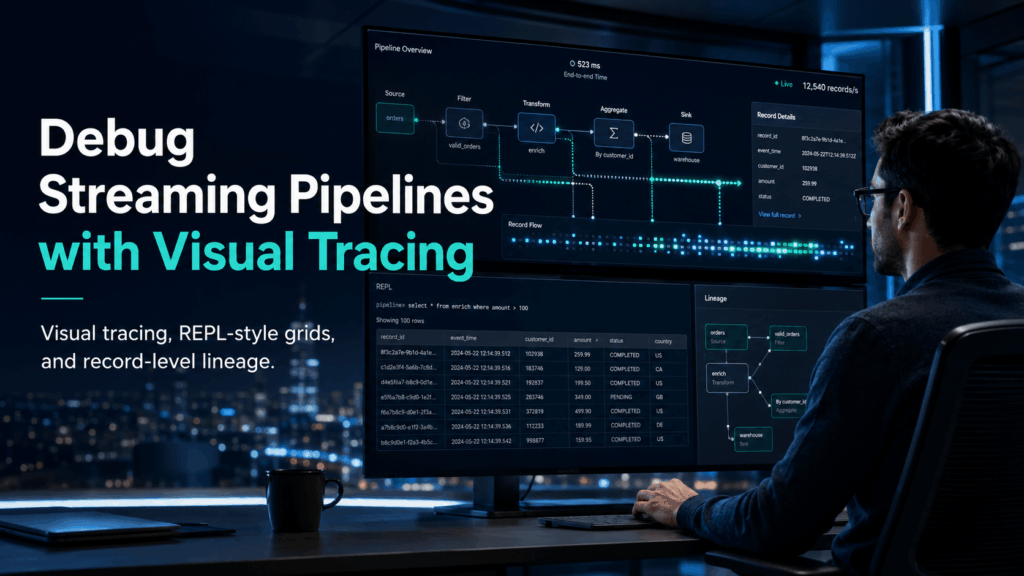
Real-time pipelines are easier to trust when engineers can see what a record actually did.
Streaming systems are difficult to debug because the data does not wait for somebody to attach a breakpoint. IOblend combines visual pipeline development, record-level lineage, test execution and integrated debugging so engineers can inspect logic before deployment and investigate production exceptions with context.
Fresh data matters when the decision expires quickly.
Fraud signals, dynamic pricing, machine conditions, logistics events and live customer interactions lose value as they age. IOblend can deliver low-latency, governed context directly into analytical, operational and AI workloads instead of forcing every live event through a slow storage-first integration chain.
Use the broker, cloud service and lakehouse that fit your architecture.
IOblend is the production integration and processing layer, not a requirement to standardise every transport around one vendor. Kafka, cloud event services, Spark environments and lakehouse targets can remain part of the architecture where they make sense.
Questions architects ask before a streaming pipeline goes into production.
These answers focus on the production engineering behind real-time integration: CDC, event streams, state, quality, latency, deduplication and how IOblend fits alongside the streaming technologies already in the estate.
What is real-time data integration?
Real-time data integration continuously captures, transforms and delivers operational data as changes or events occur. Sources can include databases via Change Data Capture, event brokers, IoT devices, APIs and applications. Production pipelines also need state, quality, lineage, error handling and downstream delivery—not only fast ingestion.
What is the difference between CDC and event streaming?
Change Data Capture tracks inserts, updates and deletes in an existing operational data source, usually a database. Event streaming typically publishes business or technical events intentionally from applications, devices or services. IOblend can consume both patterns and process them inside the same production data flow.
Can IOblend combine streaming and batch data in one pipeline?
Yes. IOblend uses a Kappa-style architecture so real-time events can be enriched with batch, static, historical or master data without requiring a separate streaming implementation of the same business logic.
Does IOblend require Apache Kafka?
No. Kafka can be used as a source or transport where it fits the architecture, but IOblend does not require every real-time pipeline to use Kafka. It can work with CDC, JDBC streaming, files, cloud event services, APIs and other supported sources and sinks.
How does IOblend handle streaming data quality?
Validation, schema checks and business rules can be applied to each record in flight. Invalid records can be quarantined while healthy data continues, reducing the need to halt an entire operational stream because of a small number of exceptions.
How does IOblend handle duplicate events?
IOblend supports stateful deduplication and idempotent processing patterns. Records can be identified using event IDs, business keys or composite rules so retries and duplicate delivery do not automatically create duplicate business outcomes downstream.
How are late-arriving or out-of-order events handled?
State, windows and event-time logic can be used to process records according to their business time rather than assuming every event arrives in perfect order. The correct approach depends on the latency tolerance and correctness requirements of the use case.
What latency can IOblend support?
IOblend supports low-latency production data delivery, including p99 below 100 ms under defined benchmark conditions. Actual latency depends on infrastructure, network topology, transformation complexity, data volume, state requirements and deployment architecture.
Can IOblend run on our existing Spark infrastructure?
Yes. IOblend Enterprise Edition is designed to execute on customer-controlled compatible Spark infrastructure in cloud, on-premises or hybrid environments. The objective is to add the production pipeline and DataOps layer without forcing the enterprise to replace the infrastructure it already operates.
How does IOblend support real-time AI?
IOblend can provide fresh, governed features or enterprise context to AI models, agents and applications. Streaming inputs can be combined with historical data, validated and transformed before the result reaches inference or operational decisioning.
How do engineers debug a live IOblend stream?
IOblend provides visual pipeline development, integrated testing, versioning, exception information and record-level lineage. This gives engineers a structured way to understand what a record did through the flow rather than relying only on disconnected runtime logs.
When is IOblend a strong fit for real-time integration?
IOblend is a strong fit when an organisation needs more than event transport: CDC, transformation, state, stream/batch enrichment, quality, lineage, deduplication and multi-target delivery across a heterogeneous enterprise estate.
Bring us the event, the source, the latency requirement and what has to happen next.
We can map the real-time architecture into capture, state, transformation, quality, lineage and delivery—then identify where IOblend can replace custom streaming engineering without replacing the event or cloud platforms you already use.