Compliance-Friendly DataOps: Repeatable, Reviewable, Versioned Pipelines
📓 Did you know? According to industry compliance reports, nearly 70% of businesses face difficulties tracing their data back to its raw origins during regular regulatory audits.
The Concept of Compliance-Friendly DataOps
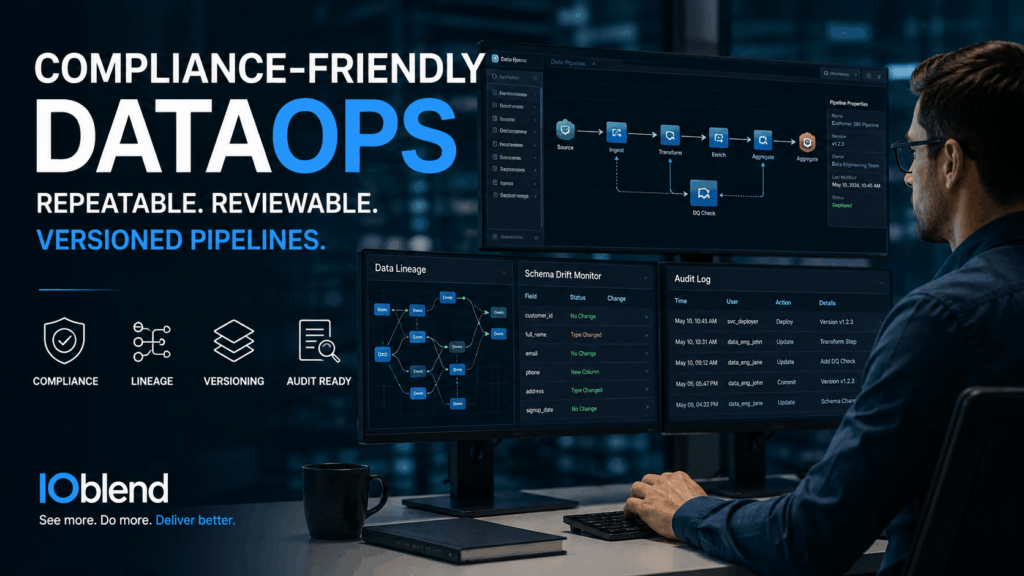
Compliance-friendly DataOps represents an operational framework that embeds strict regulatory governance directly into the data engineering lifecycle. Instead of treating data auditing as an afterthought, this methodology ensures that data transformation pipelines are systematically repeatable, fully reviewable, and meticulously versioned. In practice, this means every single record can be traced back to its precise source code state and ingestion window.
Fragmented Pipelines and the Cost of Chaos
Modern enterprise data architectures are frequently crippled by structural drift and opaque processing layers. Data experts regularly battle with fragmented workflows where a sudden upstream schema change completely breaks downstream analytics without warning.
When a financial institution or healthcare provider is asked to explain a specific metric to an auditor, they are forced into a scramble of manual code inspection, database log reconstruction, and speculative debugging.
Consider a real-world use case in banking risk assessment. If a machine learning model flags an account based on transformed streaming data, compliance requires absolute reproducibility. Without pipeline versioning, reproducing the exact state of that data from three months ago is practically impossible.
The IOblend Solution
Designed as an advanced end-to-end data integration application with native DataOps capability, IOblend standardises production data pipelines on Apache Spark as portable JSON and Python playbooks.
IOblend resolves enterprise governance challenges through an array of built-in production features:
- Automated Record-Level Lineage: It registers auditing metadata dynamically across the full data journey, giving experts precise visibility from source to sink.
- Pipeline Versioning and Collaborative Development: The platform natively supports strict CI/CD deployment principles and pipeline versioning via the IOblend Designer, allowing teams to track code changes and safely replay historical data transforms.
- Real-Time Governance & Drift Handling: IOblend features out-of-the-box Change Data Capture (CDC) and instantaneous schema drift monitoring. If changes happen, they do not fail quietly; you see exactly what was impacted down to individual records.
- Advanced Error Management: Out-of-the-box data validation and exception handling isolate anomalies into secure quarantine zones for immediate SME review.
Standardise your data governance and build production-ready, auditable pipelines with ease.

Real-Time Churn Agents with Closed-Loop MLOps
Churn Prevention: Building “closed-loop” MLOps systems that predict churn and trigger automated retention agents 🔗 Did you know? In the telecommunications and subscription-based sectors, a mere 5% increase in customer retention can lead to a staggering profit surge of more than 25%. Closed-Loop MLOps A “closed-loop” MLOps system is an advanced architectural pattern that transcends simple predictive analytics. While

Streaming Predictive MX: Drift-Aware Inference
Predictive Maintenance 2.0: Feeding real-time sensor drifts directly into inference models using streaming engine 🔩 Did you know? The cost of unplanned downtime for industrial manufacturers is estimated at nearly £400 billion annually. Predictive Maintenance 2.0: The Real-Time Evolution Predictive Maintenance 2.0 represents a paradigm shift from batch-processed diagnostics to live, autonomous synchronisation. In the traditional 1.0

Beyond Micro-Batching: Continuous Streaming for AI
Beyond Micro-batching: Why Continuous Streaming Engine is the Future of “Fresh Data” for AI 💻 Did you know? Most modern “real-time” AI applications are actually running on data that is already several minutes old. Traditional micro-batching collects data into small chunks before processing it, introducing a “latency tax” that can render predictive models obsolete before they

ERP Cloud Migration With Live Data Sync
Seamless Core System Migration: The Move of Large-Scale Banking and Insurance ERP Data to a Modern Cloud Architecture ⛅ Did you know that core system migrations in large financial institutions, which typically rely on manual data mapping and validation, often require parallel runs lasting over 18 months? The Core Challenge The migration of multi-terabyte ERP and

Legacy ERP Integration to Modern Data Fabric
Warehouse Automation Efficiency: Migrating and Integrating Legacy ERP Data into a Modern Big Data Ecosystem 📦 Did you know? Analysts estimate that warehouses leveraging robust, real-time data integration see inventory accuracy improvements of up to 99%. The Convergence of WMS and Big Data Data professionals in logistics face a profound challenge extracting mission-critical operational data such

Dynamic Pricing with Agentic AI
The Agentic Edge: Real-Time Dynamic Pricing through AI-Driven Cloud Data Integration 📊 Did You Know? The most sophisticated dynamic pricing systems can process and react to market signals in under 100 milliseconds. The Evolution of Value Optimisation Dynamic Pricing and Revenue Management (DPRM) is a complex computational science. At its core, DPRM aims to sell the right