
Churn Prevention: Building “closed-loop” MLOps systems that predict churn and trigger automated retention agents
🔗 Did you know? In the telecommunications and subscription-based sectors, a mere 5% increase in customer retention can lead to a staggering profit surge of more than 25%.
Closed-Loop MLOps
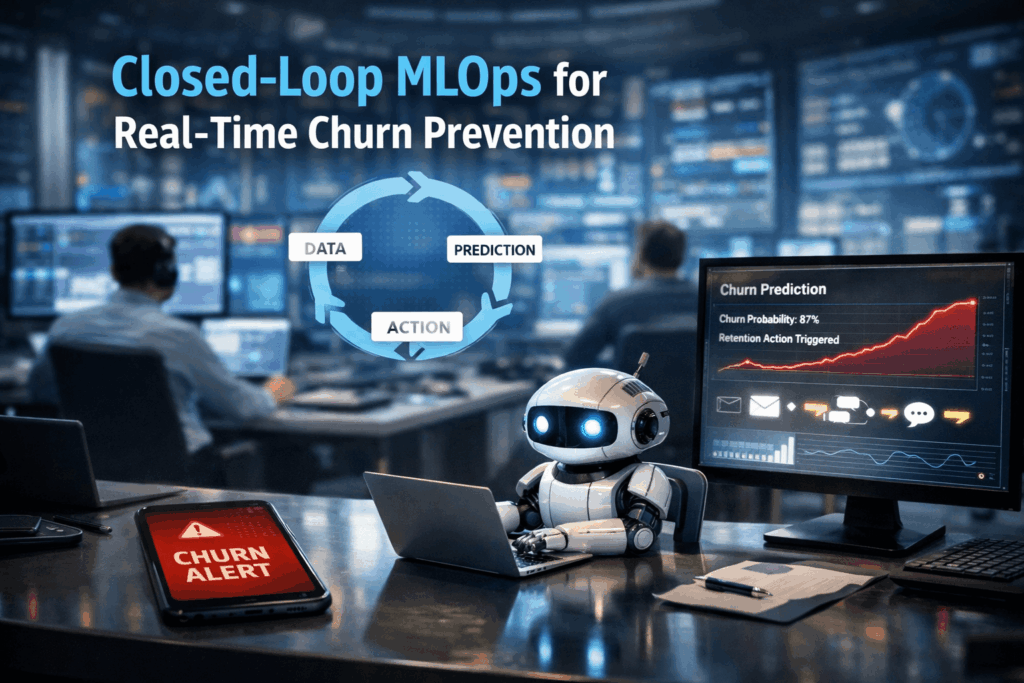
A “closed-loop” MLOps system is an advanced architectural pattern that transcends simple predictive analytics. While standard machine learning models might output a list of high-risk customers for a weekly review, a closed-loop system functions as an autonomous nervous system. It continuously ingests real-time data, calculates “fresh” behavioral features, generates churn probabilities, and crucially, triggers automated “retention agents” or downstream APIs to intervene instantly. It is the bridge between knowing a customer might leave and doing something about it before they do.
The Persistence of Churn Latency
Modern businesses are drowning in data but starving for timely action. The primary issue is data latency: the gap between a customer showing signs of dissatisfaction (such as decreased app login frequency or failed payment attempts) and the business responding. Traditional batch-processed pipelines often take 24–48 hours to refresh, by which time a competitor’s “welcome” email has already been opened.
Furthermore, engineering these systems often requires a fragmented tech stack: separate tools for ingestion, feature stores for serving, and complex custom code to trigger actions. This fragmentation leads to “training-serving skew,” where the logic used to train the model doesn’t match the live data, resulting in inaccurate predictions and wasted retention spend on the wrong customers.
How IOblend Solves the Loop
IOblend eliminates the friction of building these complex systems by providing a unified, production-grade DataOps and MLOps environment.
Real-Time Feature Engineering: IOblend acts as a “Feature Store without the Store.” It embeds feature engineering directly into your pipelines, allowing for sub-second freshness (P99 latency) without requiring separate infrastructure like Redis or Feast.
From Inference to Action: Beyond just serving features, IOblend allows you to capture model outputs and immediately generate AI agents or trigger automated actions.
Kappa Architecture at Scale: By utilizing a streaming-first Spark engine, IOblend handles over 1 million transactions per second. This allows you to monitor millions of customers simultaneously, ensuring no “silent” churn signal goes unnoticed.
Eliminating Tool Sprawl: With its low-code Designer and automated governance, IOblend replaces the need for disparate ETL tools, feature registries, and monitoring suites, keeping your entire retention loop inside your own secure environment.
Close the gap on customer loss and accelerate your retention intelligence with IOblend.
IOblend presents a ground-breaking approach to IoT and data integration, revolutionizing the way businesses handle their data. It’s an all-in-one data integration accelerator, boasting real-time, production-grade, managed Apache Spark™ data pipelines that can be set up in mere minutes. This facilitates a massive acceleration in data migration projects, whether from on-prem to cloud or between clouds, thanks to its low code/no code development and automated data management and governance.
IOblend also simplifies the integration of streaming and batch data through Kappa architecture, significantly boosting the efficiency of operational analytics and MLOps. Its system enables the robust and cost-effective delivery of both centralized and federated data architectures, with low latency and massively parallelized data processing, capable of handling over 10 million transactions per second. Additionally, IOblend integrates seamlessly with leading cloud services like Snowflake and Microsoft Azure, underscoring its versatility and broad applicability in various data environments.
At its core, IOblend is an end-to-end enterprise data integration solution built with DataOps capability. It stands out as a versatile ETL product for building and managing data estates with high-grade data flows. The platform powers operational analytics and AI initiatives, drastically reducing the costs and development efforts associated with data projects and data science ventures. It’s engineered to connect to any source, perform in-memory transformations of streaming and batch data, and direct the results to any destination with minimal effort.
IOblend’s use cases are diverse and impactful. It streams live data from factories to automated forecasting models and channels data from IoT sensors to real-time monitoring applications, enabling automated decision-making based on live inputs and historical statistics. Additionally, it handles the movement of production-grade streaming and batch data to and from cloud data warehouses and lakes, powers data exchanges, and feeds applications with data that adheres to complex business rules and governance policies.
The platform comprises two core components: the IOblend Designer and the IOblend Engine. The IOblend Designer is a desktop GUI used for designing, building, and testing data pipeline DAGs, producing metadata that describes the data pipelines. The IOblend Engine, the heart of the system, converts this metadata into Spark streaming jobs executed on any Spark cluster. Available in Developer and Enterprise suites, IOblend supports both local and remote engine operations, catering to a wide range of development and operational needs. It also facilitates collaborative development and pipeline versioning, making it a robust tool for modern data management and analytics

IOblend: Simplifying SCD for Real-Time Analytics
Businesses rely on accurate, up-to-date data to make informed decisions, which is why understanding and managing slowly changing dimensions (SCDs) is crucial.

Metadata Management Made Simple with IOblend
Metadata In today’s data-driven world, information reigns supreme. Businesses and organizations are constantly seeking ways to extract valuable insights from their data to make informed decisions. One often overlooked but essential aspect of this process is metadata. Metadata is the unsung hero that empowers data management, analytics, and decision-making. In this blog, we will delve

Change Data Capture: IOblend’s Seamless Approach
Change Data Capture In the fast-paced world of data management, staying ahead of the curve is not an option, it’s a necessity. Change Data Capture (CDC) is the secret weapon that allows businesses to keep pace with the constant flux of data. In this blog, we will delve into the world of CDC, explore different

Data Schema Management with IOblend
Data Schema Management In today’s data-driven world, managing data effectively is crucial for businesses seeking to gain insights and make informed decisions. Data schema management is a fundamental aspect of this process, ensuring that data is organized, structured, and compatible with various applications and systems. In this blog post, we’ll explore the significance of data

Smarter office management with real-time analytics
Commercial property Welcome to the next issue of our real-time analytics blog. This time we are taking a detour from the aviation analytics to the world of commercial property management. The topic arose from a use case we are working on now at IOblend. It just shows how broad a scope is for real-time data

Better airport operations with real-time analytics
Good and bad Welcome to the next issue of our real-time analytics blog. Now that the summer holiday season is upon us, many of us will be using air travel to get to their destinations of choice. This means, we will be going through the airports. As passengers, we have love-hate relationships with airports. Some

Ship AI-Ready Data Products Faster
Build a “Data Product” in Days: Reusable Pipeline Playbooks 📝 Did you know? According to industry research, over 75% of the enterprise data budget is swallowed by repetitive data integration tasks. Rather than delivering high-value analytical models, engineers spend the majority of their time building the same structural boilerplate over and over again. What are reusable

Schema Evolution with Strong Data Contracts
Schema Evolution Without Chaos: Strong Data Contracts Enforced In Pipelines 📋 Did you know? In the early days of big data, a single altered column in a production database could trigger a catastrophic “data graveyard” effect. The Concept of Schema Evolution Schema evolution is the ability of a data platform to gracefully adapt to structural changes

Mainframe to Cloud: Data Migration with CDC
Mainframe to Cloud: A Practical Data Migration Playbook 💾 Did you know? An alarming 83% of data migrations fail outright or drastically overrun their budgets. Shifting Mainframe Heavyweights to the Cloud Mainframe-to-cloud data migration is the process of moving core legacy data assets, often stored in rigid formats like DB2, VSAM, or IMS, into modern cloud

Real-Time CDC to Databricks Delta Tables
Realtime Ingestion to Databricks: From Source to Delta Tables 💽 Did you know? According to industry surveys, nearly eighty per cent of an enterprise’s data budget is consumed purely by data integration and upfront data wrangling rather than actual analytics. Defining real-time ingestion Real-time ingestion to Databricks represents the technical evolution from rigid scheduled batch processing

De-Risk Cloud Migration with Parallel Runs
De-Risk Your Migration: Run Legacy and New Systems in Parallel 💻 Did you know? An alarming 83% of data migrations either fail outright or drastically overrun their budgets. When management loses patience with mounting technical friction, entire digital transformations are written off. Minimising the migration gamble To eliminate this operational hazard, running legacy and new systems in

Compliance DataOps for Auditable Pipelines
Compliance-Friendly DataOps: Repeatable, Reviewable, Versioned Pipelines 📓 Did you know? According to industry compliance reports, nearly 70% of businesses face difficulties tracing their data back to its raw origins during regular regulatory audits. The Concept of Compliance-Friendly DataOps Compliance-friendly DataOps represents an operational framework that embeds strict regulatory governance directly into the data engineering lifecycle. Instead of treating data auditing