


Smart Data Integration: More $ for Your D&A Budget
Data integration is the heart of data engineering. The process is inherently complex and consumes the most of your D&A budget.

Data Pipelines: From Raw Data to Real Results
The primary purpose of data pipelines is to enable a smooth, automated flow of data. Data pipelines are at the core of informed decision-making.

Golden Record: Finding the Single Truth Source
A golden record of data is a consolidated dataset that serves as a single source of truth for all business data about a customer, employee, or product.

Penny-wise: Strategies for surviving budget cuts
Weathering budget cuts, particularly in the realm of data projects, require a combination of resilience, strategic thinking, and a willingness to adapt.

Data Syncing: The Evolution Of Data Integration
Data syncing, a crucial aspect of modern data management. It ensures data remains consistent and up-to-date across various sources, applications, and devices.

How IOblend Enables Real-Time Analytics of IoT Data
The real power of IoT lies in the data it generates in real-time. This data is continuously analysed to derive meaningful insights, mainly by automated systems.

When Enterprise Data Platforms Become Too Complex
When Enterprise Data Platforms Become Too Complex Enterprise data platforms usually start with a sensible goal: Connect the data Make it trustworthy Make it useful The problem is that, over time, the platform itself can become part of the complexity. More services are added. More specialist skills are needed. More workloads become dependent on one
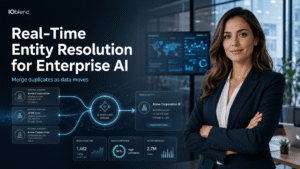
Real-Time Entity Resolution for Enterprise Data and AI
Entity Resolution at Scale: Merge Duplicates as Data Moves Enterprise data rarely arrives clean. The same customer, supplier or product can exist across multiple systems under different names, IDs or formats. For reporting, this creates inconsistency. For AI and automation, it creates unreliable context. Entity resolution has traditionally been handled through batch processing. But when

Real-Time Customer 360: MDM for AI-Ready Data
Real-Time Customer 360: MDM That Keeps Data Current A Customer 360 view is only useful if the data behind it is current. Many organisations still rely on batch integration, which means customer profiles can quickly fall behind reality. As businesses adopt AI, copilots and real-time analytics, that gap becomes harder to ignore. Real-time Master Data
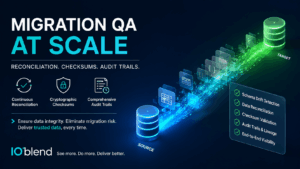
Data Migration QA: Checksums & Audit Trails
Migration QA at Scale: Reconciliation, Checksums, and Audit Trails 📂 Did you know that during enterprise database migrations, as much as 20% of quiet data corruption goes entirely unnoticed until post-cutover operational failures occur? Understanding migration QA at scale Migration QA at scale refers to the systematic validation of volume, structure, and integrity when shifting enterprise
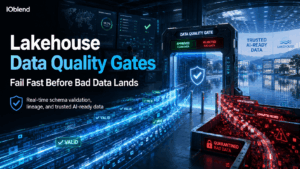
Lakehouse Data Quality Gates: Stop Bad Data Fast
Lakehouse Quality Gates: Fail Fast Before Bad Data Lands 📋 Did You Know? Up to 20% of real-time event streams suffer from schema drift, duplicate payloads, or corrupted records, costing global organisations billions each year in wasted compute, broken analytical models, and polluted reporting layers. The Concept: Stopping Bad Data at the Border Lakehouse Quality Gates are automated,
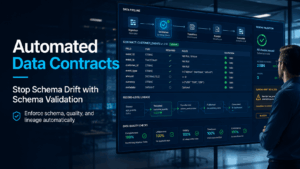
Automated Data Contracts: Stop Schema Drift
Data Contracts That Stick: Enforce Schema and Expectations Automatically 📜 Did You Know? In the early days of big data, a single unannounced column type change in an upstream transactional database could trigger a catastrophic “data graveyard” effect, corrupting millions of analytics records before anyone noticed. The Concept of Enforceable Data Contracts A data contract is
