
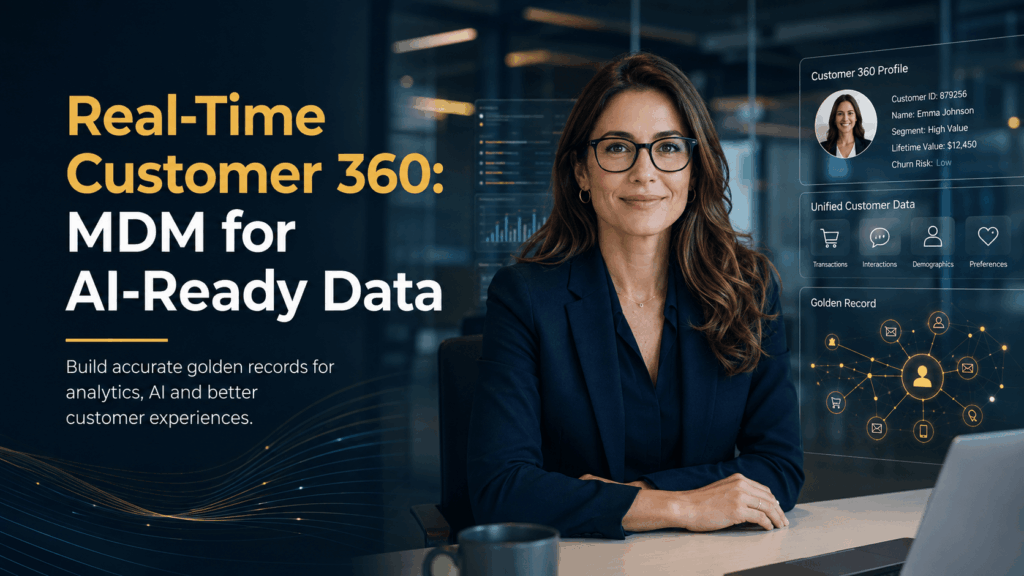
Real-Time Customer 360: MDM That Keeps Data Current
A Customer 360 view is only useful if the data behind it is current.
Many organisations still rely on batch integration, which means customer profiles can quickly fall behind reality. As businesses adopt AI, copilots and real-time analytics, that gap becomes harder to ignore.
Real-time Master Data Management (MDM) combines Change Data Capture (CDC), streaming, identity resolution and continuous data quality to keep customer records updated as changes happen.
What Is Real-Time Customer 360?
A Customer 360 brings together customer data from systems such as:
- CRM and ERP
- Orders and transactions
- Billing and account systems
- Customer service platforms
- Websites and applications
- Marketing and behavioural data
Traditional Customer 360 models refresh this data through scheduled ETL jobs.
Real-time MDM works differently. CDC and streaming pipelines capture changes as they happen, while validation, matching and deduplication rules continuously update the customer golden record.
Why Traditional Customer 360 Falls Behind
The challenge is not collecting customer data. It is keeping it consistent across multiple systems.
Common problems include:
- Stale profiles: Teams work with outdated customer information.
- Conflicting records: CRM, ERP and other platforms hold different versions of the same customer.
- Pipeline complexity: Separate tools for batch, CDC, streaming and data quality create growing maintenance overhead.
The result is fragmented customer experiences and unreliable data for analytics and AI.
Why Traditional Customer 360 Falls Behind
The Modern Real-Time MDM Pattern
A modern Customer 360 treats customer data as continuously changing.
Source Systems → CDC & Events → Data Quality → Identity Resolution → Golden Record → Analytics & AI
The core capabilities are:
- CDC: Capture only the data that changes.
- Batch and streaming: Combine historical and live data in one integration model.
- Continuous data quality: Validate, cleanse and deduplicate data before it reaches the golden record.
- Identity resolution: Match multiple records to the correct customer.
The result is a trusted customer profile that stays current.
Why Customer 360 Matters for AI
Customer 360 is increasingly an AI readiness issue.
AI assistants, copilots, recommendation engines and predictive models depend on accurate customer context. If the underlying data is duplicated, incomplete or outdated, AI outputs can be unreliable.
More data does not automatically create better AI.
Trusted, governed and current data does.
Real-time Customer 360 gives AI systems access to up-to-date customer history, transactions, preferences, behaviour and service interactions.
How IOblend Supports Real-Time Customer 360
IOblend helps enterprises build real-time Customer 360 without replacing their existing data estate.
IOblend brings together:
- Batch ingestion
- Change Data Capture
- Real-time streaming
- In-memory transformation
- Data quality
- Pipeline orchestration
Data Quality Built Into the Flow
Validation, transformation and deduplication happen while data is moving, helping prevent poor-quality records from reaching analytics, operational systems or AI applications.
Works With Existing Platforms
IOblend integrates with platforms including:
- Microsoft Fabric
- Databricks
- Snowflake
- CRM systems
- Operational databases
- Cloud and on-premise sources
Teams can continue using familiar SQL and Python while adding modern CDC, streaming and DataOps capabilities.
Build a Customer 360 That Stays Current
Customer 360 should not be a historical snapshot.
By combining CDC, streaming integration, identity resolution and continuous data quality, organisations can create a customer golden record that stays aligned with the business in real time.
That creates a stronger foundation for customer experience, analytics and enterprise AI.

Data Migration QA: Checksums & Audit Trails
Migration QA at Scale: Reconciliation, Checksums, and Audit Trails 📂 Did you know that during enterprise database migrations, as much as 20% of quiet data corruption goes entirely unnoticed until post-cutover operational failures occur? Understanding migration QA at scale Migration QA
Lakehouse Data Quality Gates: Stop Bad Data Fast
Lakehouse Quality Gates: Fail Fast Before Bad Data Lands 📋 Did You Know? Up to 20% of real-time event streams suffer from schema drift, duplicate payloads, or corrupted records, costing global organisations billions each year in wasted compute, broken analytical models, and polluted
Automated Data Contracts: Stop Schema Drift
Data Contracts That Stick: Enforce Schema and Expectations Automatically 📜 Did You Know? In the early days of big data, a single unannounced column type change in an upstream transactional database could trigger a catastrophic “data graveyard” effect, corrupting millions of