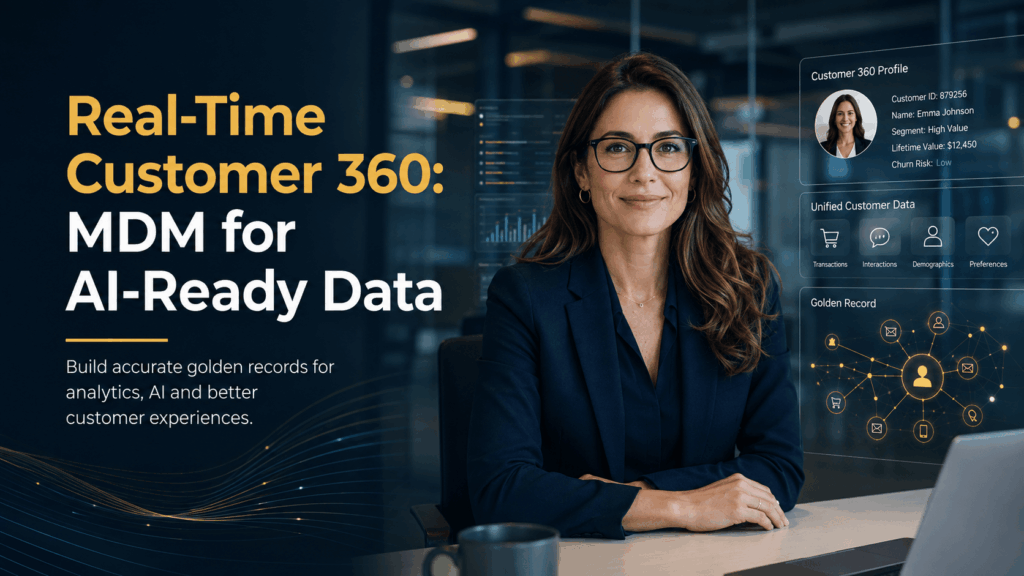

Real-Time Customer 360: MDM That Keeps Data Current
A Customer 360 view is only useful if the data behind it is current.
Many organisations still rely on batch integration, which means customer profiles can quickly fall behind reality. As businesses adopt AI, copilots and real-time analytics, that gap becomes harder to ignore.
Real-time Master Data Management (MDM) combines Change Data Capture (CDC), streaming, identity resolution and continuous data quality to keep customer records updated as changes happen.
What Is Real-Time Customer 360?
A Customer 360 brings together customer data from systems such as:
- CRM and ERP
- Orders and transactions
- Billing and account systems
- Customer service platforms
- Websites and applications
- Marketing and behavioural data
Traditional Customer 360 models refresh this data through scheduled ETL jobs.
Real-time MDM works differently. CDC and streaming pipelines capture changes as they happen, while validation, matching and deduplication rules continuously update the customer golden record.
Why Traditional Customer 360 Falls Behind
The challenge is not collecting customer data. It is keeping it consistent across multiple systems.
Common problems include:
- Stale profiles: Teams work with outdated customer information.
- Conflicting records: CRM, ERP and other platforms hold different versions of the same customer.
- Pipeline complexity: Separate tools for batch, CDC, streaming and data quality create growing maintenance overhead.
The result is fragmented customer experiences and unreliable data for analytics and AI.
Why Traditional Customer 360 Falls Behind
The Modern Real-Time MDM Pattern
A modern Customer 360 treats customer data as continuously changing.
Source Systems → CDC & Events → Data Quality → Identity Resolution → Golden Record → Analytics & AI
The core capabilities are:
- CDC: Capture only the data that changes.
- Batch and streaming: Combine historical and live data in one integration model.
- Continuous data quality: Validate, cleanse and deduplicate data before it reaches the golden record.
- Identity resolution: Match multiple records to the correct customer.
The result is a trusted customer profile that stays current.
Why Customer 360 Matters for AI
Customer 360 is increasingly an AI readiness issue.
AI assistants, copilots, recommendation engines and predictive models depend on accurate customer context. If the underlying data is duplicated, incomplete or outdated, AI outputs can be unreliable.
More data does not automatically create better AI.
Trusted, governed and current data does.
Real-time Customer 360 gives AI systems access to up-to-date customer history, transactions, preferences, behaviour and service interactions.
How IOblend Supports Real-Time Customer 360
IOblend helps enterprises build real-time Customer 360 without replacing their existing data estate.
IOblend brings together:
- Batch ingestion
- Change Data Capture
- Real-time streaming
- In-memory transformation
- Data quality
- Pipeline orchestration
Data Quality Built Into the Flow
Validation, transformation and deduplication happen while data is moving, helping prevent poor-quality records from reaching analytics, operational systems or AI applications.
Works With Existing Platforms
IOblend integrates with platforms including:
- Microsoft Fabric
- Databricks
- Snowflake
- CRM systems
- Operational databases
- Cloud and on-premise sources
Teams can continue using familiar SQL and Python while adding modern CDC, streaming and DataOps capabilities.
Build a Customer 360 That Stays Current
Customer 360 should not be a historical snapshot.
By combining CDC, streaming integration, identity resolution and continuous data quality, organisations can create a customer golden record that stays aligned with the business in real time.
That creates a stronger foundation for customer experience, analytics and enterprise AI.

Predictive Aircraft Maintenance with Agentic AI
Predictive Aircraft Maintenance: Consolidating Data from Engine Sensors and MRO Systems 🛫 Did you know that leveraging Big Data analytics for predictive aircraft maintenance can reduce unscheduled aircraft downtime by up to 30% Predictive Maintenance: The Core Concept Predictive Maintenance (PdM) in aviation is the strategic shift from a time-based or reactive approach to an ‘as-needed’ model,

Digital Twin Evolution: Big Data & AI with
The Industrial Renaissance: How Agentic AI and Big Data Power the Self-Optimising Digital Twin 🏭 Did You Know? A fully realised industrial Digital Twin, underpinned by real-time data, has been proven to reduce unplanned production downtime by up to 20%. The Digital Twin Evolution The Digital Twin is a sophisticated, living, virtual counterpart of a physical production system. It

Real-Time Risk Modelling with Legacy & Modern Data
Risk Modelling in Real-time: Integrating Legacy Oracle/HP Underwriting Data with Modern External Datasets 💼 Did you know that in the time it takes to brew a cup of tea, a real-time risk model could have processed enough data to flag over 60 million potential fraudulent insurance claims? The Real-Time Risk Modelling Imperative Real-time risk modelling is

Unify Clinical & Financial Data to Cut Readmissions
Clinical-Financial Synergy: The Seamless Integration of Clinical and Financial Data to Minimise Readmissions 🚑 Did You Know? Unnecessary hospital readmissions within 30 days represent a colossal financial burden, often reflecting suboptimal transitional care. Clinical-Financial Synergy: The Seamless Integration of Clinical and Financial Data to Minimise Readmissions The Convergence of Clinical and Financial Data The convergence of clinical and financial

Agentic Pipelines and Real-Time Data with Guardrails
The New Era of ETL: Agentic Pipelines and Real-Time Data with Guardrails For years, ETL meant one thing — moving and transforming data in predictable, scheduled batches, often using a multitude of complementary tools. It was practical, reliable, and familiar. But in 2025, well, that’s no longer enough. Let’s have a look at the shift

Real-Time Insurance Claims with CDC and Spark
From Batch to Real-Time: Accelerating Insurance Claims Processing with CDC and Spark 💼 Did you know? In the insurance sector, the move from overnight batch processing to real-time stream processing has been shown to reduce the average claims settlement time from several days to under an hour in highly automated systems. Real-Time Data and Insurance