AW-10865990051

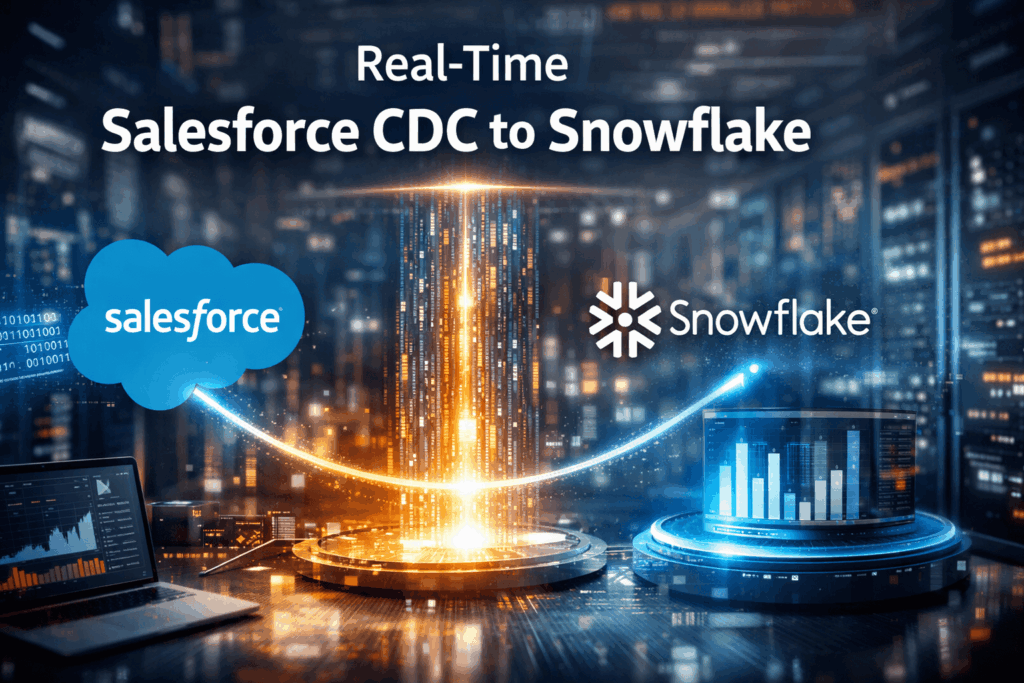
Real-Time Salesforce CDC to Snowflake

IOblend_Salesforce_CDC_sync_Snowflake

Real-Time CDC: Keep Salesforce and Snowflake in Perfect Sync

🔎 Did you know? While many businesses still rely on nightly batch windows to move CRM data, Salesforce generates millions of events every hour.

The Concept: Real-Time CDC

Real-Time Change Data Capture (CDC) is a software design pattern used to determine and track data that has changed in a source system so that action can be taken using the changed data. When syncing Salesforce with Snowflake, CDC monitors the Salesforce event bus for any insertions, updates, or deletions. Instead of bulk-loading the entire database, it streams only the delta (the changes). This creates a “live mirror” of your CRM environment within your Snowflake Data Cloud, allowing for instantaneous analytical readiness without the overhead of traditional ETL.

The Friction: Why Legacy Syncing Fails

Data experts often grapple with the “Stale Data Trap.” When Salesforce and Snowflake are out of sync, the consequences are felt across the entire organisation. Marketing teams may send “welcome” emails to customers who have already unsubscribed, or finance teams might forecast based on cancelled contracts.

Technically, the challenges are even steeper. High-volume Salesforce orgs often hit API limits when subjected to frequent polling. Furthermore, handling schema evolution is a nightmare; if a salesperson adds a custom field in Salesforce, a rigid legacy pipeline will typically break, requiring manual intervention from data engineers.

There is also the issue of “hard deletes”, traditional incremental loads often miss records that were deleted in the source, leading to “phantom records” in Snowflake that skew reporting accuracy.

Seamless Synchronisation with IOblend

IOblend redefines the Salesforce-to-Snowflake pipeline by moving away from brittle, code-heavy integrations and embracing a “Stream-First” architecture. Here is how IOblend solves the sync dilemma:

  • Real-Time Agility: IOblend leverages Salesforce’s native streaming events to push changes to Snowflake the moment they occur. This bypasses the need for resource-heavy scheduled batches and ensures your data latency is measured in seconds, not hours.
  • Automatic Schema Evolution detection: As your Salesforce environment grows, IOblend assists. It detects new/deleted fields or objects and automatically alerts the admins showing explicitly what has changed. It makes accepting/rejecting the changes transparent and very easy. Keep your sync robust and governed. What’s more, IOblend allows direct embedding of AI agents into the workflows, so you can inject a logic where you can update the schema downstream automatically if it meets your criteria, further removing the manual interventions.
  • Limitless Scaling: By using optimised ingestion patterns, IOblend avoids exhausting Salesforce API quotas, making it suitable for enterprise-level data volumes.
  • Unified Data Engineering: IOblend provides a single interface to manage complex transformations, allowing experts to refine and join Salesforce data with other sources directly as it lands in Snowflake.

Stop lagging behind and start leading with live data, optimise your architecture with IOblend.

IOblend: See more. Do more. Deliver better.

Deduplicate Streaming Events IOblend
AI
admin

Streaming Deduplication for Exactly-Once Outcomes

Deduplicate Streaming Events: Exact-Once Outcomes in Real Life  📋 Did you know? In high-velocity streaming environments, network retries and transient worker failures cause up to 20% of event streams to contain duplicate payloads.  Understanding exact-once outcomes  In real-time data engineering, achieving “exactly-once” outcomes does not mean a message is transported across the wire only once, distributed
Read More »
Debugging-for-Apache-Spark-Streams-IOblend
AI
admin

Visual Debugging for Apache Spark Streams

Debug Streaming Like a Pro: Visual Tracing and Rapid Iteration  📎 Did you know? The vast majority of real-time streaming data pipeline bugs only reveal themselves under production workloads, usually at 03:00 am. Because streaming systems process unbounded data in memory, traditional breakpoints and step-through debugging are impossible without stopping the entire world, corrupting states, and
Read More »
Ship AI-Ready Data Products Faster IOblend
AI
admin

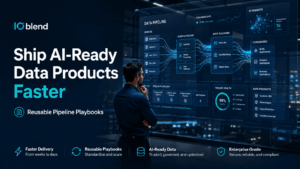
Ship AI-Ready Data Products Faster

Build a “Data Product” in Days: Reusable Pipeline Playbooks  📝 Did you know? According to industry research, over 75% of the enterprise data budget is swallowed by repetitive data integration tasks. Rather than delivering high-value analytical models, engineers spend the majority of their time building the same structural boilerplate over and over again.  What are reusable
Read More »
Schema-Evolution-Without-Chaos-Strong-Data-Contracts-Enforced-In-Pipelines
AI
admin

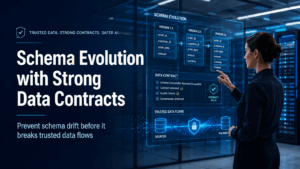
Schema Evolution with Strong Data Contracts

Schema Evolution Without Chaos: Strong Data Contracts Enforced In Pipelines  📋 Did you know? In the early days of big data, a single altered column in a production database could trigger a catastrophic “data graveyard” effect.  The Concept of Schema Evolution  Schema evolution is the ability of a data platform to gracefully adapt to structural changes
Read More »
Mainframe-to-Cloud-with-CDC-IOblend
Data analytics
admin

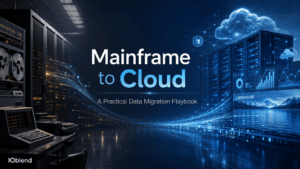
Mainframe to Cloud: Data Migration with CDC

Mainframe to Cloud: A Practical Data Migration Playbook  💾 Did you know? An alarming 83% of data migrations fail outright or drastically overrun their budgets.  Shifting Mainframe Heavyweights to the Cloud  Mainframe-to-cloud data migration is the process of moving core legacy data assets, often stored in rigid formats like DB2, VSAM, or IMS, into modern cloud
Read More »
Real-time-CDC-pipelines-into-Delta-tables-IOblend
AI
admin

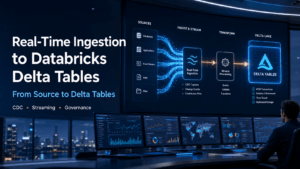
Real-Time CDC to Databricks Delta Tables

Realtime Ingestion to Databricks: From Source to Delta Tables  💽 Did you know? According to industry surveys, nearly eighty per cent of an enterprise’s data budget is consumed purely by data integration and upfront data wrangling rather than actual analytics.  Defining real-time ingestion  Real-time ingestion to Databricks represents the technical evolution from rigid scheduled batch processing

Read More »
Scroll to Top