Real-Time CDC: Keep Salesforce and Snowflake in Perfect Sync
🔎 Did you know? While many businesses still rely on nightly batch windows to move CRM data, Salesforce generates millions of events every hour.
The Concept: Real-Time CDC
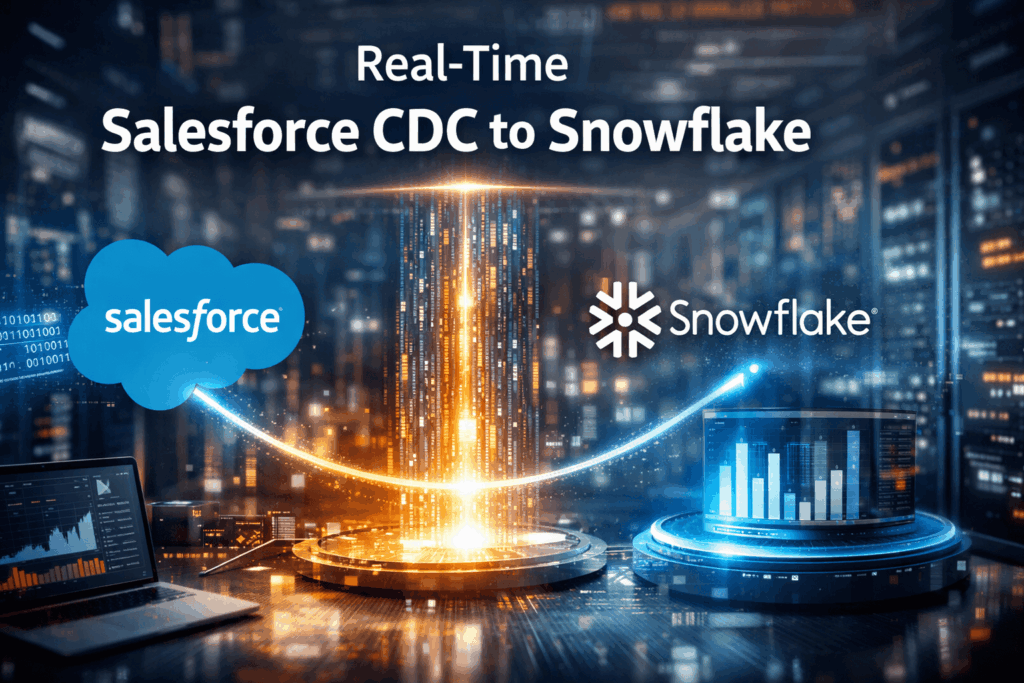
Real-Time Change Data Capture (CDC) is a software design pattern used to determine and track data that has changed in a source system so that action can be taken using the changed data. When syncing Salesforce with Snowflake, CDC monitors the Salesforce event bus for any insertions, updates, or deletions. Instead of bulk-loading the entire database, it streams only the delta (the changes). This creates a “live mirror” of your CRM environment within your Snowflake Data Cloud, allowing for instantaneous analytical readiness without the overhead of traditional ETL.
The Friction: Why Legacy Syncing Fails
Data experts often grapple with the “Stale Data Trap.” When Salesforce and Snowflake are out of sync, the consequences are felt across the entire organisation. Marketing teams may send “welcome” emails to customers who have already unsubscribed, or finance teams might forecast based on cancelled contracts.
Technically, the challenges are even steeper. High-volume Salesforce orgs often hit API limits when subjected to frequent polling. Furthermore, handling schema evolution is a nightmare; if a salesperson adds a custom field in Salesforce, a rigid legacy pipeline will typically break, requiring manual intervention from data engineers.
There is also the issue of “hard deletes”, traditional incremental loads often miss records that were deleted in the source, leading to “phantom records” in Snowflake that skew reporting accuracy.
Seamless Synchronisation with IOblend
IOblend redefines the Salesforce-to-Snowflake pipeline by moving away from brittle, code-heavy integrations and embracing a “Stream-First” architecture. Here is how IOblend solves the sync dilemma:
- Real-Time Agility: IOblend leverages Salesforce’s native streaming events to push changes to Snowflake the moment they occur. This bypasses the need for resource-heavy scheduled batches and ensures your data latency is measured in seconds, not hours.
- Automatic Schema Evolution detection: As your Salesforce environment grows, IOblend assists. It detects new/deleted fields or objects and automatically alerts the admins showing explicitly what has changed. It makes accepting/rejecting the changes transparent and very easy. Keep your sync robust and governed. What’s more, IOblend allows direct embedding of AI agents into the workflows, so you can inject a logic where you can update the schema downstream automatically if it meets your criteria, further removing the manual interventions.
- Limitless Scaling: By using optimised ingestion patterns, IOblend avoids exhausting Salesforce API quotas, making it suitable for enterprise-level data volumes.
- Unified Data Engineering: IOblend provides a single interface to manage complex transformations, allowing experts to refine and join Salesforce data with other sources directly as it lands in Snowflake.
Stop lagging behind and start leading with live data, optimise your architecture with IOblend.

De-Risk Cloud Migration with Parallel Runs
De-Risk Your Migration: Run Legacy and New Systems in Parallel 💻 Did you know? An alarming 83% of data migrations either fail outright or drastically overrun their budgets. When management loses patience with mounting technical friction, entire digital transformations are written off. Minimising the migration gamble To eliminate this operational hazard, running legacy and new systems in

Compliance DataOps for Auditable Pipelines
Compliance-Friendly DataOps: Repeatable, Reviewable, Versioned Pipelines 📓 Did you know? According to industry compliance reports, nearly 70% of businesses face difficulties tracing their data back to its raw origins during regular regulatory audits. The Concept of Compliance-Friendly DataOps Compliance-friendly DataOps represents an operational framework that embeds strict regulatory governance directly into the data engineering lifecycle. Instead of treating data auditing

Continuous Data Replication for DR and Continuity
Continuous Data Replication: for Business Continuity and DR 📝 Did you know? According to industry studies, the average cost of IT downtime is approximately £4,500 per minute. For a large enterprise, a single hour of data loss or system unavailability can translate into millions in lost revenue, legal penalties, and irreparable brand damage. The Pulse of

Smart Meter Data: Billing to Forecasting
Utilities: Smart Meter Data to Billing and Demand Forecasting 📋 Did You Know? The global roll-out of smart meters generates more data in a single day than most utility companies used to collect in an entire decade. While traditional meters were read once a month, or even once a quarter, smart meters transmit data at intervals

SCADA Streams to Reliability Analytics
Energy: SCADA Streams to Reliability Analytics 🔌 Did you know? The average modern wind turbine or smart substation generates roughly 1 to 2 terabytes of data every month. However, historically, less than 5% of that sensor data was actually used for decision-making. Most of it was simply discarded or “siloed” in SCADA systems, serving as a

Building Live ETA Pipelines for Fleet Operations
Logistics: Live ETA Prediction Pipelines from Fleet + Orders 🚚 Did you know? The “Last Mile” is famously the most expensive and inefficient part of the supply chain, often accounting for up to 53% of total shipping costs. The Evolution of Real-Time Logistics Live ETA (Estimated Time of Arrival) prediction pipelines represent the shift from reactive