Real-Time CDC: Keep Salesforce and Snowflake in Perfect Sync
🔎 Did you know? While many businesses still rely on nightly batch windows to move CRM data, Salesforce generates millions of events every hour.
The Concept: Real-Time CDC
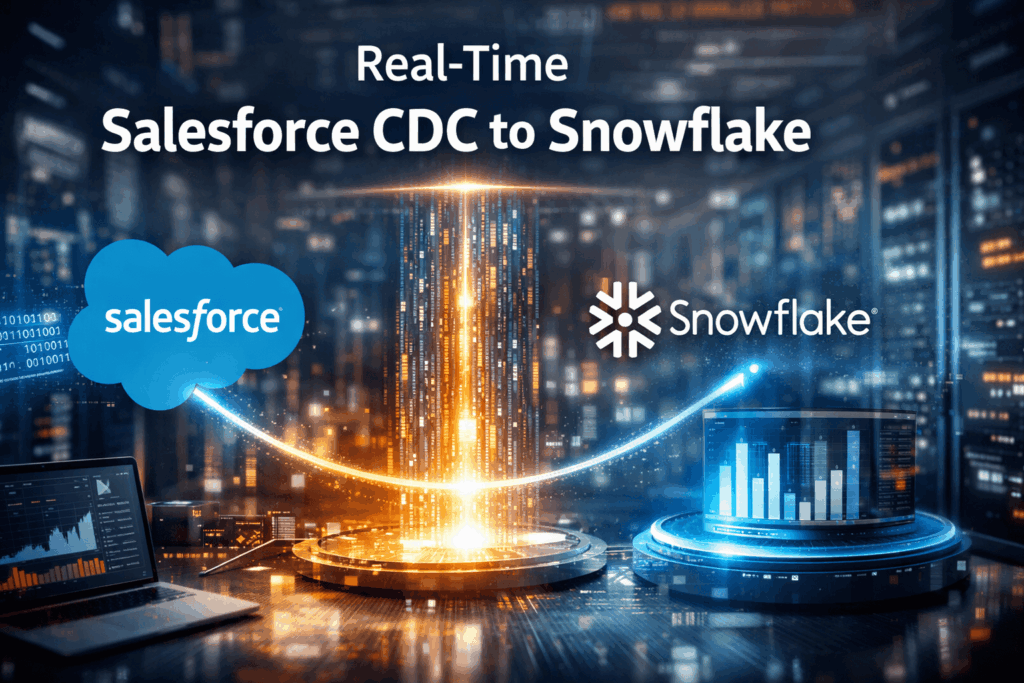
Real-Time Change Data Capture (CDC) is a software design pattern used to determine and track data that has changed in a source system so that action can be taken using the changed data. When syncing Salesforce with Snowflake, CDC monitors the Salesforce event bus for any insertions, updates, or deletions. Instead of bulk-loading the entire database, it streams only the delta (the changes). This creates a “live mirror” of your CRM environment within your Snowflake Data Cloud, allowing for instantaneous analytical readiness without the overhead of traditional ETL.
The Friction: Why Legacy Syncing Fails
Data experts often grapple with the “Stale Data Trap.” When Salesforce and Snowflake are out of sync, the consequences are felt across the entire organisation. Marketing teams may send “welcome” emails to customers who have already unsubscribed, or finance teams might forecast based on cancelled contracts.
Technically, the challenges are even steeper. High-volume Salesforce orgs often hit API limits when subjected to frequent polling. Furthermore, handling schema evolution is a nightmare; if a salesperson adds a custom field in Salesforce, a rigid legacy pipeline will typically break, requiring manual intervention from data engineers.
There is also the issue of “hard deletes”, traditional incremental loads often miss records that were deleted in the source, leading to “phantom records” in Snowflake that skew reporting accuracy.
Seamless Synchronisation with IOblend
IOblend redefines the Salesforce-to-Snowflake pipeline by moving away from brittle, code-heavy integrations and embracing a “Stream-First” architecture. Here is how IOblend solves the sync dilemma:
- Real-Time Agility: IOblend leverages Salesforce’s native streaming events to push changes to Snowflake the moment they occur. This bypasses the need for resource-heavy scheduled batches and ensures your data latency is measured in seconds, not hours.
- Automatic Schema Evolution detection: As your Salesforce environment grows, IOblend assists. It detects new/deleted fields or objects and automatically alerts the admins showing explicitly what has changed. It makes accepting/rejecting the changes transparent and very easy. Keep your sync robust and governed. What’s more, IOblend allows direct embedding of AI agents into the workflows, so you can inject a logic where you can update the schema downstream automatically if it meets your criteria, further removing the manual interventions.
- Limitless Scaling: By using optimised ingestion patterns, IOblend avoids exhausting Salesforce API quotas, making it suitable for enterprise-level data volumes.
- Unified Data Engineering: IOblend provides a single interface to manage complex transformations, allowing experts to refine and join Salesforce data with other sources directly as it lands in Snowflake.
Stop lagging behind and start leading with live data, optimise your architecture with IOblend.

IOblend JSON Playbooks: Keep Logic Portable, No Lock-In
The End of Vendor Lock-in: Keeping your logic portable with IOblend’s JSON-based playbooks and Python/SQL core 💾 Did you know? The average enterprise now uses over 350 different data sources, yet nearly 70% of data leaders feel “trapped” by their infrastructure. Recent industry reports suggest that migrating a legacy data warehouse to a new provider can

Real-Time Defect Detection with Agentic AI + ETL
Smart Quality Control: Embedding Agentic AI into ETL pipelines to visually inspect and categorise production defects 🔩 Did you know? “visual drift” in manual quality control can lead to a 20% drop in defect detection accuracy over a single eight-hour shift The Concept: Agentic AI in the ETL Stream Traditional ETL (Extract, Transform, Load) has long been the

Agentic AI ETL for Real-Time Sentiment Pricing
Sentiment-Driven Pricing: Using Agentic AI ETL to scrape social sentiment and adjust prices dynamically within the data flow 🤖 Did you know? A single viral tweet or a trending TikTok “dupe” video can alter the perceived value of a product by over 40% in less than six hours. Traditional pricing engines, which rely on historical sales

BCBS 239 Compliance with Record-Level Lineage
Regulatory Compliance at Scale: Automating record-level lineage and audit trails for BCBS 239 📋 Did you know? In the wake of the 2008 financial crisis, the Basel Committee found that many global banks were unable to aggregate risk exposures accurately or quickly because their data landscapes were too complex. This led to the birth of BCBS

Real-Time Churn Agents with Closed-Loop MLOps
Churn Prevention: Building “closed-loop” MLOps systems that predict churn and trigger automated retention agents 🔗 Did you know? In the telecommunications and subscription-based sectors, a mere 5% increase in customer retention can lead to a staggering profit surge of more than 25%. Closed-Loop MLOps A “closed-loop” MLOps system is an advanced architectural pattern that transcends simple predictive analytics. While

Streaming Predictive MX: Drift-Aware Inference
Predictive Maintenance 2.0: Feeding real-time sensor drifts directly into inference models using streaming engine 🔩 Did you know? The cost of unplanned downtime for industrial manufacturers is estimated at nearly £400 billion annually. Predictive Maintenance 2.0: The Real-Time Evolution Predictive Maintenance 2.0 represents a paradigm shift from batch-processed diagnostics to live, autonomous synchronisation. In the traditional 1.0