AW-10865990051

Schema Evolution with Strong Data Contracts

Schema-Evolution-Without-Chaos-Strong-Data-Contracts-Enforced-In-Pipelines

Schema Evolution Without Chaos: Strong Data Contracts Enforced In Pipelines 

📋 Did you know? In the early days of big data, a single altered column in a production database could trigger a catastrophic “data graveyard” effect. 

The Concept of Schema Evolution 

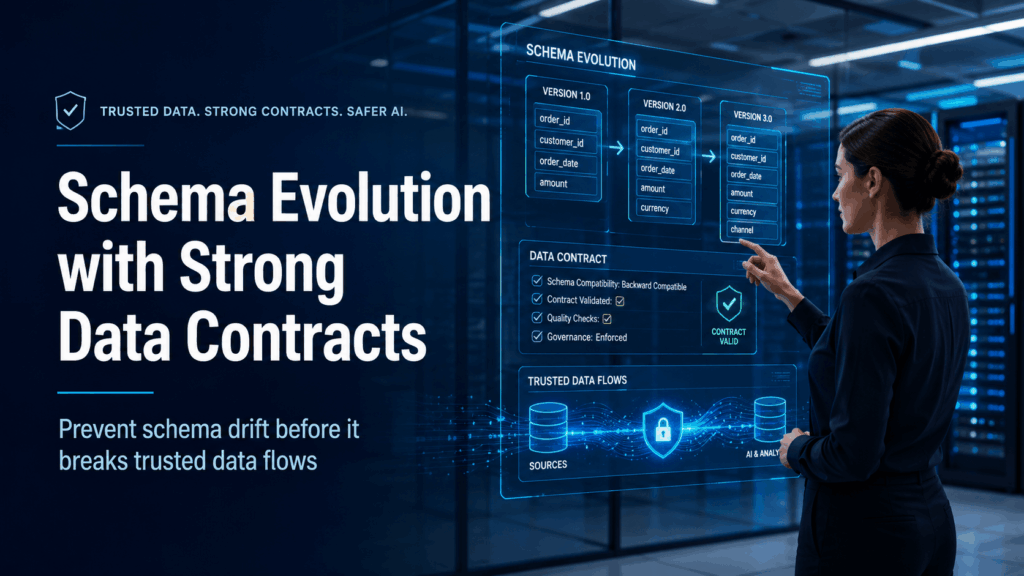
Schema evolution is the ability of a data platform to gracefully adapt to structural changes in incoming data, such as added, renamed, or dropped columns, without failing or corrupting existing datasets. In modern data lakehouses, this is achieved by moving away from rigid, hard-coded structures and adopting strong data contracts. These contracts act as explicit, enforceable agreements between data producers and consumers, ensuring that any structural evolution happens safely, predictably, and without manual pipeline intervention. 

The Brittle Reality of Schema Drift 

When organizations scale their data operations, they inevitably face schema drift. As upstream applications evolve, their underlying data models change. Without strict enforcement mechanisms, these changes ripple through to the data lake and such, causing severe operational pain: 

  • Broken Downstream Applications: A sudden alteration in a source database column type instantly breaks downstream machine learning models and business intelligence dashboards. 
  • The “Silent Failure” Dilemma: Pipelines often do not crash; they simply ingest malformed data, poisoning clean tables and rendering historical reports inaccurate. 
  • Engineering Bottlenecks: Data engineers spend more time writing defensive error-handling code and manually patching broken pipelines than building new data products. 

Mastering Schema Evolution with IOblend 

Managing schema evolution manually is a losing battle, but IOblend completely automates this operational challenge. Built with advanced DataOps capabilities, IOblend turns complex Apache Spark™ engine management into simple, metadata-driven pipelines that handle structure changes out of the box. 

  • Dynamic Schema Generation & Versioning: IOblend automatically generates schemas based on incoming data streams. It tracks and versions schema changes over time, maintaining full backward compatibility. 
  • Automatic Schema Validation: Every incoming batch or stream is checked against predefined contracts. If data deviates catastrophically, IOblend prevents ingestion, keeping your target tables clean. 
  • Automated Error Isolation: Rather than crashing the pipeline, invalid records are automatically channelled into a dedicated error table for isolation and automated debugging, while valid data continues to flow smoothly. 
  • Record-Level Lineage: If a drift event occurs, IOblend tracks exact record-level lineage and metadata, allowing engineers to instantly see what changed, what it impacted, and how to address it. 

Eliminate data downtime and secure your data platform against schema drift. 

IOblend: See more. Do more. Deliver better.

Smart meter billing and AI forecasting with IOblend
AI
admin

Smart Meter Data: Billing to Forecasting

Utilities: Smart Meter Data to Billing and Demand Forecasting  📋 Did You Know? The global roll-out of smart meters generates more data in a single day than most utility companies used to collect in an entire decade. While traditional meters were read once a month, or even once a quarter, smart meters transmit data at intervals

Read More »
SCADA streams with IOblend
AI
admin

SCADA Streams to Reliability Analytics

Energy: SCADA Streams to Reliability Analytics  🔌 Did you know? The average modern wind turbine or smart substation generates roughly 1 to 2 terabytes of data every month. However, historically, less than 5% of that sensor data was actually used for decision-making. Most of it was simply discarded or “siloed” in SCADA systems, serving as a

Read More »
Logistics operator at a workstation using a tablet with holographic screens showing live ETA, weather, and a route map at a busy distribution hub.
AI
admin

Building Live ETA Pipelines for Fleet Operations

Logistics: Live ETA Prediction Pipelines from Fleet + Orders  🚚 Did you know? The “Last Mile” is famously the most expensive and inefficient part of the supply chain, often accounting for up to 53% of total shipping costs.  The Evolution of Real-Time Logistics  Live ETA (Estimated Time of Arrival) prediction pipelines represent the shift from reactive

Read More »
DB2-to-Lakehouse-with-CDC-IOblend
AI
admin

DB2 CDC to Lakehouse Without Re-Platforming

From DB2 to Lakehouse: Real-Time CDC Without Re-Platforming  💻 Did you know? Mainframe systems like DB2 still process approximately 30 billion business transactions every single day. Despite the rush toward modern cloud architectures, the world’s most critical financial and logistical data often resides in these “legacy” environments, making them the silent engines of the global economy. 

Read More »
Real-time-data-processing-with-deduplication
AI
admin

Real-Time Upserts: Deduping and Idempotency

Streaming Upserts Done Right: Deduping and Idempotency at Scale  💻 Did you know? In many high-velocity streaming environments, the “same” event can be sent or processed multiple times due to network retries or distributed system failures.  The Art of the Upsert  At its core, a streaming upsert (a portmanteau of “update” and “insert”) is the process of synchronising incoming data with an existing

Read More »
Optimising-data-streams-and-analytics-with-IOblend
AI
admin

Streaming Data Quality That Won’t Break Pipelines

Streaming Without the Sting: Data Quality Rules That Never Break the Flow  💻 Did you know? A single minute of downtime in a high-velocity streaming environment can result in the loss of millions of data points, potentially costing a business thousands of pounds in missed opportunities or regulatory fines. —  Defining Resilient Streaming Quality  Data quality in

Read More »
Scroll to Top