
Schema Evolution Without Chaos: Strong Data Contracts Enforced In Pipelines
📋 Did you know? In the early days of big data, a single altered column in a production database could trigger a catastrophic “data graveyard” effect.
The Concept of Schema Evolution
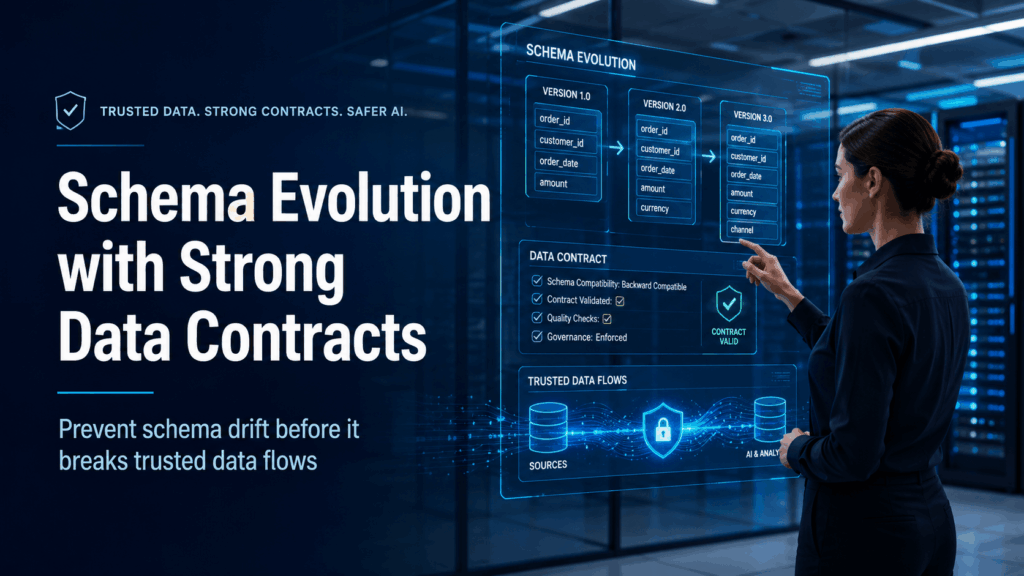
Schema evolution is the ability of a data platform to gracefully adapt to structural changes in incoming data, such as added, renamed, or dropped columns, without failing or corrupting existing datasets. In modern data lakehouses, this is achieved by moving away from rigid, hard-coded structures and adopting strong data contracts. These contracts act as explicit, enforceable agreements between data producers and consumers, ensuring that any structural evolution happens safely, predictably, and without manual pipeline intervention.
The Brittle Reality of Schema Drift
When organizations scale their data operations, they inevitably face schema drift. As upstream applications evolve, their underlying data models change. Without strict enforcement mechanisms, these changes ripple through to the data lake and such, causing severe operational pain:
- Broken Downstream Applications: A sudden alteration in a source database column type instantly breaks downstream machine learning models and business intelligence dashboards.
- The “Silent Failure” Dilemma: Pipelines often do not crash; they simply ingest malformed data, poisoning clean tables and rendering historical reports inaccurate.
- Engineering Bottlenecks: Data engineers spend more time writing defensive error-handling code and manually patching broken pipelines than building new data products.
Mastering Schema Evolution with IOblend
Managing schema evolution manually is a losing battle, but IOblend completely automates this operational challenge. Built with advanced DataOps capabilities, IOblend turns complex Apache Spark™ engine management into simple, metadata-driven pipelines that handle structure changes out of the box.
- Dynamic Schema Generation & Versioning: IOblend automatically generates schemas based on incoming data streams. It tracks and versions schema changes over time, maintaining full backward compatibility.
- Automatic Schema Validation: Every incoming batch or stream is checked against predefined contracts. If data deviates catastrophically, IOblend prevents ingestion, keeping your target tables clean.
- Automated Error Isolation: Rather than crashing the pipeline, invalid records are automatically channelled into a dedicated error table for isolation and automated debugging, while valid data continues to flow smoothly.
- Record-Level Lineage: If a drift event occurs, IOblend tracks exact record-level lineage and metadata, allowing engineers to instantly see what changed, what it impacted, and how to address it.
Eliminate data downtime and secure your data platform against schema drift.

IOblend: Simplifying Feature Stores for Modern MLOps
IOblend: Simplifying Feature Stores for Modern MLOps Feature stores emerged to solve a real challenge in machine learning: managing features across models, maintaining consistency between training and inference, and ensuring proper governance. To meet this need, many solutions introduced new infrastructure layers—Redis, DynamoDB, Feast-style APIs, and others. While these tools provided powerful capabilities, they also

Rethinking the Feature Store concept for MLOps
Rethinking the Feature Store concept for MLOps Today we talk about Feature Stores. The recent Databricks acquisition of Tecton raised an interesting question for us: can we make a feature store work with any infra just as easily as a dedicated system using IOblend? Let’s have a look. How a Feature Store Works Today Machine

CRM + ERP: Powering Predictive Analytics
The Data-Driven Value Chain: Predictive Analytics with CRM and ERP 📊 Did you know? A study on real-time data integration platforms revealed that organisations can reduce their average response time to supply chain disruptions from 5.2 hours to just 37 minutes. A Unified Data Landscape The modern value chain is a complex ecosystem where every component is interconnected,

Enhancing Data Migrations with IOblend Agentic AI ETL
LeanData Optimising Cloud Migration: for Telecoms with Agentic AI ETL 📡 Did you know? The global telecommunications industry is projected to create over £120 billion in value from agentic AI by 2026. The Dawn of Agentic AI ETL For data experts in the telecoms sector, the term ETL—Extract, Transform, Load—is a familiar, if often laborious, process. It’s

LeanData: Reduce Data Waste & Boost Efficiency
LeanData Strategy: Reduce Data Waste & Boost Efficiency | IOblend 📊 Did you know? Globally, we generate around 50 million tonnes of e-waste every year. What is LeanData? LeanData is more than a passing trend — it’s a disciplined, results-focused approach to data management.At its core, LeanData means shifting from a “collect everything, sort it later” mentality to

The Data Deluge: Are You Ready?
The Data Deluge: Are You Ready? 📰 Did you know? Some modern data centres are being designed with modularity in mind, allowing them to expand upwards – effectively “raising the roof” – to accommodate future increases in data demand without significant structural overhauls. — Raising the data roof refers to designing and implementing a data