
Build a “Data Product” in Days: Reusable Pipeline Playbooks
📝 Did you know? According to industry research, over 75% of the enterprise data budget is swallowed by repetitive data integration tasks. Rather than delivering high-value analytical models, engineers spend the majority of their time building the same structural boilerplate over and over again.
What are reusable pipeline playbooks?
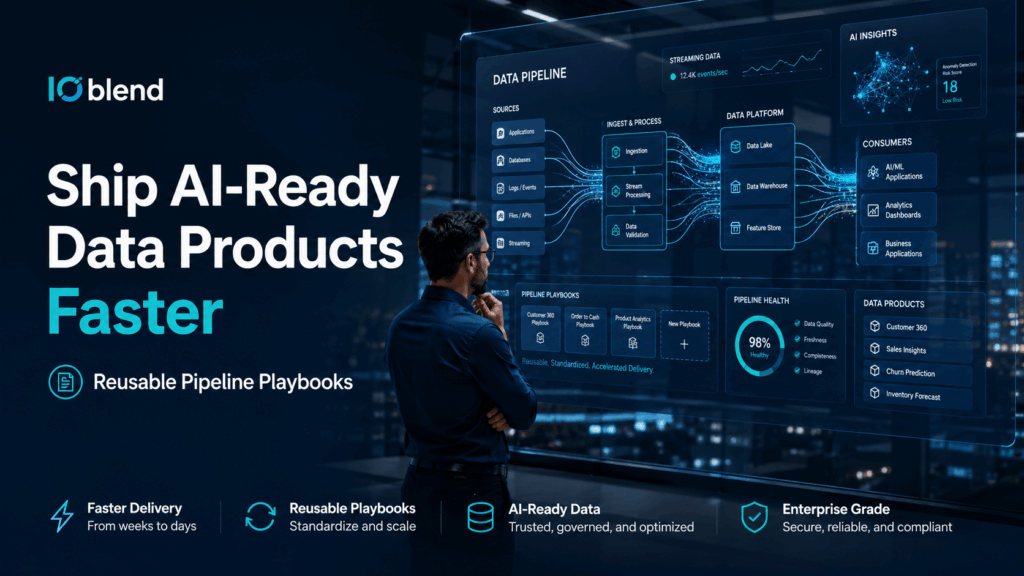
A data product treats data as a curated, standalone asset designed for immediate business consumption. Historically, shipping a new data product meant writing bespoke, monolithic Extract, Transform, Load (ETL) code. Reusable pipeline playbooks flip this model. They decouple infrastructure and orchestration from business rules by storing dataflows as modular, metadata-driven configuration files (like JSON). This means you can standardise ingestion, cleaning, and delivery into plug-and-play templates. Data teams can instantiate a robust, production-grade data product in days by simply feeding new schemas or parameters into an existing playbook.
Common architectural bottlenecks
Most enterprises suffer from brittle, hand-coded pipelines that cannot scale. When a source schema changes unexpectedly, downstream systems break silently, causing data drift chaos.
Consider a financial services firm trying to create an emergency risk-analytics data product. The engineering team has to stitch together historical batch databases and real-time streaming feeds. They spend weeks writing complex Apache Spark™ logic, managing Slowly Changing Dimensions (SCD), tracking record-level lineage, and tuning infrastructure. By the time the code is tested and deployed, the business opportunity has passed, and the team is trapped under a mountain of maintenance technical debt.
Accelerating data products with IOblend
This is precisely where IOblend eliminates friction. IOblend standardises production data pipelines on Spark as portable, lightweight JSON playbooks. It provides a low-code, drag-and-drop interface that abstracts the engineering complexity while autogenerating highly optimised distributed compute code behind the scenes.
- Seamless Kappa Architecture: Easily mix real-time streaming and batch sources dynamically without writing disparate pipelines.
- Built-in DataOps & Governance: Out-of-the-box features automatically handle Change Data Capture (CDC), Type I and II SCD regressions, deduplication, and record-level lineage.
- Resilience to Drift: Schema evolution is managed safely via strong data contracts, ensuring pipelines never fail quietly.
With IOblend, you build your core dataflow logic once and run it anywhere, across multi-cloud, on-prem, or hybrid environments.
Stop wasting quarters hand-coding brittle pipelines; accelerate your modern data estate and ship production-ready data products in days with IOblend.

Tangled in the Data Web
Tangled in the Data Web Data is now one of the most valuable assets for companies across all industries, right up there with their biggest asset – people. Whether you’re in retail, healthcare, or financial services, the ability to analyse data effectively gives a competitive edge. You’d think making the most of data would have

The ERP Shortcut: How to Integrate Faster Than You Think
IOblend was designed with one mission in mind: to simplify data integration. We deliver complex, real-time multi-system syncing with ERP in under a week.

IOblend seamlessly powers real-time multi-system integration
The adoption of IOblend significantly improved our data transformation capabilities, allowing for efficient and secure data integration between multiple systems

The AI Hype Trap: Why Overblown Promises Backfire
AI and GenAI adoption must make a visible and material positive impact on the business or it’s a waste of money.

The Art of Assembly: Where Data Meets Conveyors
Manufacturing is all about getting the most out of automation, skilled workforce, and data. Data helps drive the decisions that keep everything running smoothly

Saving Cents on Data Sense: Less Cost, More Value
No company is immune from the pains of data integration. It is one of the top IT cost items. Companies must get on top of their integration effort.