Build a “Data Product” in Days: Reusable Pipeline Playbooks
📝 Did you know? According to industry research, over 75% of the enterprise data budget is swallowed by repetitive data integration tasks. Rather than delivering high-value analytical models, engineers spend the majority of their time building the same structural boilerplate over and over again.
What are reusable pipeline playbooks?
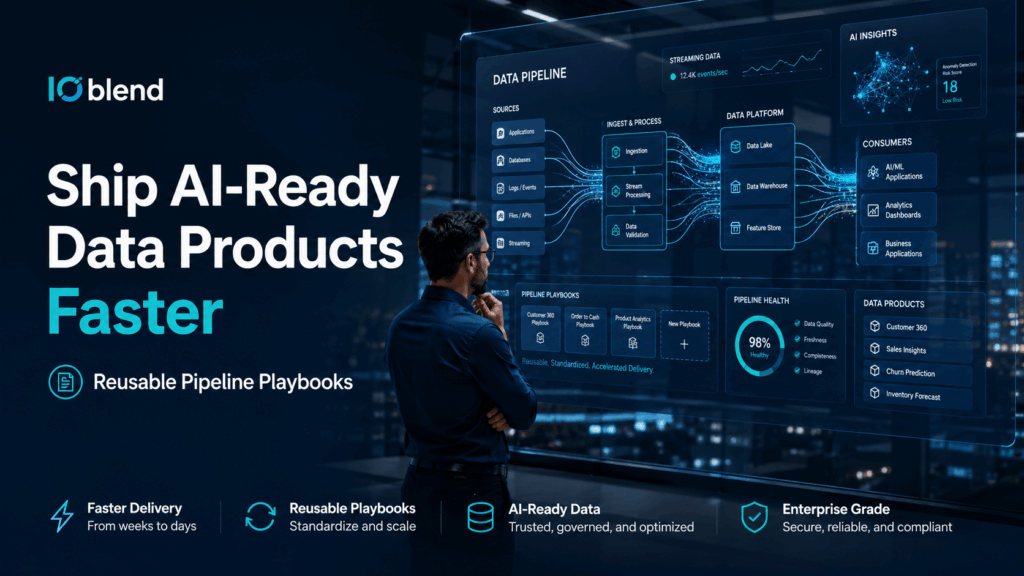
A data product treats data as a curated, standalone asset designed for immediate business consumption. Historically, shipping a new data product meant writing bespoke, monolithic Extract, Transform, Load (ETL) code. Reusable pipeline playbooks flip this model. They decouple infrastructure and orchestration from business rules by storing dataflows as modular, metadata-driven configuration files (like JSON). This means you can standardise ingestion, cleaning, and delivery into plug-and-play templates. Data teams can instantiate a robust, production-grade data product in days by simply feeding new schemas or parameters into an existing playbook.
Common architectural bottlenecks
Most enterprises suffer from brittle, hand-coded pipelines that cannot scale. When a source schema changes unexpectedly, downstream systems break silently, causing data drift chaos.
Consider a financial services firm trying to create an emergency risk-analytics data product. The engineering team has to stitch together historical batch databases and real-time streaming feeds. They spend weeks writing complex Apache Spark™ logic, managing Slowly Changing Dimensions (SCD), tracking record-level lineage, and tuning infrastructure. By the time the code is tested and deployed, the business opportunity has passed, and the team is trapped under a mountain of maintenance technical debt.
Accelerating data products with IOblend
This is precisely where IOblend eliminates friction. IOblend standardises production data pipelines on Spark as portable, lightweight JSON playbooks. It provides a low-code, drag-and-drop interface that abstracts the engineering complexity while autogenerating highly optimised distributed compute code behind the scenes.
- Seamless Kappa Architecture: Easily mix real-time streaming and batch sources dynamically without writing disparate pipelines.
- Built-in DataOps & Governance: Out-of-the-box features automatically handle Change Data Capture (CDC), Type I and II SCD regressions, deduplication, and record-level lineage.
- Resilience to Drift: Schema evolution is managed safely via strong data contracts, ensuring pipelines never fail quietly.
With IOblend, you build your core dataflow logic once and run it anywhere, across multi-cloud, on-prem, or hybrid environments.
Stop wasting quarters hand-coding brittle pipelines; accelerate your modern data estate and ship production-ready data products in days with IOblend.

Continuous Data Replication for DR and Continuity
Continuous Data Replication: for Business Continuity and DR 📝 Did you know? According to industry studies, the average cost of IT downtime is approximately £4,500 per minute. For a large enterprise, a single hour of data loss or system unavailability can translate into millions in lost revenue, legal penalties, and irreparable brand damage. The Pulse of

Smart Meter Data: Billing to Forecasting
Utilities: Smart Meter Data to Billing and Demand Forecasting 📋 Did You Know? The global roll-out of smart meters generates more data in a single day than most utility companies used to collect in an entire decade. While traditional meters were read once a month, or even once a quarter, smart meters transmit data at intervals

SCADA Streams to Reliability Analytics
Energy: SCADA Streams to Reliability Analytics 🔌 Did you know? The average modern wind turbine or smart substation generates roughly 1 to 2 terabytes of data every month. However, historically, less than 5% of that sensor data was actually used for decision-making. Most of it was simply discarded or “siloed” in SCADA systems, serving as a

Building Live ETA Pipelines for Fleet Operations
Logistics: Live ETA Prediction Pipelines from Fleet + Orders 🚚 Did you know? The “Last Mile” is famously the most expensive and inefficient part of the supply chain, often accounting for up to 53% of total shipping costs. The Evolution of Real-Time Logistics Live ETA (Estimated Time of Arrival) prediction pipelines represent the shift from reactive

DB2 CDC to Lakehouse Without Re-Platforming
From DB2 to Lakehouse: Real-Time CDC Without Re-Platforming 💻 Did you know? Mainframe systems like DB2 still process approximately 30 billion business transactions every single day. Despite the rush toward modern cloud architectures, the world’s most critical financial and logistical data often resides in these “legacy” environments, making them the silent engines of the global economy.

Real-Time Upserts: Deduping and Idempotency
Streaming Upserts Done Right: Deduping and Idempotency at Scale 💻 Did you know? In many high-velocity streaming environments, the “same” event can be sent or processed multiple times due to network retries or distributed system failures. The Art of the Upsert At its core, a streaming upsert (a portmanteau of “update” and “insert”) is the process of synchronising incoming data with an existing