
Utilities: Smart Meter Data to Billing and Demand Forecasting
📋 Did You Know? The global roll-out of smart meters generates more data in a single day than most utility companies used to collect in an entire decade. While traditional meters were read once a month, or even once a quarter, smart meters transmit data at intervals as frequent as every 15 minutes, creating a granular “digital heartbeat” of the power grid.
The Concept: From Pulse to Profit
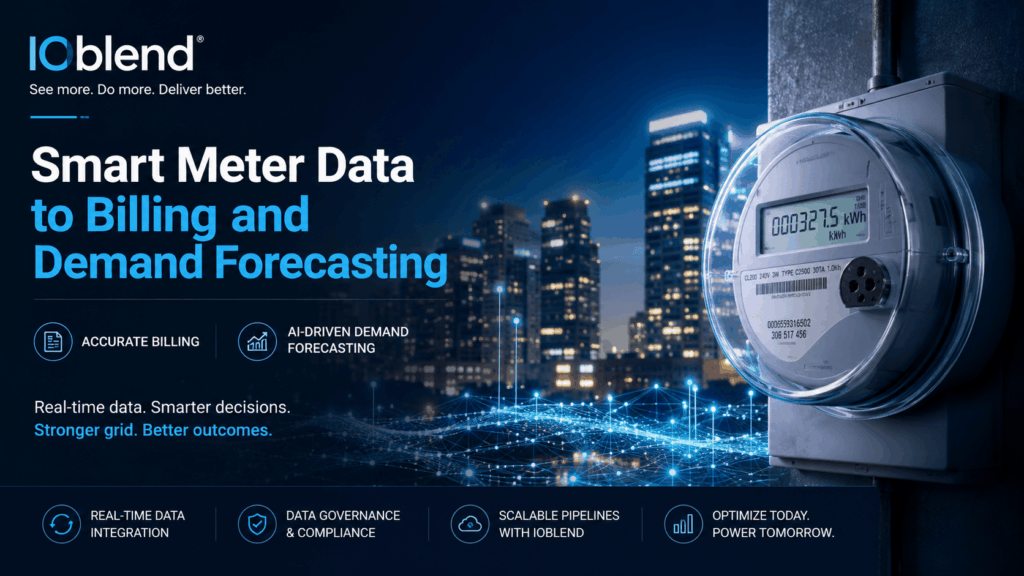
Smart meter data integration is the process of transforming raw telemetric pulses into actionable financial and operational intelligence. At its core, this involves capturing high-frequency interval data, validating it for “missing” periods, and routing it into two critical streams. The first is Billing, where consumption data is mapped against complex tariff structures. The second is Demand Forecasting, which uses historical patterns and environmental variables to predict future load, ensuring grid stability and efficient energy procurement.
The Data Silo Trap
For data experts in the utility sector, the primary challenge is not the volume of data, but its velocity and variety. Legacy Meter Data Management (MDM) systems often struggle to sync with modern cloud-based billing platforms, leading to “data lag.” When billing engines receive delayed or corrupted data, it results in estimated bills, a leading cause of customer dissatisfaction and regulatory fines.
Furthermore, demand forecasting requires merging smart meter telemetry with external datasets like weather feeds and demographic shifts. Traditional ETL (Extract, Transform, Load) pipelines are often too rigid to handle these schema-on-read requirements, resulting in “stale” forecasts that fail to predict peak load events, costing utilities millions in emergency energy purchases.
Solving the Pipeline Crisis with IOblend
This is where IOblend redefines the utility data landscape. By moving away from brittle, code-heavy ETL and embracing a high-performance, metadata-driven approach, IOblend allows data engineers to build resilient, API-to-Spark pipelines in a fraction of the time.
- Automated Data Masking & Governance: IOblend ensures that sensitive customer consumption patterns are masked during the forecasting phase, maintaining strict GDPR and industry compliance without slowing down the data flow.
- Real-Time CDC: IOblend’s Change Data Capture capabilities allow utilities to sync their MDM systems with billing engines in real-time, eliminating estimated billing and ensuring financial accuracy.
- Low-Code Complexity: Using the IOblend Designer, experts can integrate disparate sources, from legacy SQL databases to modern IoT streams, into a unified data lake for advanced AI-driven forecasting.
Stop fighting your data and start fuelling your grid, supercharge your utility pipelines with the power of IOblend.

Time to automate your airline’s DOC data
How to automate Direct Operating Cost (DOC) data collection, processing and serving with IOblend.

Automate airline fuel data collection & management
Collecting and managing airline fuel data is complex and time consuming. IOblend can greatly streamline the process and enable real-time decisioning.

The Data Mesh Gotchas!
I think most practitioners in the data world would agree that the core data mesh principles of decentralisation to improve data enablement are sound. Originally penned by Zhamak Dehghani, Data Mesh architecture is attracting a lot of attention, and rightly so. However, there is a growing concern in the data industry regarding how the data

IOblend Data Mesh
IOblend Data Mesh – power to the data people! Analyst engineering made simple Hello folks, IOblend here. Hope you are all keeping well. Companies are increasingly leaning towards self-service data authoring. Why, you ask? It is because the prevailing monolithic data architecture (no matter how advanced) does not condone an easy way to manage the

Data lineage is a “must have”, not “nice to have”
Hello folks, IOblend here. Hope you are all keeping well. There is one thing that has been bugging us recently, which led to the writing of this blog. While working on several data projects with some of our clients, we observed instances when data lineage had not been implemented as part of the solutions. In

Welcome to the IOblend blog
Welcome to the IOblend blog page. We are the creators of the IOblend real-time data integration and advanced DataOps solution. Over the many (many!) years, we have gained experience and insight from the world of data, especially in the data engineering and data management areas. Data challenges are everywhere and happen daily. We are sure,