
AW-10865990051

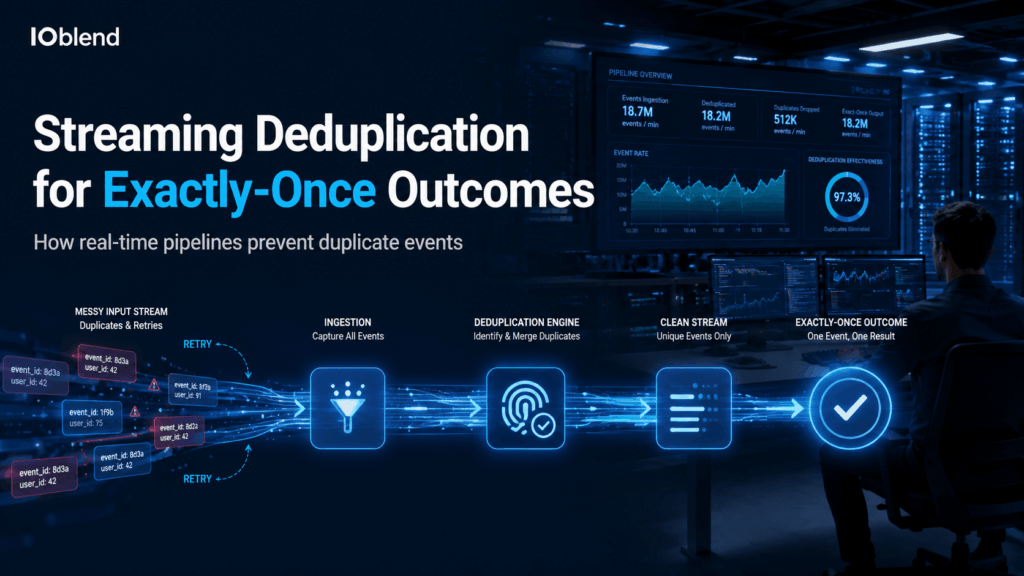
Streaming Deduplication for Exactly-Once Outcomes

Deduplicate Streaming Events IOblend

Deduplicate Streaming Events: Exact-Once Outcomes in Real Life 

📋 Did you know? In high-velocity streaming environments, network retries and transient worker failures cause up to 20% of event streams to contain duplicate payloads. 

Understanding exact-once outcomes 

In real-time data engineering, achieving “exactly-once” outcomes does not mean a message is transported across the wire only once, distributed networks make physical delivery guarantees at the wire level impossible. Instead, it means that despite network timeouts, retries, and consumer restarts, the end result of processing a message is committed to your target system precisely once. Stateful deduplication is the engine behind idempotency, transforming an unruly “at-least-once” stream into crisp, deterministic data states. 

The painful business cost of duplicate streams 

When organisations rely on streaming architectures for real-time analytics or operational automation, duplicate records create severe operational friction: 


  • Financial and transactional distortion: Consider a fintech payment gateway processing thousands of transactions per second. If a network glitch triggers a producer retry and the pipeline lacks stateful deduplication, a payment event is processed twice, leading to duplicate debits, compliance breaches, and customer churn. 
  • Corrupted analytics and AI models: In IoT fleet management or airline logistics, duplicated telemetry events distort windowed aggregations. A safety monitoring system reading doubled sensor pings might falsely trigger emergency alerts or corrupt real-time ML feature stores, degrading decision quality. 
  • Engineering complexity and infrastructure bloat: Building custom deduplication logic in native Apache Spark or Flink requires managing state stores, handling late-arriving data, and writing complex windowing boilerplate. 

Solved: Seamless deduplication with IOblend 

To achieve true exactly-once processing without drowning in custom code, modern data teams rely on IOblend. Designed around a high-performance Kappa architecture powered by Apache Spark, IOblend abstracts away the heavy lifting of stateful streaming pipelines. 

  • In-built, zero-code deduplication: IOblend provides automated, record-level de-duping, full-spectrum Change Data Capture (CDC), and real-time upserts out of the box. Engineers no longer need to write complex Spark code or maintain custom state managers. 
  • Ultra-low latency at scale: Operating seamlessly in-memory on modest hardware or existing Spark infrastructure (such as Databricks or cloud EMR), IOblend processes over 1,000,000 transactions per second at P99 ultra-low latencies. 
  • Unified stream and batch DataOps: By defining portable playbooks, IOblend unifies streaming and batch workloads while managing schema drift and record-level lineage automatically. 

Blend precision into your real-time data pipelines with IOblend. 

IOblend: See more. Do more. Deliver better.

Data analytics
admin

Smarter office management with real-time analytics

Commercial property Welcome to the next issue of our real-time analytics blog. This time we are taking a detour from the aviation analytics to the world of commercial property management. The topic arose from a use case we are working on now at IOblend. It just shows how broad a scope is for real-time data

Read More »
Airlines
admin

Better airport operations with real-time analytics

Good and bad Welcome to the next issue of our real-time analytics blog. Now that the summer holiday season is upon us, many of us will be using air travel to get to their destinations of choice. This means, we will be going through the airports. As passengers, we have love-hate relationships with airports. Some

Read More »
Airlines
admin

The making of a commercial flight

What makes a flight Welcome to the next leg of our airline data blog journey. In this article, we will be looking at what happens behind the scenes to make a single commercial flight, well, take flight. We will again consider how processes and data come together in (somewhat of a) harmony to bring your

Read More »
Airlines
admin

Enhance your airline’s analytics with a data mesh

Building a flying program In the last blog, I have covered how airlines plan their route networks using various strategies, data sources and analytical tools. Today, we will be covering how the network plan comes to life. Once the plans are developed, they are handed over to “production”. Putting a network plan into production is

Read More »
Airlines
admin

Planning an airline’s route network with deep data insights

What makes an airline Commercial airlines are complex beasts. They comprise of multiple intertwined (and siloed!) functions that make the business work. As passengers, we see a “tip of the iceberg” when we fly. A lot of work goes into making that flight happen, which starts well in advance. Let’s distil the complexity into something

Read More »
plane, flight, sunset-513641.jpg
Airlines
admin

Flying smarter with real-time analytics

Dynamic decisioning We continue exploring the topics of operational analytics (OA) in the aviation industry. Data plays a crucial role in flight performance analytics, operational decisioning and risk management. Real-time data enhances them. The aviation industry uses real-time data for a multitude of operational analytics cases: monitor operational systems, measure wear and tear of equipment,

Read More »
Scroll to Top