AW-10865990051

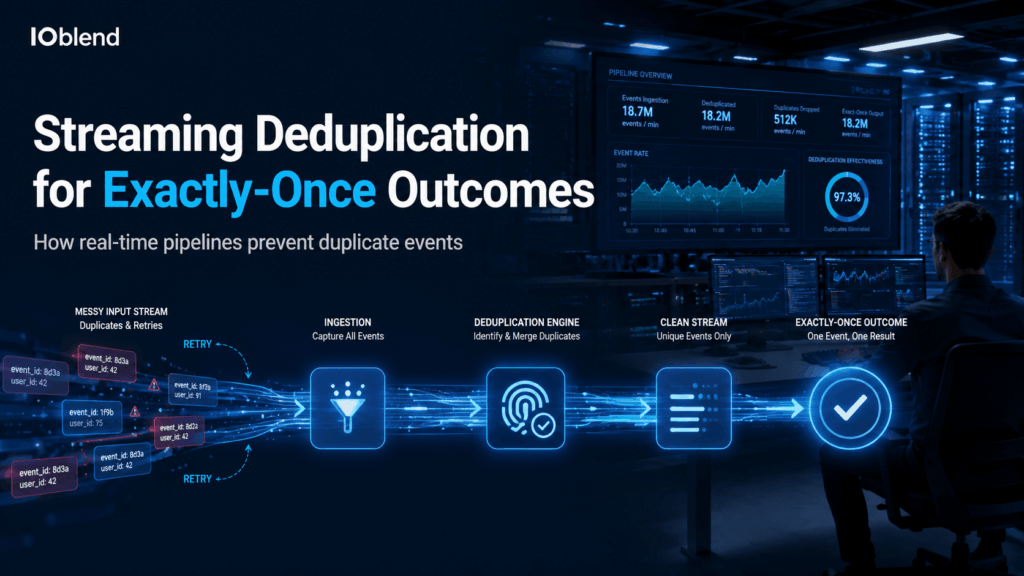
Streaming Deduplication for Exactly-Once Outcomes

Deduplicate Streaming Events IOblend

Deduplicate Streaming Events: Exact-Once Outcomes in Real Life 

📋 Did you know? In high-velocity streaming environments, network retries and transient worker failures cause up to 20% of event streams to contain duplicate payloads. 

Understanding exact-once outcomes 

In real-time data engineering, achieving “exactly-once” outcomes does not mean a message is transported across the wire only once, distributed networks make physical delivery guarantees at the wire level impossible. Instead, it means that despite network timeouts, retries, and consumer restarts, the end result of processing a message is committed to your target system precisely once. Stateful deduplication is the engine behind idempotency, transforming an unruly “at-least-once” stream into crisp, deterministic data states. 
The painful business cost of duplicate streams 

When organisations rely on streaming architectures for real-time analytics or operational automation, duplicate records create severe operational friction: 


  • Financial and transactional distortion: Consider a fintech payment gateway processing thousands of transactions per second. If a network glitch triggers a producer retry and the pipeline lacks stateful deduplication, a payment event is processed twice, leading to duplicate debits, compliance breaches, and customer churn. 
  • Corrupted analytics and AI models: In IoT fleet management or airline logistics, duplicated telemetry events distort windowed aggregations. A safety monitoring system reading doubled sensor pings might falsely trigger emergency alerts or corrupt real-time ML feature stores, degrading decision quality. 
  • Engineering complexity and infrastructure bloat: Building custom deduplication logic in native Apache Spark or Flink requires managing state stores, handling late-arriving data, and writing complex windowing boilerplate. 

Solved: Seamless deduplication with IOblend 

To achieve true exactly-once processing without drowning in custom code, modern data teams rely on IOblend. Designed around a high-performance Kappa architecture powered by Apache Spark, IOblend abstracts away the heavy lifting of stateful streaming pipelines. 

  • In-built, zero-code deduplication: IOblend provides automated, record-level de-duping, full-spectrum Change Data Capture (CDC), and real-time upserts out of the box. Engineers no longer need to write complex Spark code or maintain custom state managers. 
  • Ultra-low latency at scale: Operating seamlessly in-memory on modest hardware or existing Spark infrastructure (such as Databricks or cloud EMR), IOblend processes over 1,000,000 transactions per second at P99 ultra-low latencies. 
  • Unified stream and batch DataOps: By defining portable playbooks, IOblend unifies streaming and batch workloads while managing schema drift and record-level lineage automatically. 

Blend precision into your real-time data pipelines with IOblend. 

IOblend: See more. Do more. Deliver better.

Cloud migration de-risked with parallel runs IOblend
Data analytics
admin

De-Risk Cloud Migration with Parallel Runs

De-Risk Your Migration: Run Legacy and New Systems in Parallel  💻 Did you know? An alarming 83% of data migrations either fail outright or drastically overrun their budgets. When management loses patience with mounting technical friction, entire digital transformations are written off.  Minimising the migration gamble  To eliminate this operational hazard, running legacy and new systems in

Read More »
Governed and auditable data pipelines with IOblend
AI
admin

Compliance DataOps for Auditable Pipelines

Compliance-Friendly DataOps: Repeatable, Reviewable, Versioned Pipelines  📓 Did you know? According to industry compliance reports, nearly 70% of businesses face difficulties tracing their data back to its raw origins during regular regulatory audits.  The Concept of Compliance-Friendly DataOps  Compliance-friendly DataOps represents an operational framework that embeds strict regulatory governance directly into the data engineering lifecycle. Instead of treating data auditing

Read More »
DR-and-continuity-with-IOblend
AI
admin

Continuous Data Replication for DR and Continuity

Continuous Data Replication: for Business Continuity and DR  📝 Did you know? According to industry studies, the average cost of IT downtime is approximately £4,500 per minute. For a large enterprise, a single hour of data loss or system unavailability can translate into millions in lost revenue, legal penalties, and irreparable brand damage.  The Pulse of

Read More »
Smart meter billing and AI forecasting with IOblend
AI
admin

Smart Meter Data: Billing to Forecasting

Utilities: Smart Meter Data to Billing and Demand Forecasting  📋 Did You Know? The global roll-out of smart meters generates more data in a single day than most utility companies used to collect in an entire decade. While traditional meters were read once a month, or even once a quarter, smart meters transmit data at intervals

Read More »
SCADA streams with IOblend
AI
admin

SCADA Streams to Reliability Analytics

Energy: SCADA Streams to Reliability Analytics  🔌 Did you know? The average modern wind turbine or smart substation generates roughly 1 to 2 terabytes of data every month. However, historically, less than 5% of that sensor data was actually used for decision-making. Most of it was simply discarded or “siloed” in SCADA systems, serving as a

Read More »
Logistics operator at a workstation using a tablet with holographic screens showing live ETA, weather, and a route map at a busy distribution hub.
AI
admin

Building Live ETA Pipelines for Fleet Operations

Logistics: Live ETA Prediction Pipelines from Fleet + Orders  🚚 Did you know? The “Last Mile” is famously the most expensive and inefficient part of the supply chain, often accounting for up to 53% of total shipping costs.  The Evolution of Real-Time Logistics  Live ETA (Estimated Time of Arrival) prediction pipelines represent the shift from reactive

Read More »
Scroll to Top