
Deduplicate Streaming Events: Exact-Once Outcomes in Real Life
📋 Did you know? In high-velocity streaming environments, network retries and transient worker failures cause up to 20% of event streams to contain duplicate payloads.
Understanding exact-once outcomes
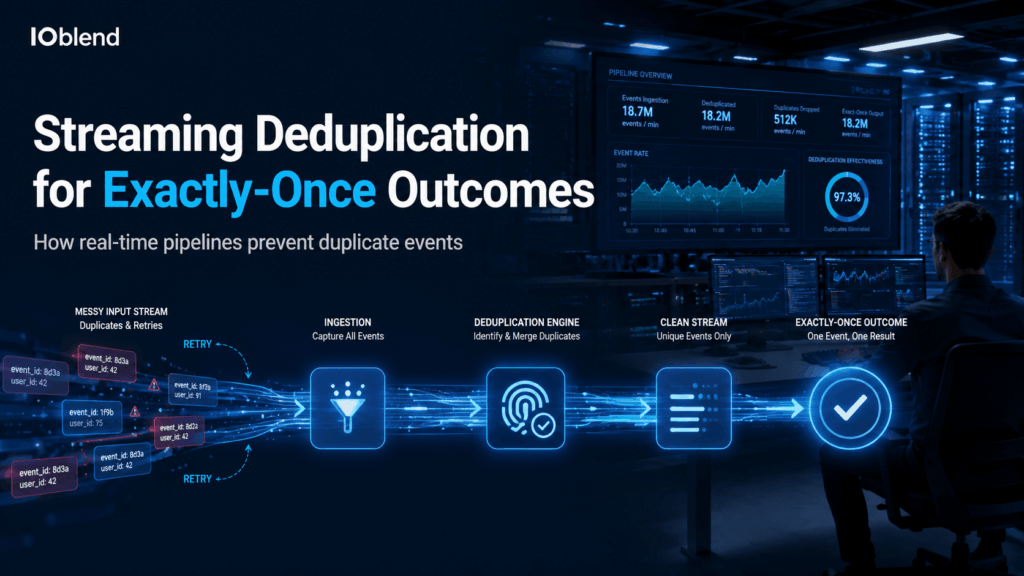
In real-time data engineering, achieving “exactly-once” outcomes does not mean a message is transported across the wire only once, distributed networks make physical delivery guarantees at the wire level impossible. Instead, it means that despite network timeouts, retries, and consumer restarts, the end result of processing a message is committed to your target system precisely once. Stateful deduplication is the engine behind idempotency, transforming an unruly “at-least-once” stream into crisp, deterministic data states.
The painful business cost of duplicate streams
When organisations rely on streaming architectures for real-time analytics or operational automation, duplicate records create severe operational friction:
- Financial and transactional distortion: Consider a fintech payment gateway processing thousands of transactions per second. If a network glitch triggers a producer retry and the pipeline lacks stateful deduplication, a payment event is processed twice, leading to duplicate debits, compliance breaches, and customer churn.
- Corrupted analytics and AI models: In IoT fleet management or airline logistics, duplicated telemetry events distort windowed aggregations. A safety monitoring system reading doubled sensor pings might falsely trigger emergency alerts or corrupt real-time ML feature stores, degrading decision quality.
- Engineering complexity and infrastructure bloat: Building custom deduplication logic in native Apache Spark or Flink requires managing state stores, handling late-arriving data, and writing complex windowing boilerplate.
Solved: Seamless deduplication with IOblend
To achieve true exactly-once processing without drowning in custom code, modern data teams rely on IOblend. Designed around a high-performance Kappa architecture powered by Apache Spark, IOblend abstracts away the heavy lifting of stateful streaming pipelines.
- In-built, zero-code deduplication: IOblend provides automated, record-level de-duping, full-spectrum Change Data Capture (CDC), and real-time upserts out of the box. Engineers no longer need to write complex Spark code or maintain custom state managers.
- Ultra-low latency at scale: Operating seamlessly in-memory on modest hardware or existing Spark infrastructure (such as Databricks or cloud EMR), IOblend processes over 1,000,000 transactions per second at P99 ultra-low latencies.
- Unified stream and batch DataOps: By defining portable playbooks, IOblend unifies streaming and batch workloads while managing schema drift and record-level lineage automatically.
Blend precision into your real-time data pipelines with IOblend.

DB2 CDC to Lakehouse Without Re-Platforming
From DB2 to Lakehouse: Real-Time CDC Without Re-Platforming 💻 Did you know? Mainframe systems like DB2 still process approximately 30 billion business transactions every single day. Despite the rush toward modern cloud architectures, the world’s most critical financial and logistical data often resides in these “legacy” environments, making them the silent engines of the global economy.

Real-Time Upserts: Deduping and Idempotency
Streaming Upserts Done Right: Deduping and Idempotency at Scale 💻 Did you know? In many high-velocity streaming environments, the “same” event can be sent or processed multiple times due to network retries or distributed system failures. The Art of the Upsert At its core, a streaming upsert (a portmanteau of “update” and “insert”) is the process of synchronising incoming data with an existing

Streaming Data Quality That Won’t Break Pipelines
Streaming Without the Sting: Data Quality Rules That Never Break the Flow 💻 Did you know? A single minute of downtime in a high-velocity streaming environment can result in the loss of millions of data points, potentially costing a business thousands of pounds in missed opportunities or regulatory fines. — Defining Resilient Streaming Quality Data quality in

Schema Drift: The Silent Killer of Data Pipelines
The Silent Pipeline Killer: Surviving Schema Drift in the Wild 📊 Did you know? In the early days of big data, a single column change in a source database could trigger a “data graveyard” effect, where downstream analytics remained broken for weeks. The silent pipeline killer Schema drift occurs when the structure of source data changes

Preventing Data Drift in Modern Data Systems
The Invisible Erosion: Detecting and Managing Data Drift in Modern Architectures 📊 Did you know? According to recent industry surveys, over 70% of organisations experience significant data drift within the first six months of deploying a production system. The Concept of Data Drift Data drift occurs when the statistical properties or the underlying structure of incoming data change

Stream Database Changes to Your Lakehouse with CDC
Zero-Lag Operations: Stream Database Changes to Your Lakehouse 💾 Did you know? The “data downtime” caused by traditional batch processing costs the average enterprise approximately £12,000 per minute. The Concept: Moving at the Speed of Change Zero-lag operations rely on a transition from periodic “snapshots” to continuous “streams.” Instead of moving massive blocks of data at