Debug Streaming Like a Pro: Visual Tracing and Rapid Iteration
📎 Did you know? The vast majority of real-time streaming data pipeline bugs only reveal themselves under production workloads, usually at 03:00 am. Because streaming systems process unbounded data in memory, traditional breakpoints and step-through debugging are impossible without stopping the entire world, corrupting states, and causing downstream disaster.
The Concept of Visual Tracing
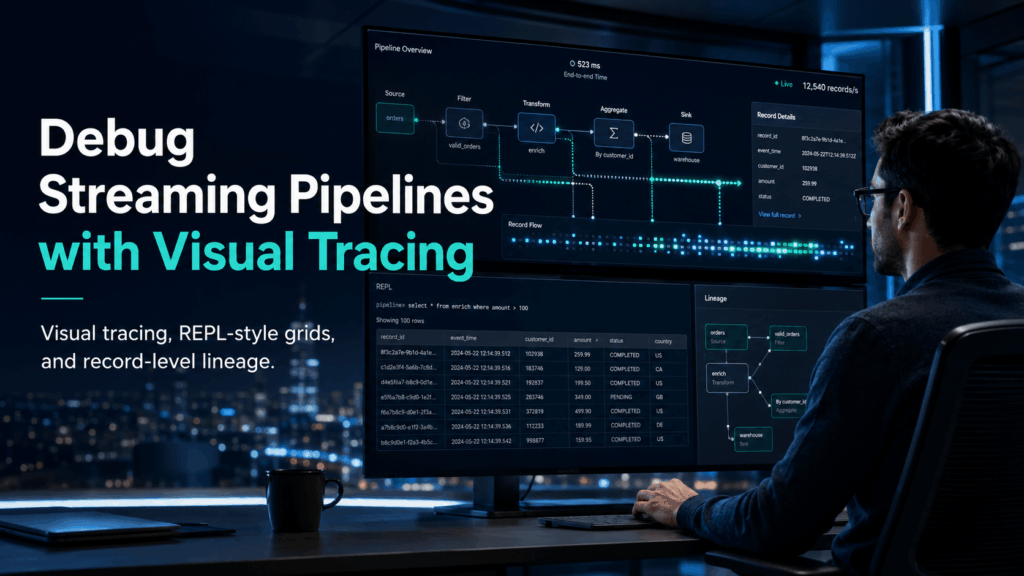
Streaming debugging is notoriously complex. Unlike batch processing, where you can pause, inspect, and rerun a static chunk of data, streaming flows constantly. Visual tracing changes this entirely. It acts like a high-speed camera for data-in-motion, allowing data experts to map out data flows and evaluate execution blocks in real time. Instead of looking at unformatted command-line error logs, engineers can see records moving through transformations interactively, mimicking Read-Eval-Print Loop (REPL) interactive grids.
Streaming Bottlenecks for Modern Enterprises
Building real-time data architectures, like Kappa or Lambda models, presents massive operational challenges for businesses:
- The Black Box Dilemma: When an aggregate metric spikes or a schema drifts, finding the exact corrupted record or broken joint downstream requires hours of parsing log files.
- Sluggish Iteration Cycles: Testing a minor business logic adjustment or custom Python snippet often requires full redeployment to a remote Apache Spark or Apache Flink cluster, dragging out development phases from days into weeks.
- Late-Arriving Records & Drift: Data arriving out of order or unexpected upstream structural modifications can silently break hand-written stateful transformations, resulting in inaccurate real-time dashboards and broken business trust.
The IOblend Solution
To overcome these production bottlenecks, IOblend shifts the entire streaming paradigm by embedding built-in DataOps directly into a low-code visual environment. Running on a highly optimised Kappa architecture, IOblend autogenerates distributed Apache Spark streaming jobs without requiring manual code.
For data experts debugging complex streams, IOblend provides specific, production-ready capabilities:
- Visual Debugging & REPL Grids: Test real-time data flows locally via an interactive developer desktop application with REPL-like data grids, allowing you to iterate instantly before pushing pipelines live.
- Granular Record-Level Lineage: If an error occurs, IOblend tracks data changes down to the individual record, exposing exactly what modified the data.
- Automated Drift & Late Data Handling: It automatically tracks schema evolution, protects data contracts, and seamlessly replays transforms whenever late-arriving data hits the engine.
Simplify your pipelines and scale with confidence by leveraging the real-time observability of IOblend.

Smarter Quality Control with Cloud + IOblend
Quality Control Reimagined: Cloud, the Fusion of Legacy Data and Vision AI 🏭 Did You Know? Over 80% of manufacturing and quality data is considered ‘dark’ inaccessible or siloed within legacy on-premises systems, dramatically hindering the deployment of real-time, predictive Quality Control (QC) systems like Vision AI. Quality Control Reimagined The core concept of modern quality

Predictive Aircraft Maintenance with Agentic AI
Predictive Aircraft Maintenance: Consolidating Data from Engine Sensors and MRO Systems 🛫 Did you know that leveraging Big Data analytics for predictive aircraft maintenance can reduce unscheduled aircraft downtime by up to 30% Predictive Maintenance: The Core Concept Predictive Maintenance (PdM) in aviation is the strategic shift from a time-based or reactive approach to an ‘as-needed’ model,

Digital Twin Evolution: Big Data & AI with
The Industrial Renaissance: How Agentic AI and Big Data Power the Self-Optimising Digital Twin 🏭 Did You Know? A fully realised industrial Digital Twin, underpinned by real-time data, has been proven to reduce unplanned production downtime by up to 20%. The Digital Twin Evolution The Digital Twin is a sophisticated, living, virtual counterpart of a physical production system. It

Real-Time Risk Modelling with Legacy & Modern Data
Risk Modelling in Real-time: Integrating Legacy Oracle/HP Underwriting Data with Modern External Datasets 💼 Did you know that in the time it takes to brew a cup of tea, a real-time risk model could have processed enough data to flag over 60 million potential fraudulent insurance claims? The Real-Time Risk Modelling Imperative Real-time risk modelling is

Unify Clinical & Financial Data to Cut Readmissions
Clinical-Financial Synergy: The Seamless Integration of Clinical and Financial Data to Minimise Readmissions 🚑 Did You Know? Unnecessary hospital readmissions within 30 days represent a colossal financial burden, often reflecting suboptimal transitional care. Clinical-Financial Synergy: The Seamless Integration of Clinical and Financial Data to Minimise Readmissions The Convergence of Clinical and Financial Data The convergence of clinical and financial

Agentic Pipelines and Real-Time Data with Guardrails
The New Era of ETL: Agentic Pipelines and Real-Time Data with Guardrails For years, ETL meant one thing — moving and transforming data in predictable, scheduled batches, often using a multitude of complementary tools. It was practical, reliable, and familiar. But in 2025, well, that’s no longer enough. Let’s have a look at the shift