Debug Streaming Like a Pro: Visual Tracing and Rapid Iteration
📎 Did you know? The vast majority of real-time streaming data pipeline bugs only reveal themselves under production workloads, usually at 03:00 am. Because streaming systems process unbounded data in memory, traditional breakpoints and step-through debugging are impossible without stopping the entire world, corrupting states, and causing downstream disaster.
The Concept of Visual Tracing
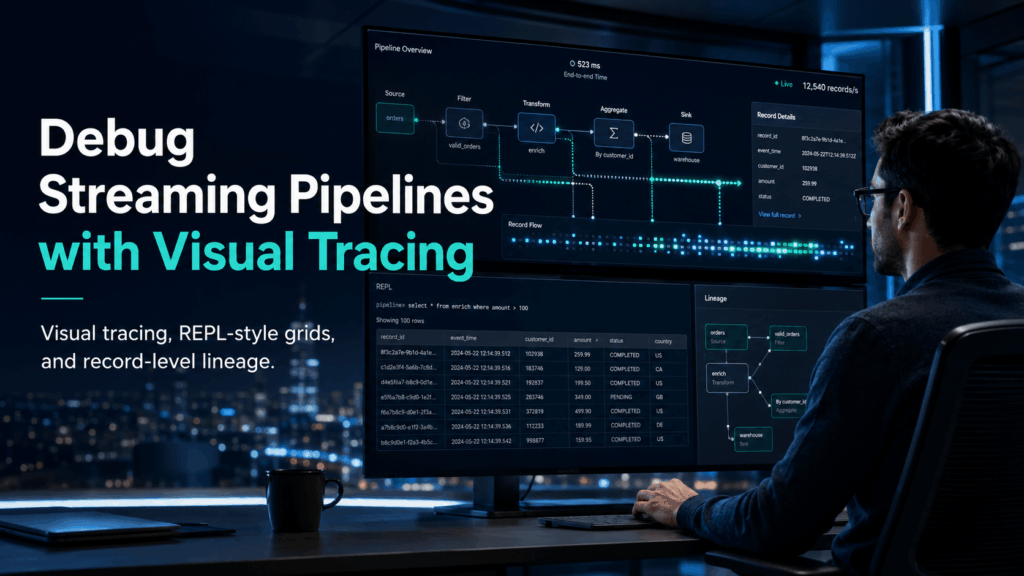
Streaming debugging is notoriously complex. Unlike batch processing, where you can pause, inspect, and rerun a static chunk of data, streaming flows constantly. Visual tracing changes this entirely. It acts like a high-speed camera for data-in-motion, allowing data experts to map out data flows and evaluate execution blocks in real time. Instead of looking at unformatted command-line error logs, engineers can see records moving through transformations interactively, mimicking Read-Eval-Print Loop (REPL) interactive grids.
Streaming Bottlenecks for Modern Enterprises
Building real-time data architectures, like Kappa or Lambda models, presents massive operational challenges for businesses:
- The Black Box Dilemma: When an aggregate metric spikes or a schema drifts, finding the exact corrupted record or broken joint downstream requires hours of parsing log files.
- Sluggish Iteration Cycles: Testing a minor business logic adjustment or custom Python snippet often requires full redeployment to a remote Apache Spark or Apache Flink cluster, dragging out development phases from days into weeks.
- Late-Arriving Records & Drift: Data arriving out of order or unexpected upstream structural modifications can silently break hand-written stateful transformations, resulting in inaccurate real-time dashboards and broken business trust.
The IOblend Solution
To overcome these production bottlenecks, IOblend shifts the entire streaming paradigm by embedding built-in DataOps directly into a low-code visual environment. Running on a highly optimised Kappa architecture, IOblend autogenerates distributed Apache Spark streaming jobs without requiring manual code.
For data experts debugging complex streams, IOblend provides specific, production-ready capabilities:
- Visual Debugging & REPL Grids: Test real-time data flows locally via an interactive developer desktop application with REPL-like data grids, allowing you to iterate instantly before pushing pipelines live.
- Granular Record-Level Lineage: If an error occurs, IOblend tracks data changes down to the individual record, exposing exactly what modified the data.
- Automated Drift & Late Data Handling: It automatically tracks schema evolution, protects data contracts, and seamlessly replays transforms whenever late-arriving data hits the engine.
Simplify your pipelines and scale with confidence by leveraging the real-time observability of IOblend.

Real-Time Churn Agents with Closed-Loop MLOps
Churn Prevention: Building “closed-loop” MLOps systems that predict churn and trigger automated retention agents 🔗 Did you know? In the telecommunications and subscription-based sectors, a mere 5% increase in customer retention can lead to a staggering profit surge of more than 25%. Closed-Loop MLOps A “closed-loop” MLOps system is an advanced architectural pattern that transcends simple predictive analytics. While

Streaming Predictive MX: Drift-Aware Inference
Predictive Maintenance 2.0: Feeding real-time sensor drifts directly into inference models using streaming engine 🔩 Did you know? The cost of unplanned downtime for industrial manufacturers is estimated at nearly £400 billion annually. Predictive Maintenance 2.0: The Real-Time Evolution Predictive Maintenance 2.0 represents a paradigm shift from batch-processed diagnostics to live, autonomous synchronisation. In the traditional 1.0

Beyond Micro-Batching: Continuous Streaming for AI
Beyond Micro-batching: Why Continuous Streaming Engine is the Future of “Fresh Data” for AI 💻 Did you know? Most modern “real-time” AI applications are actually running on data that is already several minutes old. Traditional micro-batching collects data into small chunks before processing it, introducing a “latency tax” that can render predictive models obsolete before they

ERP Cloud Migration With Live Data Sync
Seamless Core System Migration: The Move of Large-Scale Banking and Insurance ERP Data to a Modern Cloud Architecture ⛅ Did you know that core system migrations in large financial institutions, which typically rely on manual data mapping and validation, often require parallel runs lasting over 18 months? The Core Challenge The migration of multi-terabyte ERP and

Legacy ERP Integration to Modern Data Fabric
Warehouse Automation Efficiency: Migrating and Integrating Legacy ERP Data into a Modern Big Data Ecosystem 📦 Did you know? Analysts estimate that warehouses leveraging robust, real-time data integration see inventory accuracy improvements of up to 99%. The Convergence of WMS and Big Data Data professionals in logistics face a profound challenge extracting mission-critical operational data such

Dynamic Pricing with Agentic AI
The Agentic Edge: Real-Time Dynamic Pricing through AI-Driven Cloud Data Integration 📊 Did You Know? The most sophisticated dynamic pricing systems can process and react to market signals in under 100 milliseconds. The Evolution of Value Optimisation Dynamic Pricing and Revenue Management (DPRM) is a complex computational science. At its core, DPRM aims to sell the right