AW-10865990051

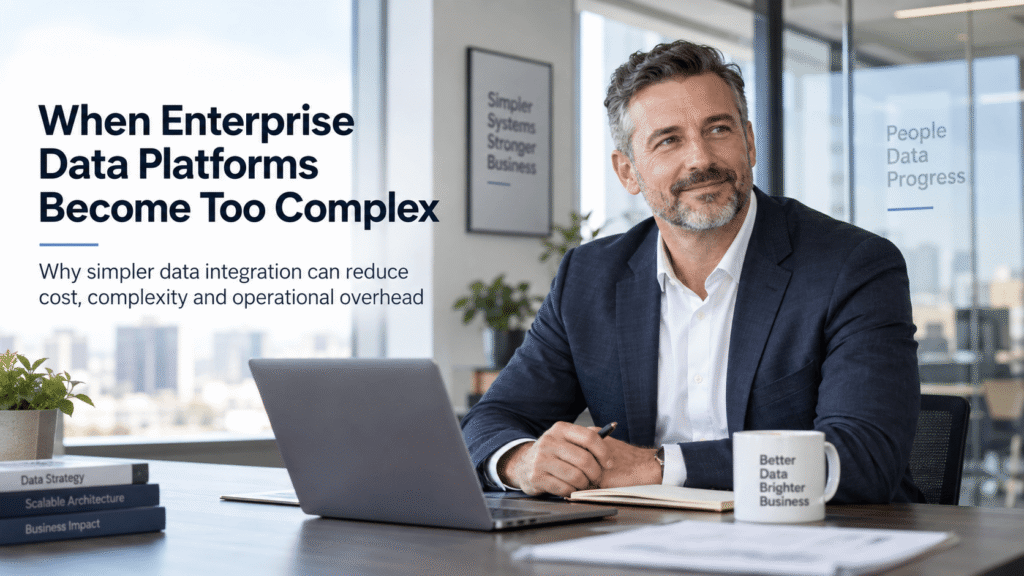
When Enterprise Data Platforms Become Too Complex

Enterpsise-Data-Platform-blog-IOblend

When Enterprise Data Platforms Become Too Complex

Enterprise data platforms usually start with a sensible goal:

  • Connect the data
  • Make it trustworthy
  • Make it useful

The problem is that, over time, the platform itself can become part of the complexity.

More services are added. More specialist skills are needed. More workloads become dependent on one environment.

Eventually, the technology introduced to simplify data can become another major system the organisation has to manage.

The better question for a CTO is:

Do we really need an entire enterprise data platform to solve what is mainly a data integration problem?

When the solution becomes bigger than the problem

Take healthcare.

A large healthcare organisation may need to connect:

  • Patient administration systems
  • Waiting lists
  • Theatre schedules
  • Bed occupancy
  • Staffing
  • Medical supplies
  • Clinical and operational systems

The business need is simple:

Bring the right information together, keep it current and make it available where it is needed.

The value is obvious.

But if this gradually requires:

  • A large proprietary platform
  • Specialist developers
  • Platform-specific processes
  • Expensive support
  • Increasing vendor dependency

then the architecture may have become heavier than the original problem.

Defence organisations face a similar challenge.

They may need to connect:

  • Asset information
  • Logistics
  • Engineering systems
  • Personnel data
  • Supply chains
  • Operational systems
  • Legacy databases

Again, the requirement is straightforward:

Get trusted, current data to the right place quickly enough to support a decision.

These are difficult data problems.

But difficult data problems do not always require an increasingly complex platform.

What is the platform actually doing?

Strip away the product names.

For many organisations, the daily workload comes down to:

  • Connect data
  • Capture changes
  • Clean it
  • Transform it
  • Join it
  • Validate it
  • Maintain history
  • Track lineage
  • Deliver it somewhere else

These are essential capabilities.

But they are fundamentally data engineering and data integration capabilities.

If this is where most of the value is coming from, it is reasonable to ask whether the organisation still needs the much larger platform around them.

A simpler model

The alternative is not necessarily another large platform.

It can be a smaller, independent production data layer sitting between the systems the organisation already owns.

For example:

  • SAP stays where it is
  • Oracle stays where it is
  • Salesforce stays where it is
  • Microsoft Fabric stays in place
  • Databricks stays in place
  • Snowflake stays in place
  • Existing cloud and on-premise infrastructure stays in place

The missing layer simply connects them reliably.

That is the approach behind IOblend .

IOblend handles:

  • Real-time integration
  • Batch integration
  • Change Data Capture
  • Transformation
  • Data quality
  • Deduplication
  • Historical data management
  • Lineage
  • Production pipeline management

The organisation does not need to rebuild its whole estate around IOblend.

Keep business logic portable

The hardest thing to migrate is often not the data.

It is the business logic.

Over time, organisations build rules around questions such as:

  • How is a customer matched?
  • How are duplicates handled?
  • Which record wins?
  • How is history maintained?
  • What happens when a source changes?
  • Which values are valid?

If that logic becomes trapped inside one platform, future technology decisions become harder.

IOblend takes a more portable approach.

Organisations can continue using:

  • SQL
  • Python
  • Visual pipeline logic
  • Existing engineering skills

The aim is to keep business logic useful even when the surrounding architecture changes.

Today’s target may be Fabric.

Tomorrow it may be Databricks.

The integration layer should make that change easier, not harder.

Reliability should be built in

Data teams often assemble several separate tools around a pipeline just to make it production-ready.

That can include:

  • Development tools
  • Testing frameworks
  • Debugging tools
  • Version control
  • Data quality tooling
  • Deployment scripts
  • Monitoring

IOblend integrates much of this into the development workflow.

Developers can:

  • Test components as they build
  • Inspect data visually
  • Validate pipeline logic
  • Validate SQL
  • Validate Python
  • Run developer tests
  • Compare pipeline versions
  • Prevent invalid logic from executing

There is no need to write separate testing code for normal pipeline validation.

The principle is simple:

Production reliability should be built into the pipeline, not bolted on afterwards.

Migration should not be a leap of faith

Many organisations stay with complex platforms because moving away feels risky.

Critical pipelines cannot simply be switched off and replaced overnight.

They do not need to be.

A safer approach is:

  • Build
  • Run in parallel
  • Reconcile
  • Approve
  • Cut over

The existing pipeline continues running.

The replacement processes the same source data.

Teams compare:

  • Record counts
  • Transformations
  • Data quality
  • Outputs
  • Missing records
  • Duplicates
  • Processing behaviour

Only when the results match expectations does the organisation move production across.

That turns migration into a controlled engineering process rather than a high-risk platform replacement programme.

Simplicity can be an architectural advantage

For years, enterprise technology strategy has focused on adding more.

More platforms. More services. More layers.

The next advantage may come from knowing what can be removed.

That does not mean giving up:

  • Reliability
  • Performance
  • Governance
  • Control

It means asking a simpler question:

What is the smallest architecture capable of delivering the outcome properly?

For many organisations, the answer may not be another all-encompassing enterprise data platform.

It may simply be an independent data integration layer capable of keeping trusted data moving between the technologies the organisation has already chosen.

Keep the infrastructure that works.
Keep the business logic that matters.
Remove the complexity you no longer need.


IOblend: See more. Do more. Deliver better.

Agentic_AI_IOblend_revenue_management
AI
admin

Dynamic Pricing with Agentic AI

The Agentic Edge: Real-Time Dynamic Pricing through AI-Driven Cloud Data Integration  📊 Did You Know? The most sophisticated dynamic pricing systems can process and react to market signals in under 100 milliseconds.  The Evolution of Value Optimisation  Dynamic Pricing and Revenue Management (DPRM) is a complex computational science. At its core, DPRM aims to sell the right

Read More »
QC_control_IOblend
AI
admin

Smarter Quality Control with Cloud + IOblend

Quality Control Reimagined: Cloud, the Fusion of Legacy Data and Vision AI  🏭 Did You Know? Over 80% of manufacturing and quality data is considered ‘dark’ inaccessible or siloed within legacy on-premises systems, dramatically hindering the deployment of real-time, predictive Quality Control (QC) systems like Vision AI.  Quality Control Reimagined  The core concept of modern quality

Read More »
ioblend_predicitive_maintenance_ai
AI
admin

Predictive Aircraft Maintenance with Agentic AI

Predictive Aircraft Maintenance: Consolidating Data from Engine Sensors and MRO Systems  🛫 Did you know that leveraging Big Data analytics for predictive aircraft maintenance can reduce unscheduled aircraft downtime by up to 30%  Predictive Maintenance: The Core Concept  Predictive Maintenance (PdM) in aviation is the strategic shift from a time-based or reactive approach to an ‘as-needed’ model,

Read More »
AI
admin

Digital Twin Evolution: Big Data & AI with

The Industrial Renaissance: How Agentic AI and Big Data Power the Self-Optimising Digital Twin  🏭 Did You Know? A fully realised industrial Digital Twin, underpinned by real-time data, has been proven to reduce unplanned production downtime by up to 20%.  The Digital Twin Evolution  The Digital Twin is a sophisticated, living, virtual counterpart of a physical production system. It

Read More »
real-time_risk_insurance_ioblend
AI
admin

Real-Time Risk Modelling with Legacy & Modern Data

Risk Modelling in Real-time: Integrating Legacy Oracle/HP Underwriting Data with Modern External Datasets  💼 Did you know that in the time it takes to brew a cup of tea, a real-time risk model could have processed enough data to flag over 60 million potential fraudulent insurance claims?  The Real-Time Risk Modelling Imperative  Real-time risk modelling is

Read More »
AI
admin

Unify Clinical & Financial Data to Cut Readmissions

Clinical-Financial Synergy: The Seamless Integration of Clinical and Financial Data to Minimise Readmissions   🚑 Did You Know? Unnecessary hospital readmissions within 30 days represent a colossal financial burden, often reflecting suboptimal transitional care.  Clinical-Financial Synergy: The Seamless Integration of Clinical and Financial Data to Minimise Readmissions  The Convergence of Clinical and Financial Data  The convergence of clinical and financial

Read More »
Scroll to Top