
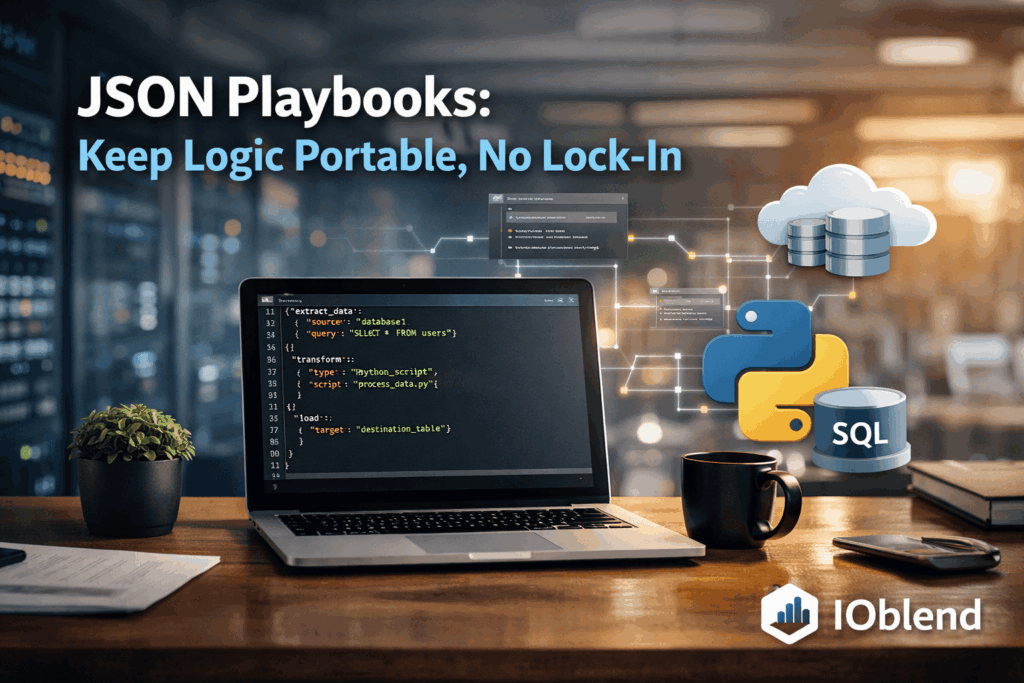
The End of Vendor Lock-in: Keeping your logic portable with IOblend’s JSON-based playbooks and Python/SQL core
💾 Did you know? The average enterprise now uses over 350 different data sources, yet nearly 70% of data leaders feel “trapped” by their infrastructure. Recent industry reports suggest that migrating a legacy data warehouse to a new provider can cost up to five times the original implementation price, primarily due to proprietary code conversion.

The Concept of Portable Logic
In the modern data stack, “vendor lock-in” is the invisible tether that binds your intellectual property, your business logic, to a specific service provider’s proprietary format. IOblend disrupts this cycle by decoupling the execution engine from the logic itself. By using a combination of universal SQL, standard Python, and JSON-based playbooks, IOblend ensures that your data pipelines remain platform-agnostic. Essentially, it treats your data integration as “living code” that can be moved, audited, and executed across different environments without a total rewrite.
The High Cost of Architectural Rigidity
For many organisations, the initial ease of “drag-and-drop” ETL tools eventually turns into a technical debt nightmare. When logic is stored in a vendor’s proprietary binary format or hidden behind a “black-box” GUI, the business loses its agility.
Data experts frequently encounter these friction points:
- The Migration Tax: Switching from one cloud provider to another often requires manual translation of thousands of stored procedures.
- Skill Gaps: Teams become specialists in a specific tool’s interface rather than the data itself, making it difficult to hire or pivot.
- Opaque Version Control: Proprietary tools often struggle with Git integration, making CI/CD pipelines fragile and difficult to peer-review.
The IOblend Solution: Portability by Design
IOblend solves these challenges by providing a developer-centric framework that prioritises transparency.
- JSON-Based Playbooks: Instead of opaque configurations, IOblend uses human-readable JSON playbooks to define pipeline stages. This means your entire workflow is documented in a standard format that can be version-controlled in Git and reviewed by any engineer.
- Python & SQL Core: By sticking to the industry-standard languages of data, SQL for transformations and Python for complex logic, IOblend ensures that your code remains your own. If you want to run a specific transformation elsewhere, the SQL block remains valid.
- Seamless Integration: IOblend’s approach allows you to build, run, and monitor pipelines at scale. By leveraging advanced metadata-driven automation, it eliminates the need for manual plumbing, allowing your team to focus on extracting value rather than managing infrastructure.
Future-proof your data strategy and break free from the shackles of legacy lock-in with IOblend.

Penny-wise: Strategies for surviving budget cuts
Weathering budget cuts, particularly in the realm of data projects, require a combination of resilience, strategic thinking, and a willingness to adapt.

Data Syncing: The Evolution Of Data Integration
Data syncing, a crucial aspect of modern data management. It ensures data remains consistent and up-to-date across various sources, applications, and devices.

How IOblend Enables Real-Time Analytics of IoT Data
The real power of IoT lies in the data it generates in real-time. This data is continuously analysed to derive meaningful insights, mainly by automated systems.

Data Plumbing Essentials: Production Pipelines
The creation of production data pipelines is an exercise in precision engineering, meticulous planning, robust construction, and continuous maintenance.

Breaking Down the Walls: Overcoming Data Silos
All enterprise data should be discoverable, catalogued and made available for analytics. But the reality is quite different. Data silos are a persistent issue.

Complex World of Enterprise Data Estates
Large enterprises data estates are complex and costly to run and maintain. IOblend enables simplified data integration capabilities that alleviates complexities