
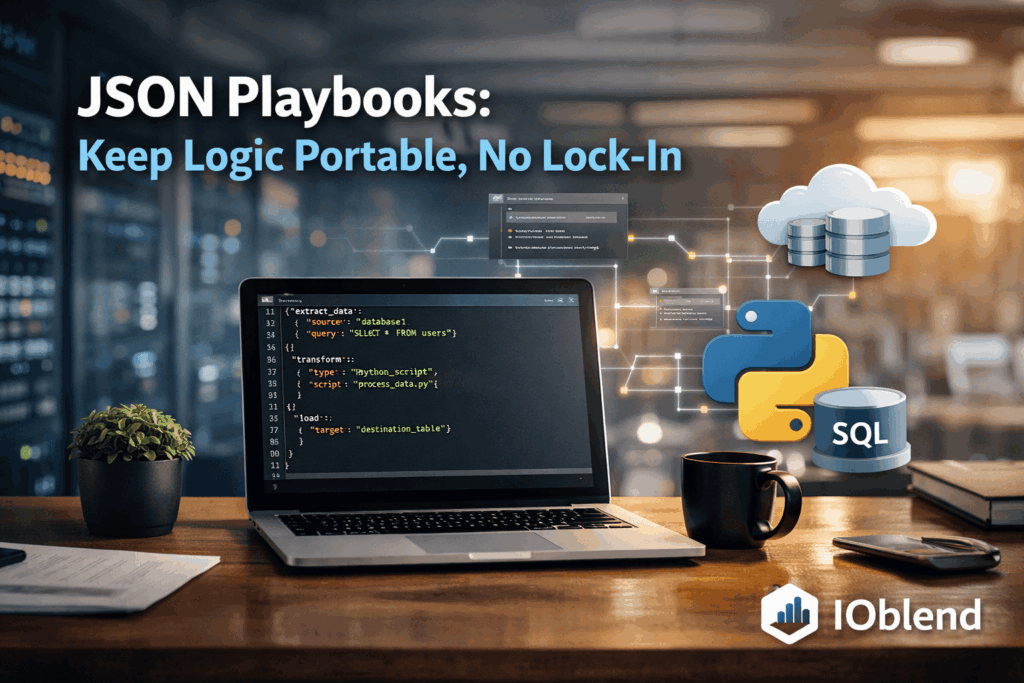

The End of Vendor Lock-in: Keeping your logic portable with IOblend’s JSON-based playbooks and Python/SQL core
💾 Did you know? The average enterprise now uses over 350 different data sources, yet nearly 70% of data leaders feel “trapped” by their infrastructure. Recent industry reports suggest that migrating a legacy data warehouse to a new provider can cost up to five times the original implementation price, primarily due to proprietary code conversion.
The Concept of Portable Logic
In the modern data stack, “vendor lock-in” is the invisible tether that binds your intellectual property, your business logic, to a specific service provider’s proprietary format. IOblend disrupts this cycle by decoupling the execution engine from the logic itself. By using a combination of universal SQL, standard Python, and JSON-based playbooks, IOblend ensures that your data pipelines remain platform-agnostic. Essentially, it treats your data integration as “living code” that can be moved, audited, and executed across different environments without a total rewrite.
The High Cost of Architectural Rigidity
For many organisations, the initial ease of “drag-and-drop” ETL tools eventually turns into a technical debt nightmare. When logic is stored in a vendor’s proprietary binary format or hidden behind a “black-box” GUI, the business loses its agility.
Data experts frequently encounter these friction points:
- The Migration Tax: Switching from one cloud provider to another often requires manual translation of thousands of stored procedures.
- Skill Gaps: Teams become specialists in a specific tool’s interface rather than the data itself, making it difficult to hire or pivot.
- Opaque Version Control: Proprietary tools often struggle with Git integration, making CI/CD pipelines fragile and difficult to peer-review.
The IOblend Solution: Portability by Design
IOblend solves these challenges by providing a developer-centric framework that prioritises transparency.
- JSON-Based Playbooks: Instead of opaque configurations, IOblend uses human-readable JSON playbooks to define pipeline stages. This means your entire workflow is documented in a standard format that can be version-controlled in Git and reviewed by any engineer.
- Python & SQL Core: By sticking to the industry-standard languages of data, SQL for transformations and Python for complex logic, IOblend ensures that your code remains your own. If you want to run a specific transformation elsewhere, the SQL block remains valid.
- Seamless Integration: IOblend’s approach allows you to build, run, and monitor pipelines at scale. By leveraging advanced metadata-driven automation, it eliminates the need for manual plumbing, allowing your team to focus on extracting value rather than managing infrastructure.
Future-proof your data strategy and break free from the shackles of legacy lock-in with IOblend.

Time to automate your airline’s DOC data
How to automate Direct Operating Cost (DOC) data collection, processing and serving with IOblend.

Automate airline fuel data collection & management
Collecting and managing airline fuel data is complex and time consuming. IOblend can greatly streamline the process and enable real-time decisioning.

The Data Mesh Gotchas!
I think most practitioners in the data world would agree that the core data mesh principles of decentralisation to improve data enablement are sound. Originally penned by Zhamak Dehghani, Data Mesh architecture is attracting a lot of attention, and rightly so. However, there is a growing concern in the data industry regarding how the data

IOblend Data Mesh
IOblend Data Mesh – power to the data people! Analyst engineering made simple Hello folks, IOblend here. Hope you are all keeping well. Companies are increasingly leaning towards self-service data authoring. Why, you ask? It is because the prevailing monolithic data architecture (no matter how advanced) does not condone an easy way to manage the

Data lineage is a “must have”, not “nice to have”
Hello folks, IOblend here. Hope you are all keeping well. There is one thing that has been bugging us recently, which led to the writing of this blog. While working on several data projects with some of our clients, we observed instances when data lineage had not been implemented as part of the solutions. In

Welcome to the IOblend blog
Welcome to the IOblend blog page. We are the creators of the IOblend real-time data integration and advanced DataOps solution. Over the many (many!) years, we have gained experience and insight from the world of data, especially in the data engineering and data management areas. Data challenges are everywhere and happen daily. We are sure,