
Lakehouse Quality Gates: Fail Fast Before Bad Data Lands
📋 Did You Know? Up to 20% of real-time event streams suffer from schema drift, duplicate payloads, or corrupted records, costing global organisations billions each year in wasted compute, broken analytical models, and polluted reporting layers.
The Concept: Stopping Bad Data at the Border
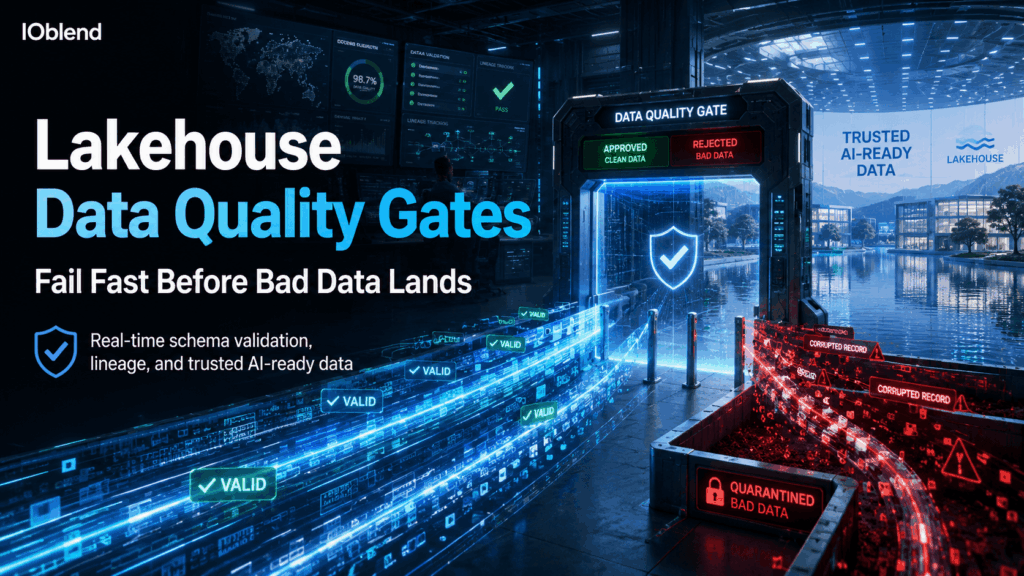
Lakehouse Quality Gates are automated, in-flight checkpoints that validate incoming data before it ever touches your Delta Lake, Apache Iceberg, or parquet tables.
Instead of landing messy payloads directly into bronze storage layers and spending expensive warehouse compute on post-hoc cleaning scripts, quality gates enforce schema rules, data types, and business expectations right at the ingestion boundary. If a record violates validation logic, it fails fast, gets quarantined for auditing, and leaves your downstream lakehouse completely pristine.
The Business Challenge: When Trash Lands in the Lake
Allowing unvalidated data to settle into a modern lakehouse creates a destructive blast radius across enterprise data platforms:
- Cascading Pipeline Failures: An upstream application deploy silently changes a JSON field from an integer to a string. Downstream Spark and dbt transformations fail hours later, derailing morning executive dashboards.
- Polluted Machine Learning Models: In MLOps pipelines, corrupted sensor telemetry or altered customer event schemas quietly skew feature stores, causing models to retrain on inaccurate feature vectors.
- Exorbitant Remediation Costs: Data engineers waste up to 70% of their bandwidth untangling schema drift, running manual backfills, and paying heavy cloud compute bills to purge corrupt storage partitions.
The Solution: Enforcing Quality Gates with IOblend
Operating as a next-generation data integration engine on Apache Spark, IOblend executes ultra-low-latency, in-flight data quality checks across real-time CDC, streaming, and batch workflows. Rather than babysitting a complex multi-tool stack, IOblend enables data teams to:
- Enforce Automated Data Contracts: Catch schema drift, missing fields, and type anomalies instantly, quarantining bad events at record level without crashing production streams.
- Maintain Record-Level Lineage & Observability: Track, audit, and debug data flows with built-in lineage, allowing engineers to pause, amend, or replay streams effortlessly.
- Slash Infrastructure Compute Costs: By shifting validation “to the left” before storage, IOblend eliminates unnecessary in-warehouse processing and cuts infrastructure spend by up to 50%.
- Standardise Portable Logic: Build production-grade pipelines using portable JSON playbooks with SQL or Python, scaling seamlessly to over 1,000,000 transactions per second.
Safeguard data products, and achieve full-throttle lakehouse quality with IOblend.

SCADA Streams to Reliability Analytics
Energy: SCADA Streams to Reliability Analytics 🔌 Did you know? The average modern wind turbine or smart substation generates roughly 1 to 2 terabytes of data every month. However, historically, less than 5% of that sensor data was actually used for decision-making. Most of it was simply discarded or “siloed” in SCADA systems, serving as a

Building Live ETA Pipelines for Fleet Operations
Logistics: Live ETA Prediction Pipelines from Fleet + Orders 🚚 Did you know? The “Last Mile” is famously the most expensive and inefficient part of the supply chain, often accounting for up to 53% of total shipping costs. The Evolution of Real-Time Logistics Live ETA (Estimated Time of Arrival) prediction pipelines represent the shift from reactive

DB2 CDC to Lakehouse Without Re-Platforming
From DB2 to Lakehouse: Real-Time CDC Without Re-Platforming 💻 Did you know? Mainframe systems like DB2 still process approximately 30 billion business transactions every single day. Despite the rush toward modern cloud architectures, the world’s most critical financial and logistical data often resides in these “legacy” environments, making them the silent engines of the global economy.

Real-Time Upserts: Deduping and Idempotency
Streaming Upserts Done Right: Deduping and Idempotency at Scale 💻 Did you know? In many high-velocity streaming environments, the “same” event can be sent or processed multiple times due to network retries or distributed system failures. The Art of the Upsert At its core, a streaming upsert (a portmanteau of “update” and “insert”) is the process of synchronising incoming data with an existing

Streaming Data Quality That Won’t Break Pipelines
Streaming Without the Sting: Data Quality Rules That Never Break the Flow 💻 Did you know? A single minute of downtime in a high-velocity streaming environment can result in the loss of millions of data points, potentially costing a business thousands of pounds in missed opportunities or regulatory fines. — Defining Resilient Streaming Quality Data quality in

Schema Drift: The Silent Killer of Data Pipelines
The Silent Pipeline Killer: Surviving Schema Drift in the Wild 📊 Did you know? In the early days of big data, a single column change in a source database could trigger a “data graveyard” effect, where downstream analytics remained broken for weeks. The silent pipeline killer Schema drift occurs when the structure of source data changes