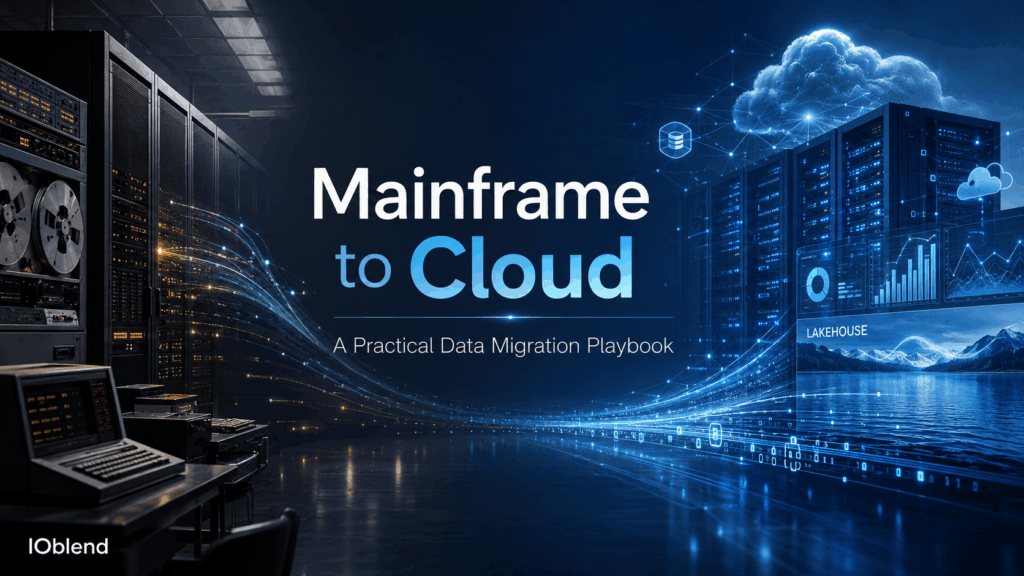

Mainframe to Cloud: A Practical Data Migration Playbook
💾 Did you know? An alarming 83% of data migrations fail outright or drastically overrun their budgets.
Shifting Mainframe Heavyweights to the Cloud
Mainframe-to-cloud data migration is the process of moving core legacy data assets, often stored in rigid formats like DB2, VSAM, or IMS, into modern cloud environments such as Databricks, Snowflake, or AWS. At its heart, this migration is not merely about moving storage bytes; it requires replicating complex, decades-old business logic and converting EBCDIC encodings into cloud-native formats without disrupting daily operational workflows.
The Friction Points of Legacy Architecture
When engineering a mainframe migration, teams consistently face severe bottlenecks. Legacy environments are notoriously opaque, making schema mapping and dependency tracking a manual nightmare. Furthermore, traditional migrations often rely on massive “big bang” cutovers that introduce unacceptable operational risks and system downtime.
Conversely, trying to run legacy and cloud systems in parallel usually triggers massive infrastructure costs and complex data drift, as standard ETL tools struggle to maintain real-time bidirectional synchronisation or handle high-throughput Change Data Capture (CDC) streams without crippling mainframe performance.
How IOblend Smooths the Migration Journey
This is where IOblend completely alters the migration playbook. Instead of forcing you to build a fragile, multi-tool stack, IOblend delivers a single, unified data integration application that standardises production pipelines on Apache Spark as portable JSON playbooks.
- Risk-Free Parallel Execution: IOblend allows you to de-risk your cloud migration by effortlessly running legacy and new systems in parallel. It handles real-time CDC and continuous data replication seamlessly, ensuring both systems remain synchronised without operational hitches.
- High-Throughput, Low-Latency Engine: Proven to handle over 1 million transactions per second with ultra-low P99 latency, IOblend processes massive mainframe batch runs and real-time streams without breaking a sweat.
- No Coding or Lock-In: Data teams can use a drag-and-drop designer to build event-driven pipelines. The system automatically generates optimised Spark jobs, using standard SQL or Python for complex transformations, ensuring your core logic remains entirely portable.
- End-to-End Observability: With record-level lineage, automated error handling, and visual debugging built in, you can trace data from its raw legacy roots right into the cloud lakehouse.
Don’t let legacy friction stall your modernisation strategy, turn your messy, scattered mainframe data into governed, cloud-ready gold by launching your migration with IOblend.

Agentic AI: The New Standard for ETL Governance
Autonomous Finance: Agentic AI as the New Standard for ETL Governance and Resilience 📌 Did You Know? Autonomous data quality agents deployed by leading financial institutions have been shown to proactively detect and correct up to 95% of critical data quality issues. The Agentic AI Concept Agentic Artificial Intelligence (AI) represents the progression beyond simple prompt-and-response

IOblend: Simplifying Feature Stores for Modern MLOps
IOblend: Simplifying Feature Stores for Modern MLOps Feature stores emerged to solve a real challenge in machine learning: managing features across models, maintaining consistency between training and inference, and ensuring proper governance. To meet this need, many solutions introduced new infrastructure layers—Redis, DynamoDB, Feast-style APIs, and others. While these tools provided powerful capabilities, they also

Rethinking the Feature Store concept for MLOps
Rethinking the Feature Store concept for MLOps Today we talk about Feature Stores. The recent Databricks acquisition of Tecton raised an interesting question for us: can we make a feature store work with any infra just as easily as a dedicated system using IOblend? Let’s have a look. How a Feature Store Works Today Machine

CRM + ERP: Powering Predictive Analytics
The Data-Driven Value Chain: Predictive Analytics with CRM and ERP 📊 Did you know? A study on real-time data integration platforms revealed that organisations can reduce their average response time to supply chain disruptions from 5.2 hours to just 37 minutes. A Unified Data Landscape The modern value chain is a complex ecosystem where every component is interconnected,

Enhancing Data Migrations with IOblend Agentic AI ETL
LeanData Optimising Cloud Migration: for Telecoms with Agentic AI ETL 📡 Did you know? The global telecommunications industry is projected to create over £120 billion in value from agentic AI by 2026. The Dawn of Agentic AI ETL For data experts in the telecoms sector, the term ETL—Extract, Transform, Load—is a familiar, if often laborious, process. It’s

LeanData: Reduce Data Waste & Boost Efficiency
LeanData Strategy: Reduce Data Waste & Boost Efficiency | IOblend 📊 Did you know? Globally, we generate around 50 million tonnes of e-waste every year. What is LeanData? LeanData is more than a passing trend — it’s a disciplined, results-focused approach to data management.At its core, LeanData means shifting from a “collect everything, sort it later” mentality to