The Invisible Erosion: Detecting and Managing Data Drift in Modern Architectures
📊 Did you know? According to recent industry surveys, over 70% of organisations experience significant data drift within the first six months of deploying a production system.
The Concept of Data Drift
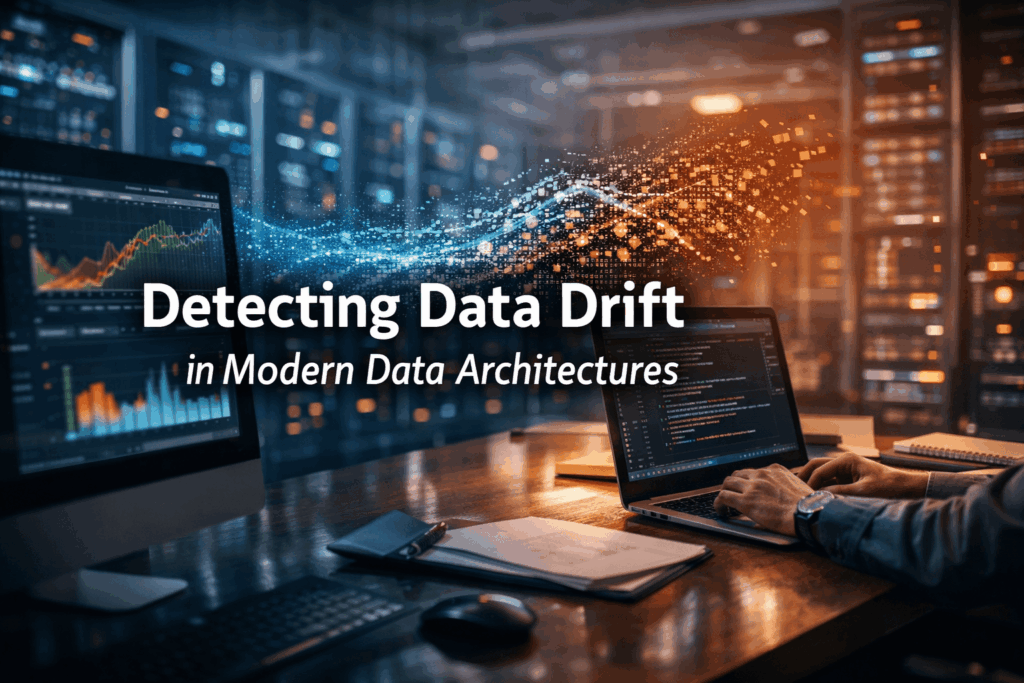
Data drift occurs when the statistical properties or the underlying structure of incoming data change over time. In a production pipeline, this isn’t necessarily a “bug” in the code; rather, it’s a shift in the reality the data represents. Imagine a retail pipeline where a “category” field suddenly receives new, undefined values because a supplier changed their system. The pipeline might continue to run, but your downstream analytics will now be missing crucial segments. Unlike a schema break, which crashes a job, drift is a sub-perceptual erosion of data quality that happens while your monitors are still showing “green”.
Issues Faced by Modern Businesses
For data-driven firms, undetected drift leads to “silent failures” that carry heavy costs.
- Decision Corruption: Executive dashboards might show a dip in performance that isn’t real, it’s just a change in how a source system labels “pending” versus “completed” transactions.
- Operational Friction: Automated supply chain triggers might fail to fire because the distribution of “stock levels” has shifted beyond the hard-coded thresholds set by engineers months ago.
- Resource Drain: Data teams often spend 80% of their time “firefighting”, manually tracing back data discrepancies to a source change that happened weeks prior.
How IOblend Solves the Drift Dilemma
Traditional tools treat drift as an afterthought, but IOblend embeds drift handling and technical governance into the very fabric of the pipeline. Built on a powerful Apache Spark™ engine and a Kappa architecture, IOblend provides a production-grade environment where data is managed throughout its entire journey.
- In-flight Quality Checks: IOblend applies data quality rules and statistical profiling in real-time. It doesn’t just move data; it validates it as it flows, catching anomalies before they land in your warehouse.
- Schema & Metadata Evolution: With built-in schema drift detection and automated metadata cataloguing, IOblend alerts you the moment a source structure changes, preventing downstream “data debt.”
- Record-Level Lineage: If drift is detected, IOblend’s automatic record-level lineage allows engineers to trace exactly where the deviation started, making debugging a matter of minutes rather than days.
- Agentic AI Integration: By embedding AI agents directly into the ETL stream, IOblend can intelligently validate and enrich data, identifying “visual drift” or conceptual shifts that traditional threshold-based monitors would miss.
Stop flying blind and start trusting your data again with IOblend.

BCBS 239 Compliance with Record-Level Lineage
Regulatory Compliance at Scale: Automating record-level lineage and audit trails for BCBS 239 📋 Did you know? In the wake of the 2008 financial crisis, the Basel Committee found that many global banks were unable to aggregate risk exposures accurately or quickly because their data landscapes were too complex. This led to the birth of BCBS

Real-Time Churn Agents with Closed-Loop MLOps
Churn Prevention: Building “closed-loop” MLOps systems that predict churn and trigger automated retention agents 🔗 Did you know? In the telecommunications and subscription-based sectors, a mere 5% increase in customer retention can lead to a staggering profit surge of more than 25%. Closed-Loop MLOps A “closed-loop” MLOps system is an advanced architectural pattern that transcends simple predictive analytics. While

Streaming Predictive MX: Drift-Aware Inference
Predictive Maintenance 2.0: Feeding real-time sensor drifts directly into inference models using streaming engine 🔩 Did you know? The cost of unplanned downtime for industrial manufacturers is estimated at nearly £400 billion annually. Predictive Maintenance 2.0: The Real-Time Evolution Predictive Maintenance 2.0 represents a paradigm shift from batch-processed diagnostics to live, autonomous synchronisation. In the traditional 1.0

Beyond Micro-Batching: Continuous Streaming for AI
Beyond Micro-batching: Why Continuous Streaming Engine is the Future of “Fresh Data” for AI 💻 Did you know? Most modern “real-time” AI applications are actually running on data that is already several minutes old. Traditional micro-batching collects data into small chunks before processing it, introducing a “latency tax” that can render predictive models obsolete before they

ERP Cloud Migration With Live Data Sync
Seamless Core System Migration: The Move of Large-Scale Banking and Insurance ERP Data to a Modern Cloud Architecture ⛅ Did you know that core system migrations in large financial institutions, which typically rely on manual data mapping and validation, often require parallel runs lasting over 18 months? The Core Challenge The migration of multi-terabyte ERP and

Legacy ERP Integration to Modern Data Fabric
Warehouse Automation Efficiency: Migrating and Integrating Legacy ERP Data into a Modern Big Data Ecosystem 📦 Did you know? Analysts estimate that warehouses leveraging robust, real-time data integration see inventory accuracy improvements of up to 99%. The Convergence of WMS and Big Data Data professionals in logistics face a profound challenge extracting mission-critical operational data such