

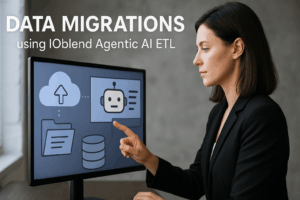

Enhancing Data Migrations with IOblend Agentic AI ETL
LeanData Optimising Cloud Migration: for Telecoms with Agentic AI ETL 📡 Did you know? The global telecommunications industry is projected to create over £120 billion in value from agentic AI by 2026. The Dawn of Agentic AI ETL For data experts in the telecoms sector, the term ETL—Extract, Transform, Load—is a familiar, if often laborious, process. It’s

LeanData: Reduce Data Waste & Boost Efficiency
LeanData Strategy: Reduce Data Waste & Boost Efficiency | IOblend 📊 Did you know? Globally, we generate around 50 million tonnes of e-waste every year. What is LeanData? LeanData is more than a passing trend — it’s a disciplined, results-focused approach to data management.At its core, LeanData means shifting from a “collect everything, sort it later” mentality to

The Data Deluge: Are You Ready?
The Data Deluge: Are You Ready? 📰 Did you know? Some modern data centres are being designed with modularity in mind, allowing them to expand upwards – effectively “raising the roof” – to accommodate future increases in data demand without significant structural overhauls. — Raising the data roof refers to designing and implementing a data

The Proactive Shift: Harnessing Data to Transform Healthcare
The Proactive Shift: Harnessing Data to Transform Healthcare Outcomes 🔔 Did You Know? According to the National Institutes of Health, the implementation of data analytics in healthcare settings can reduce hospital readmissions by over 33%. The Proactive Healthcare Paradigm The healthcare industry has traditionally operated on a reactive model, where intervention occurs only after symptoms manifest

PoC to Production: Accelerating AI Deployment with IOblend
PoC to Production: Accelerating AI Deployment with IOblend 💭 Did You Know? While a staggering 92% of companies are actively experimenting with Artificial Intelligence, a mere 1% ever achieve full maturity in deploying AI solutions at scale. The AI Production Journey A Proof of Concept (PoC) in AI serves as a small-scale, experimental project designed

AI in Healthcare with Smart Data Pipelines
AI in Healthcare: Powering Progress with Smart Data Pipelines 💉 Did you know? Hospitals in the UK alone produce an astonishing 50 petabytes of data per year, more than double the data managed by the US Library of Congress in 2022! What are Data Pipelines for AI Model Training? In the context of healthcare, this means
