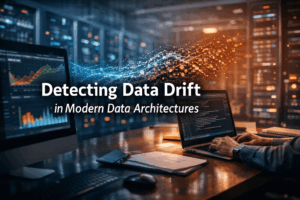
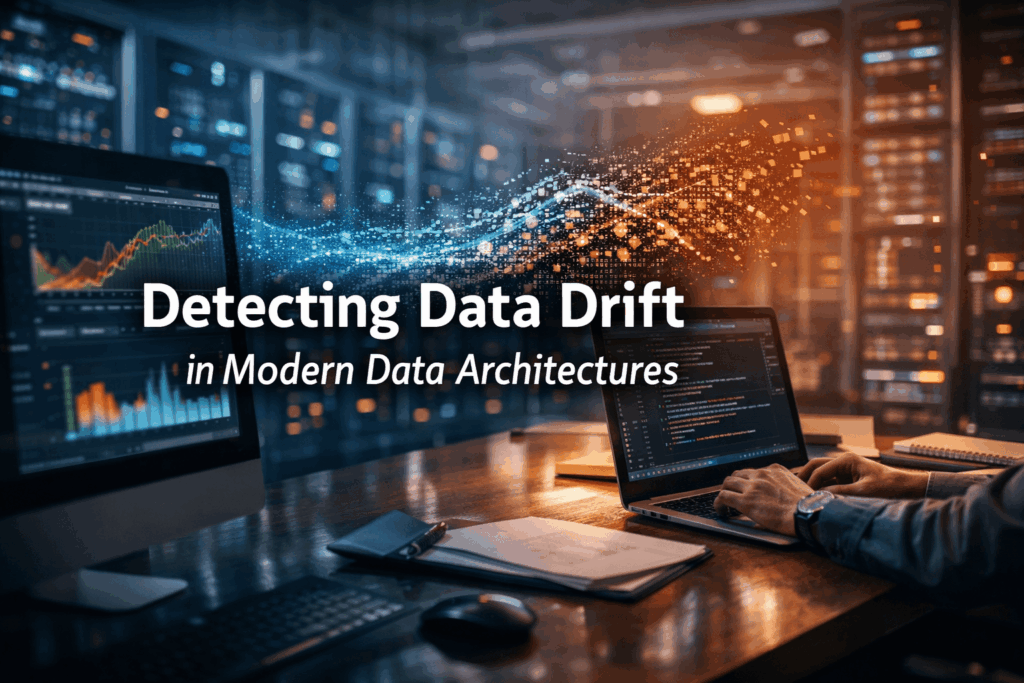
The Invisible Erosion: Detecting and Managing Data Drift in Modern Architectures
📊 Did you know? According to recent industry surveys, over 70% of organisations experience significant data drift within the first six months of deploying a production system.
The Concept of Data Drift
Data drift occurs when the statistical properties or the underlying structure of incoming data change over time. In a production pipeline, this isn’t necessarily a “bug” in the code; rather, it’s a shift in the reality the data represents. Imagine a retail pipeline where a “category” field suddenly receives new, undefined values because a supplier changed their system. The pipeline might continue to run, but your downstream analytics will now be missing crucial segments. Unlike a schema break, which crashes a job, drift is a sub-perceptual erosion of data quality that happens while your monitors are still showing “green”.
Issues Faced by Modern Businesses
For data-driven firms, undetected drift leads to “silent failures” that carry heavy costs.
- Decision Corruption: Executive dashboards might show a dip in performance that isn’t real, it’s just a change in how a source system labels “pending” versus “completed” transactions.
- Operational Friction: Automated supply chain triggers might fail to fire because the distribution of “stock levels” has shifted beyond the hard-coded thresholds set by engineers months ago.
- Resource Drain: Data teams often spend 80% of their time “firefighting”, manually tracing back data discrepancies to a source change that happened weeks prior.
How IOblend Solves the Drift Dilemma
Traditional tools treat drift as an afterthought, but IOblend embeds drift handling and technical governance into the very fabric of the pipeline. Built on a powerful Apache Spark™ engine and a Kappa architecture, IOblend provides a production-grade environment where data is managed throughout its entire journey.
- In-flight Quality Checks: IOblend applies data quality rules and statistical profiling in real-time. It doesn’t just move data; it validates it as it flows, catching anomalies before they land in your warehouse.
- Schema & Metadata Evolution: With built-in schema drift detection and automated metadata cataloguing, IOblend alerts you the moment a source structure changes, preventing downstream “data debt.”
- Record-Level Lineage: If drift is detected, IOblend’s automatic record-level lineage allows engineers to trace exactly where the deviation started, making debugging a matter of minutes rather than days.
- Agentic AI Integration: By embedding AI agents directly into the ETL stream, IOblend can intelligently validate and enrich data, identifying “visual drift” or conceptual shifts that traditional threshold-based monitors would miss.
Stop flying blind and start trusting your data again with IOblend.

Real-Time Risk Modelling with Legacy & Modern Data
Risk Modelling in Real-time: Integrating Legacy Oracle/HP Underwriting Data with Modern External Datasets 💼 Did you know that in the time it takes to brew a cup of tea, a real-time risk model could have processed enough data to flag over 60 million potential fraudulent insurance claims? The Real-Time Risk Modelling Imperative Real-time risk modelling is

Unify Clinical & Financial Data to Cut Readmissions
Clinical-Financial Synergy: The Seamless Integration of Clinical and Financial Data to Minimise Readmissions 🚑 Did You Know? Unnecessary hospital readmissions within 30 days represent a colossal financial burden, often reflecting suboptimal transitional care. Clinical-Financial Synergy: The Seamless Integration of Clinical and Financial Data to Minimise Readmissions The Convergence of Clinical and Financial Data The convergence of clinical and financial

Agentic Pipelines and Real-Time Data with Guardrails
The New Era of ETL: Agentic Pipelines and Real-Time Data with Guardrails For years, ETL meant one thing — moving and transforming data in predictable, scheduled batches, often using a multitude of complementary tools. It was practical, reliable, and familiar. But in 2025, well, that’s no longer enough. Let’s have a look at the shift

Real-Time Insurance Claims with CDC and Spark
From Batch to Real-Time: Accelerating Insurance Claims Processing with CDC and Spark 💼 Did you know? In the insurance sector, the move from overnight batch processing to real-time stream processing has been shown to reduce the average claims settlement time from several days to under an hour in highly automated systems. Real-Time Data and Insurance

Agentic AI: The New Standard for ETL Governance
Autonomous Finance: Agentic AI as the New Standard for ETL Governance and Resilience 📌 Did You Know? Autonomous data quality agents deployed by leading financial institutions have been shown to proactively detect and correct up to 95% of critical data quality issues. The Agentic AI Concept Agentic Artificial Intelligence (AI) represents the progression beyond simple prompt-and-response

IOblend: Simplifying Feature Stores for Modern MLOps
IOblend: Simplifying Feature Stores for Modern MLOps Feature stores emerged to solve a real challenge in machine learning: managing features across models, maintaining consistency between training and inference, and ensuring proper governance. To meet this need, many solutions introduced new infrastructure layers—Redis, DynamoDB, Feast-style APIs, and others. While these tools provided powerful capabilities, they also