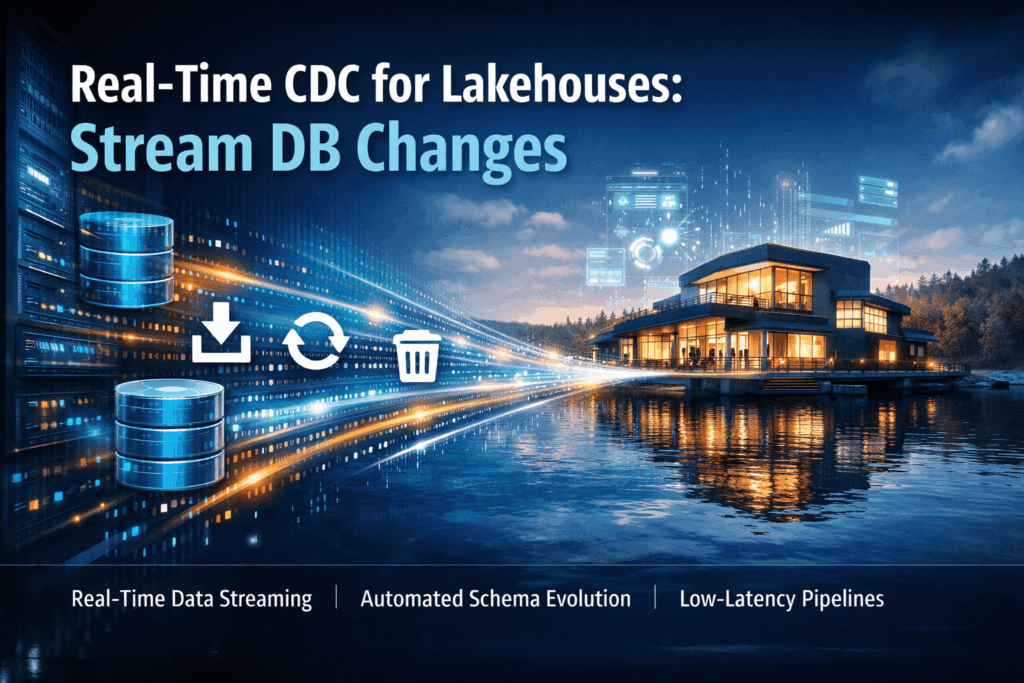

Zero-Lag Operations: Stream Database Changes to Your Lakehouse
💾 Did you know? The “data downtime” caused by traditional batch processing costs the average enterprise approximately £12,000 per minute.
The Concept: Moving at the Speed of Change
Zero-lag operations rely on a transition from periodic “snapshots” to continuous “streams.” Instead of moving massive blocks of data at midnight, modern architectures capture every insert, update, or delete in a source database the moment it happens. This approach, often powered by Change Data Capture (CDC), ensures that your Data Lakehouse remains a living, breathing mirror of your operational systems. It transforms the Lakehouse from a historical archive into a real-time engine for decision-making.
The Friction: Why Legacy Integration Fails
Most organisations still grapple with the “Batch Trap.” Traditional ETL (Extract, Transform, Load) processes are inherently high-latency. When a customer updates their profile or a stock level changes in a relational database, that information often sits stagnant until the next scheduled sync.
This delay creates several critical issues:
- Stale Insights: Data scientists build models on “yesterday’s news,” leading to inaccurate forecasting.
- Operational Fragility: Massive batch windows put immense pressure on source systems, often slowing down production databases during peak hours.
- Complex Transformation: Mapping changing relational schemas to a flat Lakehouse structure manually is a recipe for broken pipelines and inconsistent metadata.
How IOblend Solves the Latency Gap
Bridging the gap between operational databases and a Lakehouse requires more than just a fast pipe; it requires an intelligent execution engine. IOblend addresses these challenges by replacing complex, hand-coded pipelines with a streamlined, “Zero-Lag” framework.
- Real-Time Data Streaming: IOblend moves beyond legacy batching, allowing for continuous data flow from any source to your Lakehouse with minimal latency.
- Automated Schema Evolution: One of the biggest headaches in database streaming is schema drift. IOblend automatically detects and handles changes in the source database, ensuring your Lakehouse tables stay synchronised without manual intervention.
- Advanced Data Engineering: Built on a powerful Spark-based engine, IOblend allows you to perform complex transformations on the fly as data streams in, rather than waiting until it lands.
- Multi-Cloud Agility: Whether your Lakehouse sits on Azure, AWS, or GCP, IOblend provides a unified interface to manage these streams, reducing the “vendor lock-in” often found in native cloud tools.
Stop waiting for your data to catch up, achieve true operational synchronicity with IOblend.

Building Live ETA Pipelines for Fleet Operations
Logistics: Live ETA Prediction Pipelines from Fleet + Orders 🚚 Did you know? The “Last Mile” is famously the most expensive and inefficient part of the supply chain, often accounting for up to 53% of total shipping costs. The Evolution of Real-Time Logistics Live ETA (Estimated Time of Arrival) prediction pipelines represent the shift from reactive

DB2 CDC to Lakehouse Without Re-Platforming
From DB2 to Lakehouse: Real-Time CDC Without Re-Platforming 💻 Did you know? Mainframe systems like DB2 still process approximately 30 billion business transactions every single day. Despite the rush toward modern cloud architectures, the world’s most critical financial and logistical data often resides in these “legacy” environments, making them the silent engines of the global economy.

Real-Time Upserts: Deduping and Idempotency
Streaming Upserts Done Right: Deduping and Idempotency at Scale 💻 Did you know? In many high-velocity streaming environments, the “same” event can be sent or processed multiple times due to network retries or distributed system failures. The Art of the Upsert At its core, a streaming upsert (a portmanteau of “update” and “insert”) is the process of synchronising incoming data with an existing

Streaming Data Quality That Won’t Break Pipelines
Streaming Without the Sting: Data Quality Rules That Never Break the Flow 💻 Did you know? A single minute of downtime in a high-velocity streaming environment can result in the loss of millions of data points, potentially costing a business thousands of pounds in missed opportunities or regulatory fines. — Defining Resilient Streaming Quality Data quality in

Schema Drift: The Silent Killer of Data Pipelines
The Silent Pipeline Killer: Surviving Schema Drift in the Wild 📊 Did you know? In the early days of big data, a single column change in a source database could trigger a “data graveyard” effect, where downstream analytics remained broken for weeks. The silent pipeline killer Schema drift occurs when the structure of source data changes

Preventing Data Drift in Modern Data Systems
The Invisible Erosion: Detecting and Managing Data Drift in Modern Architectures 📊 Did you know? According to recent industry surveys, over 70% of organisations experience significant data drift within the first six months of deploying a production system. The Concept of Data Drift Data drift occurs when the statistical properties or the underlying structure of incoming data change