
AW-10865990051

SCADA Streams to Reliability Analytics

SCADA streams with IOblend

Energy: SCADA Streams to Reliability Analytics 

🔌 Did you know? The average modern wind turbine or smart substation generates roughly 1 to 2 terabytes of data every month. However, historically, less than 5% of that sensor data was actually used for decision-making. Most of it was simply discarded or “siloed” in SCADA systems, serving as a digital graveyard rather than a source of operational intelligence. 

From Streams to Insights 

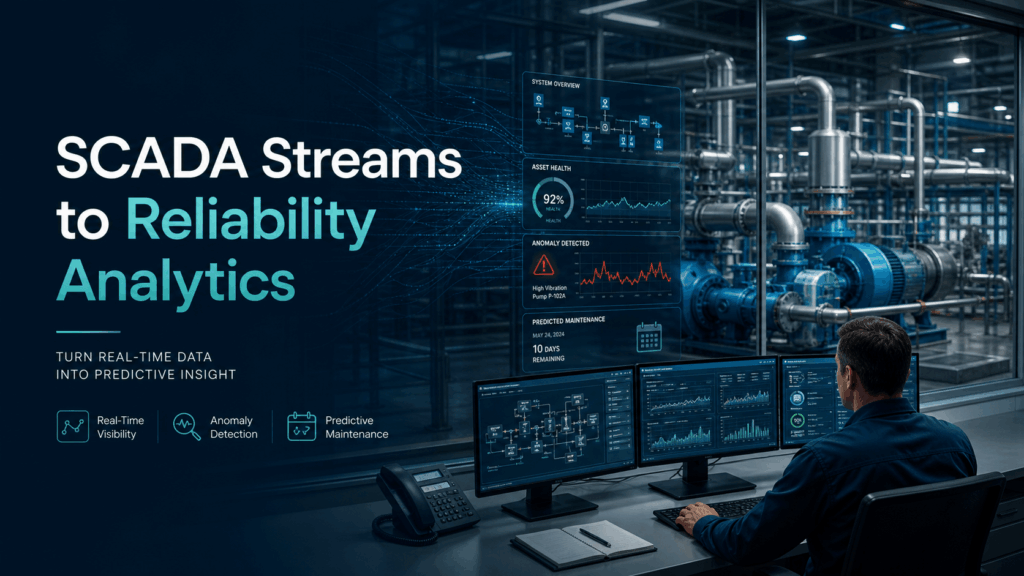
At its core, the transition from SCADA (Supervisory Control and Data Acquisition) streams to reliability analytics is about turning raw telemetry into foresight. SCADA systems are excellent at real-time monitoring, telling you if a breaker is open or a turbine is spinning. Reliability analytics, however, looks at the “health” of the asset over time. It consumes high-frequency streams of temperature, vibration, and voltage to predict when a component will fail before it actually does, moving the industry from reactive repairs to proactive maintenance.

The Data Engineering Bottleneck 

For most energy providers, the hurdle isn’t a lack of data, but the sheer complexity of moving it. SCADA data is notoriously difficult to work with; it often arrives in proprietary formats, via slow polling intervals, or through legacy protocols that don’t play well with modern cloud environments.  

Data teams face “The Three Silos”: 

  • Format Fragmentation: Mixing time-series data from sensors with relational data from Enterprise Asset Management (EAM) systems. 
  • Latency Gaps: By the time a data engineer builds a manual pipeline to clean the SCADA noise, the “real-time” window for preventing a transformer blowout has already closed. 
  • Governance Debt: Ensuring that sensitive grid data remains encrypted and compliant while moving across pipelines is often a manual, error-prone process. 

How IOblend Turns SCADA Data Into Operational Foresight

This is where IOblend changes the economics of reliability analytics. Most energy data projects do not fail because the analytics models are weak. They fail because the data arrives late, fragmented, poorly governed, or trapped inside legacy SCADA and operational systems.

IOblend removes that bottleneck by turning complex data engineering into reusable, controlled pipeline logic. Instead of spending months hand-coding fragile ETL jobs for every new asset, site, protocol, or system, teams can build governed, repeatable data flows that move SCADA telemetry, asset records, maintenance data, and operational events into analytics-ready environments faster.

  • Real-time streams, not stale snapshots
    IOblend supports real-time and event-driven ingestion, including CDC and streaming patterns, so reliability models can work from current operational signals rather than yesterday’s batch exports. That matters when the difference between prevention and failure is measured in minutes, not reporting cycles.
  • SCADA plus context, not SCADA in isolation
    Raw sensor data alone rarely explains asset risk. IOblend helps combine high-frequency SCADA streams with enterprise data from EAM, ERP, maintenance logs, inspections, and operational systems, giving reliability teams the full context behind performance degradation, recurring faults, and early warning patterns.
  • Governed pipelines by design
    Critical infrastructure data needs control, traceability, and security from the start. IOblend brings governance into the pipeline layer with validation, lineage, exception handling, and privacy-aware controls, so teams can scale analytics without creating a shadow estate of unmanaged scripts and risky data movement.
  • Built for change, not brittle integrations
    Energy environments change constantly: new assets, new schemas, new sensors, new reporting requirements, and new analytics platforms. IOblend’s metadata-driven architecture makes pipeline logic reusable and easier to adapt, reducing the cost of change compared with hard-coded integrations.
  • Flexible across modern data platforms
    Whether the target is Spark, Snowflake, Databricks, a lakehouse, warehouse, or operational analytics layer, IOblend provides a controlled framework for building and executing pipelines without locking teams into one rigid architecture.

The result is a faster path from SCADA visibility to reliability intelligence: fewer brittle pipelines, less manual engineering, stronger governance, and analytics teams that can focus on preventing failures instead of constantly repairing the data layer.

Ready to stop managing pipelines and start mastering reliability? Supercharge your energy data strategy with IOblend. 

IOblend: See more. Do more. Deliver better.

AI
admin

Real-Time Defect Detection with Agentic AI + ETL

Smart Quality Control: Embedding Agentic AI into ETL pipelines to visually inspect and categorise production defects  🔩 Did you know? “visual drift” in manual quality control can lead to a 20% drop in defect detection accuracy over a single eight-hour shift  The Concept: Agentic AI in the ETL Stream Traditional ETL (Extract, Transform, Load) has long been the

Read More »
AI
admin

Agentic AI ETL for Real-Time Sentiment Pricing

Sentiment-Driven Pricing: Using Agentic AI ETL to scrape social sentiment and adjust prices dynamically within the data flow  🤖 Did you know? A single viral tweet or a trending TikTok “dupe” video can alter the perceived value of a product by over 40% in less than six hours. Traditional pricing engines, which rely on historical sales

Read More »
AI
admin

BCBS 239 Compliance with Record-Level Lineage

Regulatory Compliance at Scale: Automating record-level lineage and audit trails for BCBS 239  📋 Did you know? In the wake of the 2008 financial crisis, the Basel Committee found that many global banks were unable to aggregate risk exposures accurately or quickly because their data landscapes were too complex. This led to the birth of BCBS

Read More »
AI
admin

Real-Time Churn Agents with Closed-Loop MLOps

Churn Prevention: Building “closed-loop” MLOps systems that predict churn and trigger automated retention agents  🔗 Did you know? In the telecommunications and subscription-based sectors, a mere 5% increase in customer retention can lead to a staggering profit surge of more than 25%.  Closed-Loop MLOps A “closed-loop” MLOps system is an advanced architectural pattern that transcends simple predictive analytics. While

Read More »
Predicitve_Maintenance_IOblend
AI
admin

Streaming Predictive MX: Drift-Aware Inference

Predictive Maintenance 2.0: Feeding real-time sensor drifts directly into inference models using streaming engine  🔩 Did you know? The cost of unplanned downtime for industrial manufacturers is estimated at nearly £400 billion annually.  Predictive Maintenance 2.0: The Real-Time Evolution  Predictive Maintenance 2.0 represents a paradigm shift from batch-processed diagnostics to live, autonomous synchronisation. In the traditional 1.0

Read More »
AI
admin

Beyond Micro-Batching: Continuous Streaming for AI

Beyond Micro-batching: Why Continuous Streaming Engine is the Future of “Fresh Data” for AI  💻 Did you know? Most modern “real-time” AI applications are actually running on data that is already several minutes old. Traditional micro-batching collects data into small chunks before processing it, introducing a “latency tax” that can render predictive models obsolete before they

Read More »
Scroll to Top