AW-10865990051

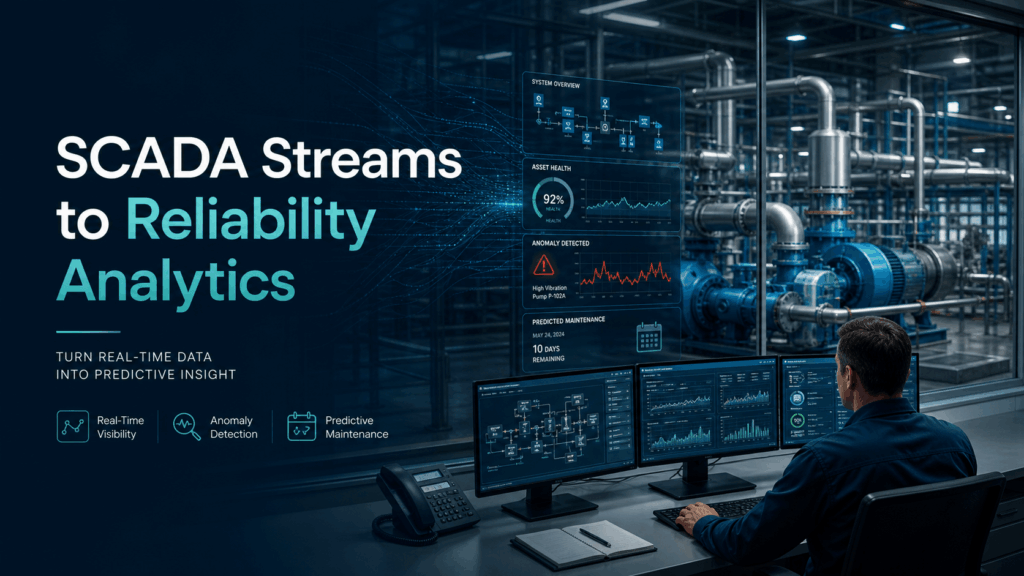
SCADA Streams to Reliability Analytics

SCADA streams with IOblend

Energy: SCADA Streams to Reliability Analytics 

🔌 Did you know? The average modern wind turbine or smart substation generates roughly 1 to 2 terabytes of data every month. However, historically, less than 5% of that sensor data was actually used for decision-making. Most of it was simply discarded or “siloed” in SCADA systems, serving as a digital graveyard rather than a source of operational intelligence. 

From Streams to Insights 

At its core, the transition from SCADA (Supervisory Control and Data Acquisition) streams to reliability analytics is about turning raw telemetry into foresight. SCADA systems are excellent at real-time monitoring, telling you if a breaker is open or a turbine is spinning. Reliability analytics, however, looks at the “health” of the asset over time. It consumes high-frequency streams of temperature, vibration, and voltage to predict when a component will fail before it actually does, moving the industry from reactive repairs to proactive maintenance.

The Data Engineering Bottleneck 

For most energy providers, the hurdle isn’t a lack of data, but the sheer complexity of moving it. SCADA data is notoriously difficult to work with; it often arrives in proprietary formats, via slow polling intervals, or through legacy protocols that don’t play well with modern cloud environments.  

Data teams face “The Three Silos”: 

  • Format Fragmentation: Mixing time-series data from sensors with relational data from Enterprise Asset Management (EAM) systems. 
  • Latency Gaps: By the time a data engineer builds a manual pipeline to clean the SCADA noise, the “real-time” window for preventing a transformer blowout has already closed. 
  • Governance Debt: Ensuring that sensitive grid data remains encrypted and compliant while moving across pipelines is often a manual, error-prone process. 

How IOblend Turns SCADA Data Into Operational Foresight

This is where IOblend changes the economics of reliability analytics. Most energy data projects do not fail because the analytics models are weak. They fail because the data arrives late, fragmented, poorly governed, or trapped inside legacy SCADA and operational systems.

IOblend removes that bottleneck by turning complex data engineering into reusable, controlled pipeline logic. Instead of spending months hand-coding fragile ETL jobs for every new asset, site, protocol, or system, teams can build governed, repeatable data flows that move SCADA telemetry, asset records, maintenance data, and operational events into analytics-ready environments faster.

  • Real-time streams, not stale snapshots
    IOblend supports real-time and event-driven ingestion, including CDC and streaming patterns, so reliability models can work from current operational signals rather than yesterday’s batch exports. That matters when the difference between prevention and failure is measured in minutes, not reporting cycles.
  • SCADA plus context, not SCADA in isolation
    Raw sensor data alone rarely explains asset risk. IOblend helps combine high-frequency SCADA streams with enterprise data from EAM, ERP, maintenance logs, inspections, and operational systems, giving reliability teams the full context behind performance degradation, recurring faults, and early warning patterns.
  • Governed pipelines by design
    Critical infrastructure data needs control, traceability, and security from the start. IOblend brings governance into the pipeline layer with validation, lineage, exception handling, and privacy-aware controls, so teams can scale analytics without creating a shadow estate of unmanaged scripts and risky data movement.
  • Built for change, not brittle integrations
    Energy environments change constantly: new assets, new schemas, new sensors, new reporting requirements, and new analytics platforms. IOblend’s metadata-driven architecture makes pipeline logic reusable and easier to adapt, reducing the cost of change compared with hard-coded integrations.
  • Flexible across modern data platforms
    Whether the target is Spark, Snowflake, Databricks, a lakehouse, warehouse, or operational analytics layer, IOblend provides a controlled framework for building and executing pipelines without locking teams into one rigid architecture.

The result is a faster path from SCADA visibility to reliability intelligence: fewer brittle pipelines, less manual engineering, stronger governance, and analytics teams that can focus on preventing failures instead of constantly repairing the data layer.

Ready to stop managing pipelines and start mastering reliability? Supercharge your energy data strategy with IOblend. 

IOblend: See more. Do more. Deliver better.

Drift-detection-in-data-systems-IOblend
AI
admin

Preventing Data Drift in Modern Data Systems

The Invisible Erosion: Detecting and Managing Data Drift in Modern Architectures  📊 Did you know? According to recent industry surveys, over 70% of organisations experience significant data drift within the first six months of deploying a production system.  The Concept of Data Drift  Data drift occurs when the statistical properties or the underlying structure of incoming data change

Read More »
CDC-steam-to-lakehouses-IOblend
AI
admin

Stream Database Changes to Your Lakehouse with CDC

Zero-Lag Operations: Stream Database Changes to Your Lakehouse  💾 Did you know? The “data downtime” caused by traditional batch processing costs the average enterprise approximately £12,000 per minute.  The Concept: Moving at the Speed of Change  Zero-lag operations rely on a transition from periodic “snapshots” to continuous “streams.” Instead of moving massive blocks of data at

Read More »
IOblend_Salesforce_CDC_sync_Snowflake
AI
admin

Real-Time Salesforce CDC to Snowflake

Real-Time CDC: Keep Salesforce and Snowflake in Perfect Sync 🔎 Did you know? While many businesses still rely on nightly batch windows to move CRM data, Salesforce generates millions of events every hour. The Concept: Real-Time CDC Real-Time Change Data Capture (CDC) is a software design pattern used to determine and track data that has

Read More »
Attachment Details IOblend_production_grade_data_pipelines_no_scala
AI
admin

Build Production Spark Pipelines—No Scala Needed

Democratising Spark: How IOblend enables Data Analysts to build production-grade Spark pipelines without writing Scala or Java   Did You Know? The average enterprise now manages over 350 different data sources, yet nearly 70% of data leaders report feeling “trapped” by their own infrastructure.    The Concept: Democratising the Spark Engine  At its core, Apache Spark is a lightning-fast, distributed computing

Read More »
IOblend-portable-JSON-SQL-and-Python
AI
admin

IOblend vs Vendor Lock-In: Portable JSON + Python + SQL

The End of Vendor Lock-in: Keeping your logic portable with IOblend’s JSON-based playbooks and Python/SQL  💾 Did you know? The average enterprise now uses over 350 different data sources, yet nearly 70% of data leaders feel “trapped” by their infrastructure. Recent industry reports suggest that migrating a legacy data warehouse to a new provider can

Read More »
AI
admin

IOblend JSON Playbooks: Keep Logic Portable, No Lock-In

The End of Vendor Lock-in: Keeping your logic portable with IOblend’s JSON-based playbooks and Python/SQL core 💾 Did you know? The average enterprise now uses over 350 different data sources, yet nearly 70% of data leaders feel “trapped” by their infrastructure. Recent industry reports suggest that migrating a legacy data warehouse to a new provider can

Read More »
Scroll to Top