
Schema Evolution Without Chaos: Strong Data Contracts Enforced In Pipelines
📋 Did you know? In the early days of big data, a single altered column in a production database could trigger a catastrophic “data graveyard” effect.
The Concept of Schema Evolution
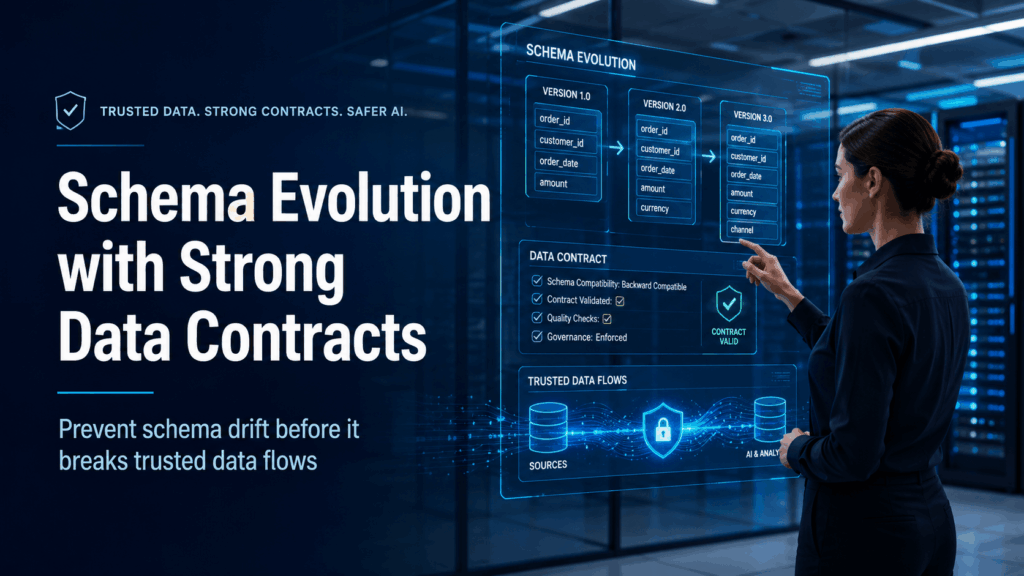
Schema evolution is the ability of a data platform to gracefully adapt to structural changes in incoming data, such as added, renamed, or dropped columns, without failing or corrupting existing datasets. In modern data lakehouses, this is achieved by moving away from rigid, hard-coded structures and adopting strong data contracts. These contracts act as explicit, enforceable agreements between data producers and consumers, ensuring that any structural evolution happens safely, predictably, and without manual pipeline intervention.
The Brittle Reality of Schema Drift
When organizations scale their data operations, they inevitably face schema drift. As upstream applications evolve, their underlying data models change. Without strict enforcement mechanisms, these changes ripple through to the data lake and such, causing severe operational pain:
- Broken Downstream Applications: A sudden alteration in a source database column type instantly breaks downstream machine learning models and business intelligence dashboards.
- The “Silent Failure” Dilemma: Pipelines often do not crash; they simply ingest malformed data, poisoning clean tables and rendering historical reports inaccurate.
- Engineering Bottlenecks: Data engineers spend more time writing defensive error-handling code and manually patching broken pipelines than building new data products.
Mastering Schema Evolution with IOblend
Managing schema evolution manually is a losing battle, but IOblend completely automates this operational challenge. Built with advanced DataOps capabilities, IOblend turns complex Apache Spark™ engine management into simple, metadata-driven pipelines that handle structure changes out of the box.
- Dynamic Schema Generation & Versioning: IOblend automatically generates schemas based on incoming data streams. It tracks and versions schema changes over time, maintaining full backward compatibility.
- Automatic Schema Validation: Every incoming batch or stream is checked against predefined contracts. If data deviates catastrophically, IOblend prevents ingestion, keeping your target tables clean.
- Automated Error Isolation: Rather than crashing the pipeline, invalid records are automatically channelled into a dedicated error table for isolation and automated debugging, while valid data continues to flow smoothly.
- Record-Level Lineage: If a drift event occurs, IOblend tracks exact record-level lineage and metadata, allowing engineers to instantly see what changed, what it impacted, and how to address it.
Eliminate data downtime and secure your data platform against schema drift.

The ERP Shortcut: How to Integrate Faster Than You Think
IOblend was designed with one mission in mind: to simplify data integration. We deliver complex, real-time multi-system syncing with ERP in under a week.

IOblend seamlessly powers real-time multi-system integration
The adoption of IOblend significantly improved our data transformation capabilities, allowing for efficient and secure data integration between multiple systems

The AI Hype Trap: Why Overblown Promises Backfire
AI and GenAI adoption must make a visible and material positive impact on the business or it’s a waste of money.

The Art of Assembly: Where Data Meets Conveyors
Manufacturing is all about getting the most out of automation, skilled workforce, and data. Data helps drive the decisions that keep everything running smoothly

Saving Cents on Data Sense: Less Cost, More Value
No company is immune from the pains of data integration. It is one of the top IT cost items. Companies must get on top of their integration effort.

Operational Analytics: Real-Time Insights That Matter
Operational analytics involves processing and analysing operational data in “real-time” to gain insights that inform immediate and actionable decisions.