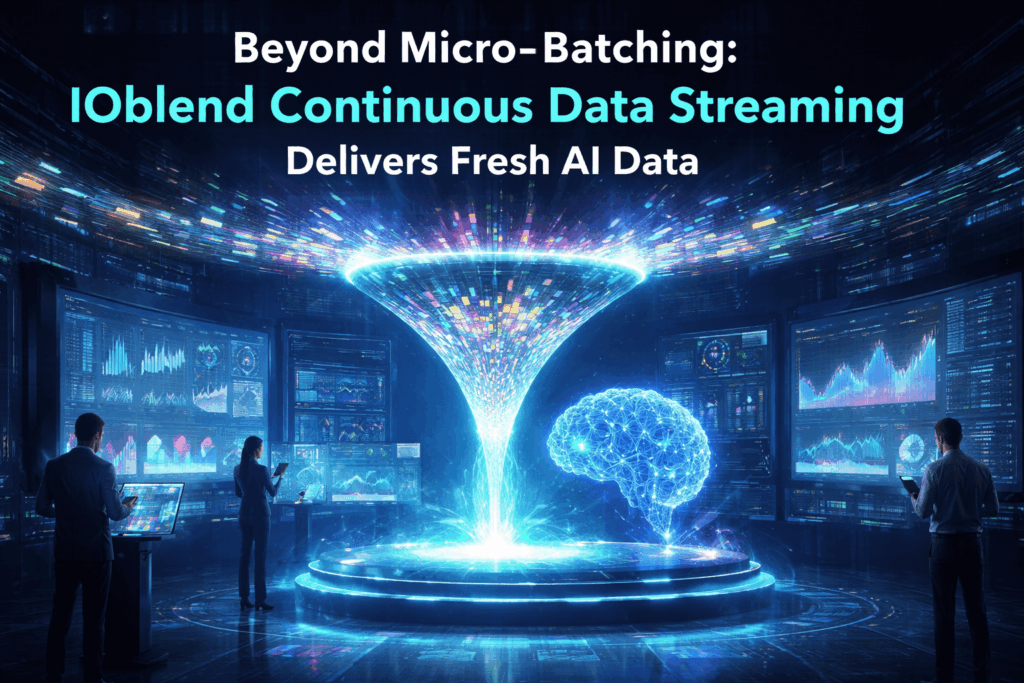

Beyond Micro-batching: Why Continuous Streaming Engine is the Future of “Fresh Data” for AIÂ
💻 Did you know? Most modern “real-time” AI applications are actually running on data that is already several minutes old. Traditional micro-batching collects data into small chunks before processing it, introducing a “latency tax” that can render predictive models obsolete before they even fire.Â
The Concept of Continuous Streaming
While micro-batching is essentially a series of very fast traditional batches, continuous streaming is a smooth, uninterrupted flow. A continuous engine processes each data event the moment it occurs. It moves beyond the limitations of Apache Spark’s standard micro-batching intervals, delivering true sub-second freshness by treating data as a perpetual, living stream rather than a collection of small files.Â
The “Stale Data” Crisis in Modern AIÂ
For data experts, the issue is clear: AI is only as good as its last update. In high-stakes environments, such as fraud detection, dynamic pricing, or autonomous logistics a 60-second delay is an eternity.Â
Businesses today face a “complexity wall.” To achieve true real-time speeds, they are often forced to maintain two separate architectures: a batch layer for historical accuracy and a streaming layer for speed. This leads to:Â
- Inconsistent Logic: Different codebases for batch and stream.Â
- Infrastructure Bloat: Managing separate clusters for Flink, Kafka, and Spark.Â
- Data Drift: The nightmare of keeping training data in sync with real-time inference data.Â
How IOblend Solves the Freshness GapÂ
IOblend replaces this fragmented mess with a “Feature Store without the Store,” leveraging its continuous streaming engine to unify the lifecycle of data. Based on its advanced technology, IOblend provides:Â
- True Streaming, Not Mini-Batch: It extends Spark to run pipelines with P99 freshness and over 1 million transactions per second (TPS), ensuring AI models always act on “Fresh Data.”Â
- The Kappa Architecture Advantage: By using a single engine for both batch and real-time data, IOblend eliminates the need for redundant systems, reducing infrastructure costs by up to 50%.Â
- In-Built DataOps & Governance: Unlike DIY setups, IOblend has record-level lineage, Change Data Capture (CDC), and schema drift management baked into the engine. It automatically handles late-arriving data and stateful transformations like windowed joins and deduplication.Â
- Agentic AI Integration: IOblend allows you to embed AI agents directly into the data flow. These agents can process unstructured documents or validate data quality before it lands in your warehouse, moving intelligence to the far left of the pipeline.Â
By removing the friction between data ingestion and model inference, IOblend ensures that your AI isn’t just fast it’s actually current.Â
Stop settling for “fast enough” and start seeing more with IOblend.Â
IOblend presents a ground-breaking approach to IoT and data integration, revolutionizing the way businesses handle their data. It’s an all-in-one data integration accelerator, boasting real-time, production-grade, managed Apache Spark™ data pipelines that can be set up in mere minutes. This facilitates a massive acceleration in data migration projects, whether from on-prem to cloud or between clouds, thanks to its low code/no code development and automated data management and governance.
IOblend also simplifies the integration of streaming and batch data through Kappa architecture, significantly boosting the efficiency of operational analytics and MLOps. Its system enables the robust and cost-effective delivery of both centralized and federated data architectures, with low latency and massively parallelized data processing, capable of handling over 10 million transactions per second. Additionally, IOblend integrates seamlessly with leading cloud services like Snowflake and Microsoft Azure, underscoring its versatility and broad applicability in various data environments.
At its core, IOblend is an end-to-end enterprise data integration solution built with DataOps capability. It stands out as a versatile ETL product for building and managing data estates with high-grade data flows. The platform powers operational analytics and AI initiatives, drastically reducing the costs and development efforts associated with data projects and data science ventures. It’s engineered to connect to any source, perform in-memory transformations of streaming and batch data, and direct the results to any destination with minimal effort.
IOblend’s use cases are diverse and impactful. It streams live data from factories to automated forecasting models and channels data from IoT sensors to real-time monitoring applications, enabling automated decision-making based on live inputs and historical statistics. Additionally, it handles the movement of production-grade streaming and batch data to and from cloud data warehouses and lakes, powers data exchanges, and feeds applications with data that adheres to complex business rules and governance policies.
The platform comprises two core components: the IOblend Designer and the IOblend Engine. The IOblend Designer is a desktop GUI used for designing, building, and testing data pipeline DAGs, producing metadata that describes the data pipelines. The IOblend Engine, the heart of the system, converts this metadata into Spark streaming jobs executed on any Spark cluster. Available in Developer and Enterprise suites, IOblend supports both local and remote engine operations, catering to a wide range of development and operational needs. It also facilitates collaborative development and pipeline versioning, making it a robust tool for modern data management and analytics

Schema Drift: The Silent Killer of Data Pipelines
The Silent Pipeline Killer: Surviving Schema Drift in the Wild 📊 Did you know? In the early days of big data, a single column change in a source database could trigger a “data graveyard” effect, where downstream analytics remained broken for weeks. The silent pipeline killer Schema drift occurs when the structure of source data changes
Preventing Data Drift in Modern Data Systems
The Invisible Erosion: Detecting and Managing Data Drift in Modern Architectures 📊 Did you know? According to recent industry surveys, over 70% of organisations experience significant data drift within the first six months of deploying a production system. The Concept of Data Drift Data drift occurs when the statistical properties or the underlying structure of incoming data change
Stream Database Changes to Your Lakehouse with CDC
Zero-Lag Operations: Stream Database Changes to Your Lakehouse 💾 Did you know? The “data downtime” caused by traditional batch processing costs the average enterprise approximately ÂŁ12,000 per minute. The Concept: Moving at the Speed of Change Zero-lag operations rely on a transition from periodic “snapshots” to continuous “streams.” Instead of moving massive blocks of data at
Real-Time Salesforce CDC to Snowflake
Real-Time CDC: Keep Salesforce and Snowflake in Perfect Sync 🔎 Did you know? While many businesses still rely on nightly batch windows to move CRM data, Salesforce generates millions of events every hour. The Concept: Real-Time CDC Real-Time Change Data Capture (CDC) is a software design pattern used to determine and track data that has

Build Production Spark Pipelines—No Scala Needed
Democratising Spark: How IOblend enables Data Analysts to build production-grade Spark pipelines without writing Scala or Java  Did You Know? The average enterprise now manages over 350 different data sources, yet nearly 70% of data leaders report feeling “trapped” by their own infrastructure.  The Concept: Democratising the Spark Engine At its core, Apache Spark is a lightning-fast, distributed computing

IOblend vs Vendor Lock-In: Portable JSON + Python + SQL
The End of Vendor Lock-in: Keeping your logic portable with IOblend’s JSON-based playbooks and Python/SQL  💾 Did you know? The average enterprise now uses over 350 different data sources, yet nearly 70% of data leaders feel “trapped” by their infrastructure. Recent industry reports suggest that migrating a legacy data warehouse to a new provider can

