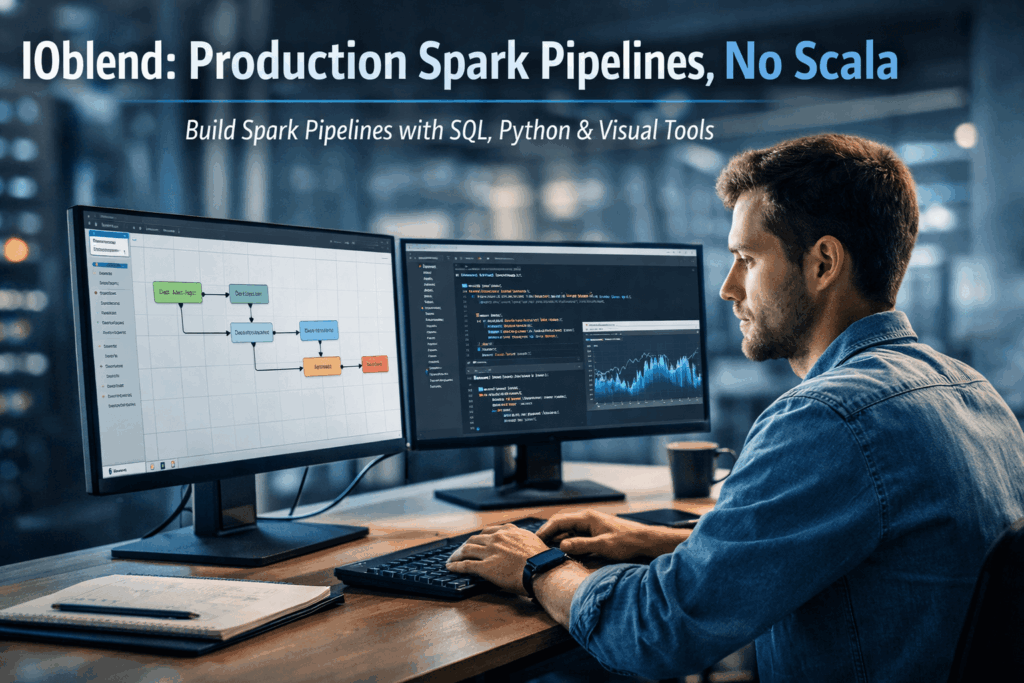
Democratising Spark: How IOblend enables Data Analysts to build production-grade Spark pipelines without writing Scala or Java
💻 Did You Know? The average enterprise now manages over 350 different data sources, yet nearly 70% of data leaders report feeling “trapped” by their own infrastructure.

The Concept: Democratising the Spark Engine
At its core, Apache Spark is a lightning-fast, distributed computing framework capable of processing petabytes of data. However, for years, “production-grade” Spark was synonymous with complex software engineering.
IOblend changes this narrative by decoupling the power of Spark from the complexity of its code. It acts as a sophisticated abstraction layer, a managed Spark DataOps environment, that allows Data Analysts to build, deploy, and govern high-performance pipelines using only SQL, Python, or an intuitive drag-and-drop interface.
Why Businesses Struggle
For most organisations, the path from “data ingestion” to “actionable insight” is riddled with three primary obstacles:
- The Talent Gap: Expert Spark developers (fluent in Scala or Java) are rare and expensive. This creates a dependency where Analysts must wait months for Engineering teams to “productionise” a simple data model.
- Brittle Pipelines: Traditional hand-coded pipelines often lack built-in DataOps. Without automated error handling, record-level lineage, or schema drift detection, pipelines “fail quietly,” leading to untrustworthy reports.
- Real-Time Rigidity: Many legacy systems are built on batch processing. Transitioning to real-time streaming usually requires a complete architectural overhaul, often resulting in “vendor lock-in” to expensive cloud ecosystems.
The IOblend Solution: Production Power Without the Code
IOblend transforms these challenges into a streamlined, automated workflow. By utilising a Kappa-based architecture, it treats batch and streaming data with equal ease, allowing businesses to achieve 90% faster delivery of data products.
Key features that solve common business issues include:
- Visual Designer & Engine: Use a desktop GUI to design complex Directed Acyclic Graphs (DAGs). The IOblend Engine then converts these into efficient Spark jobs that run on any infrastructure, on-prem, cloud, or hybrid.
- In-built DataOps: Every pipeline automatically includes record-level lineage, Change Data Capture (CDC), and Slowly Changing Dimensions (SCD). You no longer need to “bolt-on” governance; it is baked into the metadata.
- Agentic AI Integration: Uniquely, IOblend allows you to embed AI agents directly into the ETL flow. You can validate, ground, and transform unstructured data before it even hits your warehouse.
- Zero Lock-in: Pipelines are stored as portable JSON playbooks. This ensures your business logic remains your own, easily versioned in standard repositories like Git.
It’s time to find your flow with IOblend.

Airline safety management: enhance your SMS with IOblend
Today we are looking at the data aspect of flight safety management in the aviation industry.

Unlock new capabilities with real time ACARS data
In this short article we are looking at one of the key data sources for the aviation industry – ACARS – and how IOblend helps to unlock new analytical capabilities from it.

Time to automate your airline’s DOC data
How to automate Direct Operating Cost (DOC) data collection, processing and serving with IOblend.

Automate airline fuel data collection & management
Collecting and managing airline fuel data is complex and time consuming. IOblend can greatly streamline the process and enable real-time decisioning.

The Data Mesh Gotchas!
I think most practitioners in the data world would agree that the core data mesh principles of decentralisation to improve data enablement are sound. Originally penned by Zhamak Dehghani, Data Mesh architecture is attracting a lot of attention, and rightly so. However, there is a growing concern in the data industry regarding how the data

IOblend Data Mesh
IOblend Data Mesh – power to the data people! Analyst engineering made simple Hello folks, IOblend here. Hope you are all keeping well. Companies are increasingly leaning towards self-service data authoring. Why, you ask? It is because the prevailing monolithic data architecture (no matter how advanced) does not condone an easy way to manage the