
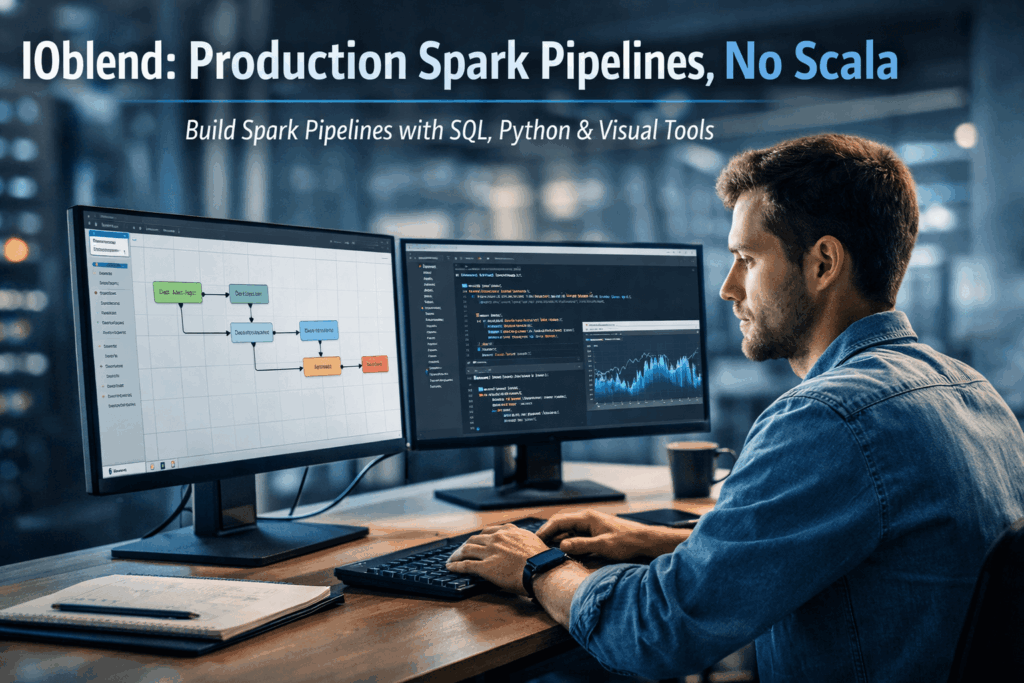
Democratising Spark: How IOblend enables Data Analysts to build production-grade Spark pipelines without writing Scala or Java
Did You Know? The average enterprise now manages over 350 different data sources, yet nearly 70% of data leaders report feeling “trapped” by their own infrastructure.

The Concept: Democratising the Spark Engine
At its core, Apache Spark is a lightning-fast, distributed computing framework capable of processing petabytes of data. However, for years, “production-grade” Spark was synonymous with complex software engineering.
IOblend changes this narrative by decoupling the power of Spark from the complexity of its code. It acts as a sophisticated abstraction layer, a managed Spark DataOps environment, that allows Data Analysts to build, deploy, and govern high-performance pipelines using only SQL, Python, or an intuitive drag-and-drop interface.
Why Businesses Struggle
For most organisations, the path from “data ingestion” to “actionable insight” is riddled with three primary obstacles:
- The Talent Gap: Expert Spark developers (fluent in Scala or Java) are rare and expensive. This creates a dependency where Analysts must wait months for Engineering teams to “productionise” a simple data model.
- Brittle Pipelines: Traditional hand-coded pipelines often lack built-in DataOps. Without automated error handling, record-level lineage, or schema drift detection, pipelines “fail quietly,” leading to untrustworthy reports.
- Real-Time Rigidity: Many legacy systems are built on batch processing. Transitioning to real-time streaming usually requires a complete architectural overhaul, often resulting in “vendor lock-in” to expensive cloud ecosystems.
The IOblend Solution: Production Power Without the Code
IOblend transforms these challenges into a streamlined, automated workflow. By utilising a Kappa-based architecture, it treats batch and streaming data with equal ease, allowing businesses to achieve 90% faster delivery of data products.
Key features that solve common business issues include:
- Visual Designer & Engine: Use a desktop GUI to design complex Directed Acyclic Graphs (DAGs). The IOblend Engine then converts these into efficient Spark jobs that run on any infrastructure, on-prem, cloud, or hybrid.
- In-built DataOps: Every pipeline automatically includes record-level lineage, Change Data Capture (CDC), and Slowly Changing Dimensions (SCD). You no longer need to “bolt-on” governance; it is baked into the metadata.
- Agentic AI Integration: Uniquely, IOblend allows you to embed AI agents directly into the ETL flow. You can validate, ground, and transform unstructured data before it even hits your warehouse.
- Zero Lock-in: Pipelines are stored as portable JSON playbooks. This ensures your business logic remains your own, easily versioned in standard repositories like Git.
It’s time to find your flow with IOblend.

De-Risk Cloud Migration with Parallel Runs
De-Risk Your Migration: Run Legacy and New Systems in Parallel 💻 Did you know? An alarming 83% of data migrations either fail outright or drastically overrun their budgets. When management loses patience with mounting technical friction, entire digital transformations are written

Compliance DataOps for Auditable Pipelines
Compliance-Friendly DataOps: Repeatable, Reviewable, Versioned Pipelines 📓 Did you know? According to industry compliance reports, nearly 70% of businesses face difficulties tracing their data back to its raw origins during regular regulatory audits. The Concept of Compliance-Friendly DataOps Compliance-friendly DataOps represents an operational framework that
Continuous Data Replication for DR and Continuity
Continuous Data Replication: for Business Continuity and DR 📝 Did you know? According to industry studies, the average cost of IT downtime is approximately £4,500 per minute. For a large enterprise, a single hour of data loss or system unavailability can