Democratising Spark: How IOblend enables Data Analysts to build production-grade Spark pipelines without writing Scala or Java
💻 Did You Know? The average enterprise now manages over 350 different data sources, yet nearly 70% of data leaders report feeling “trapped” by their own infrastructure.
The Concept: Democratising the Spark Engine
At its core, Apache Spark is a lightning-fast, distributed computing framework capable of processing petabytes of data. However, for years, “production-grade” Spark was synonymous with complex software engineering.
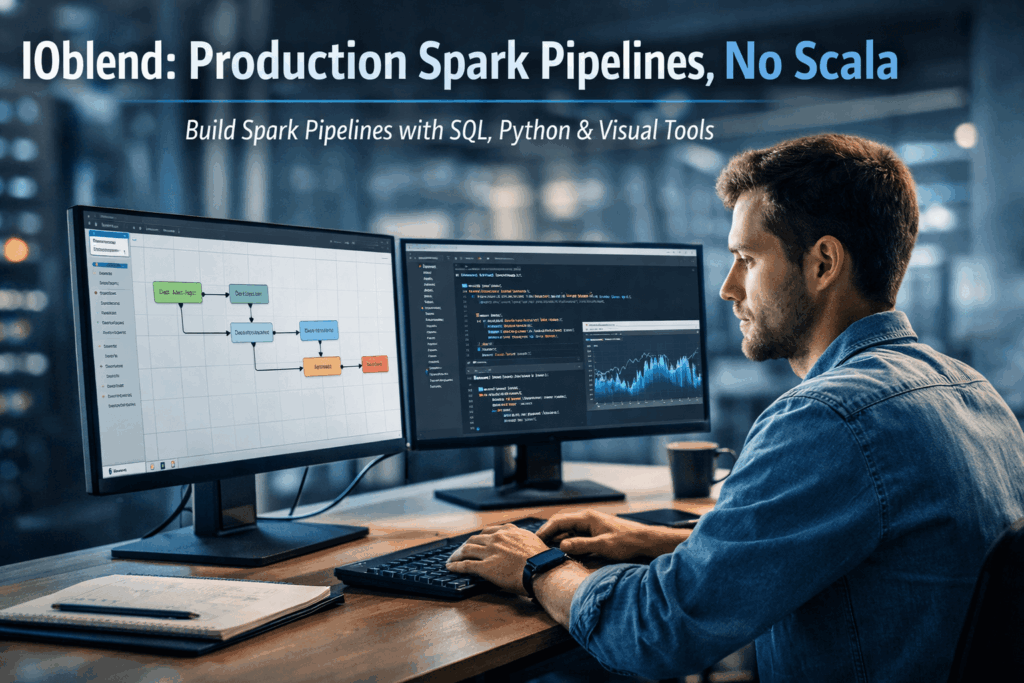
IOblend changes this narrative by decoupling the power of Spark from the complexity of its code. It acts as a sophisticated abstraction layer, a managed Spark DataOps environment, that allows Data Analysts to build, deploy, and govern high-performance pipelines using only SQL, Python, or an intuitive drag-and-drop interface.
Why Businesses Struggle
For most organisations, the path from “data ingestion” to “actionable insight” is riddled with three primary obstacles:
- The Talent Gap: Expert Spark developers (fluent in Scala or Java) are rare and expensive. This creates a dependency where Analysts must wait months for Engineering teams to “productionise” a simple data model.
- Brittle Pipelines: Traditional hand-coded pipelines often lack built-in DataOps. Without automated error handling, record-level lineage, or schema drift detection, pipelines “fail quietly,” leading to untrustworthy reports.
- Real-Time Rigidity: Many legacy systems are built on batch processing. Transitioning to real-time streaming usually requires a complete architectural overhaul, often resulting in “vendor lock-in” to expensive cloud ecosystems.
The IOblend Solution: Production Power Without the Code
IOblend transforms these challenges into a streamlined, automated workflow. By utilising a Kappa-based architecture, it treats batch and streaming data with equal ease, allowing businesses to achieve 90% faster delivery of data products.
Key features that solve common business issues include:
- Visual Designer & Engine: Use a desktop GUI to design complex Directed Acyclic Graphs (DAGs). The IOblend Engine then converts these into efficient Spark jobs that run on any infrastructure, on-prem, cloud, or hybrid.
- In-built DataOps: Every pipeline automatically includes record-level lineage, Change Data Capture (CDC), and Slowly Changing Dimensions (SCD). You no longer need to “bolt-on” governance; it is baked into the metadata.
- Agentic AI Integration: Uniquely, IOblend allows you to embed AI agents directly into the ETL flow. You can validate, ground, and transform unstructured data before it even hits your warehouse.
- Zero Lock-in: Pipelines are stored as portable JSON playbooks. This ensures your business logic remains your own, easily versioned in standard repositories like Git.
It’s time to find your flow with IOblend.

Real-Time Insurance Claims with CDC and Spark
From Batch to Real-Time: Accelerating Insurance Claims Processing with CDC and Spark 💼 Did you know? In the insurance sector, the move from overnight batch processing to real-time stream processing has been shown to reduce the average claims settlement time from several days to under an hour in highly automated systems. Real-Time Data and Insurance

Agentic AI: The New Standard for ETL Governance
Autonomous Finance: Agentic AI as the New Standard for ETL Governance and Resilience 📌 Did You Know? Autonomous data quality agents deployed by leading financial institutions have been shown to proactively detect and correct up to 95% of critical data quality issues. The Agentic AI Concept Agentic Artificial Intelligence (AI) represents the progression beyond simple prompt-and-response

IOblend: Simplifying Feature Stores for Modern MLOps
IOblend: Simplifying Feature Stores for Modern MLOps Feature stores emerged to solve a real challenge in machine learning: managing features across models, maintaining consistency between training and inference, and ensuring proper governance. To meet this need, many solutions introduced new infrastructure layers—Redis, DynamoDB, Feast-style APIs, and others. While these tools provided powerful capabilities, they also

Rethinking the Feature Store concept for MLOps
Rethinking the Feature Store concept for MLOps Today we talk about Feature Stores. The recent Databricks acquisition of Tecton raised an interesting question for us: can we make a feature store work with any infra just as easily as a dedicated system using IOblend? Let’s have a look. How a Feature Store Works Today Machine

CRM + ERP: Powering Predictive Analytics
The Data-Driven Value Chain: Predictive Analytics with CRM and ERP 📊 Did you know? A study on real-time data integration platforms revealed that organisations can reduce their average response time to supply chain disruptions from 5.2 hours to just 37 minutes. A Unified Data Landscape The modern value chain is a complex ecosystem where every component is interconnected,

Enhancing Data Migrations with IOblend Agentic AI ETL
LeanData Optimising Cloud Migration: for Telecoms with Agentic AI ETL 📡 Did you know? The global telecommunications industry is projected to create over £120 billion in value from agentic AI by 2026. The Dawn of Agentic AI ETL For data experts in the telecoms sector, the term ETL—Extract, Transform, Load—is a familiar, if often laborious, process. It’s