Democratising Spark: How IOblend enables Data Analysts to build production-grade Spark pipelines without writing Scala or Java
💻 Did You Know? The average enterprise now manages over 350 different data sources, yet nearly 70% of data leaders report feeling “trapped” by their own infrastructure.
The Concept: Democratising the Spark Engine
At its core, Apache Spark is a lightning-fast, distributed computing framework capable of processing petabytes of data. However, for years, “production-grade” Spark was synonymous with complex software engineering.
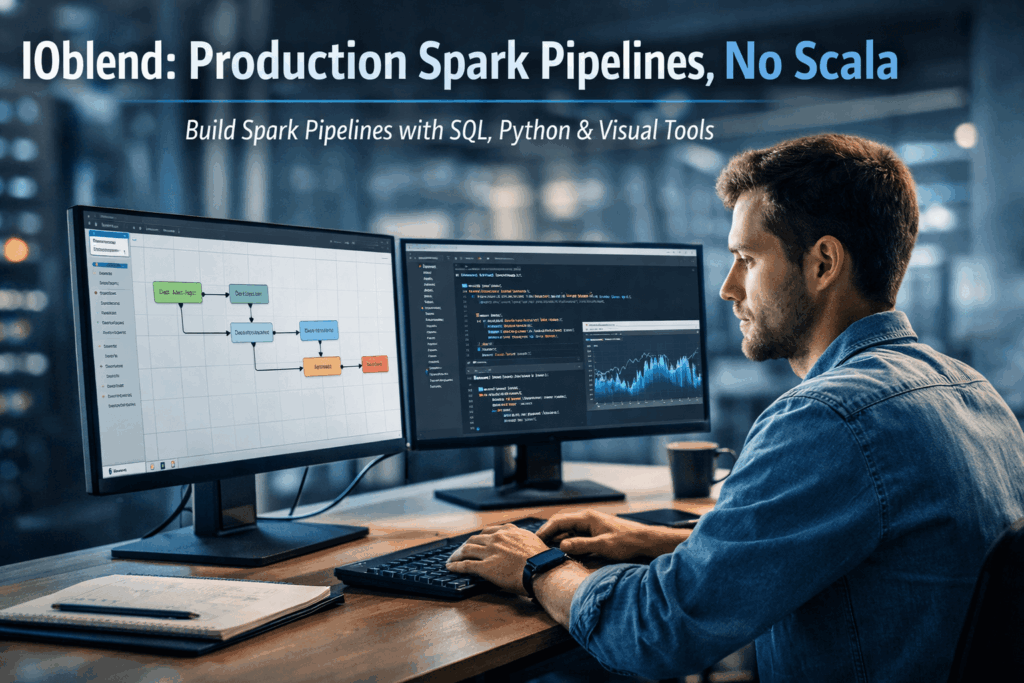
IOblend changes this narrative by decoupling the power of Spark from the complexity of its code. It acts as a sophisticated abstraction layer, a managed Spark DataOps environment, that allows Data Analysts to build, deploy, and govern high-performance pipelines using only SQL, Python, or an intuitive drag-and-drop interface.
Why Businesses Struggle
For most organisations, the path from “data ingestion” to “actionable insight” is riddled with three primary obstacles:
- The Talent Gap: Expert Spark developers (fluent in Scala or Java) are rare and expensive. This creates a dependency where Analysts must wait months for Engineering teams to “productionise” a simple data model.
- Brittle Pipelines: Traditional hand-coded pipelines often lack built-in DataOps. Without automated error handling, record-level lineage, or schema drift detection, pipelines “fail quietly,” leading to untrustworthy reports.
- Real-Time Rigidity: Many legacy systems are built on batch processing. Transitioning to real-time streaming usually requires a complete architectural overhaul, often resulting in “vendor lock-in” to expensive cloud ecosystems.
The IOblend Solution: Production Power Without the Code
IOblend transforms these challenges into a streamlined, automated workflow. By utilising a Kappa-based architecture, it treats batch and streaming data with equal ease, allowing businesses to achieve 90% faster delivery of data products.
Key features that solve common business issues include:
- Visual Designer & Engine: Use a desktop GUI to design complex Directed Acyclic Graphs (DAGs). The IOblend Engine then converts these into efficient Spark jobs that run on any infrastructure, on-prem, cloud, or hybrid.
- In-built DataOps: Every pipeline automatically includes record-level lineage, Change Data Capture (CDC), and Slowly Changing Dimensions (SCD). You no longer need to “bolt-on” governance; it is baked into the metadata.
- Agentic AI Integration: Uniquely, IOblend allows you to embed AI agents directly into the ETL flow. You can validate, ground, and transform unstructured data before it even hits your warehouse.
- Zero Lock-in: Pipelines are stored as portable JSON playbooks. This ensures your business logic remains your own, easily versioned in standard repositories like Git.
It’s time to find your flow with IOblend.

Still Confused in 2025? AI, ML & Data Science Explained
Still Confused in 2025? AI, ML & Data Science Explained…finally It seems everyone in business circles talks about these days. AI will solve all our business challenges and make/save us a ton of money. AI will replace manual labour with clever agents. It will change the world and our business will be at the forefront

Beyond Spreadsheets: The CFO’s Path to Data-Driven Decisions
Beyond Spreadsheets: The CFO’s Path to Data-Driven Decisions 📊 Did you know? Companies leveraging data-driven insights consistently report a significant uplift in profitability – often exceeding 20%. That’s not just a marginal gain; it’s a game-changer. The Data-Driven CFO The modern Chief Financial Officer operates in a world awash with data. No longer solely focused

Shift Left: Unleashing Data Power with In-Memory Processing
Mind the Gap: Bridging Data Shift Left: Unleashing Data Power with In-Memory Processing 💻 Did you know? Organisations that implement shift-left strategies can experience up to a 30% reduction in compute costs by cleaning data at the source. The Essence of Shifting Left Shifting data compute and governance “left” essentially means moving these processes closer

Mind the Gap: Bridging Data Silos with IOblend Integration
Mind the Gap: Bridging Data Silos to Unlock Organisational Insight 💾 Did you know? Back in the early days of computing, data integration often involved physically moving punch cards between different machines – a rather less streamlined approach than what we have today! Piecing Together the Data Puzzle At its core, data integration is about

Rapid AI Implementation: Moving Beyond Proof of Concept
Rapid AI Implementation: Moving Beyond Proof of Concept 💻 Did you know that in 2024, the average time it took for a business to deploy an AI model from the experimental stage to full production was approximately six months? Bringing AI Experiments to Life The journey of an AI project typically begins with a “proof

Agentic AI ETL: The Future of Data Integration
Agentic AI ETL: The Future of Data Integration 📓 Did you know? By 2025, the volume of data generated globally is projected to reach 175 zettabytes? That’s a truly enormous number, highlighting the ever-increasing importance of efficient data management. What is Agentic AI ETL? Agentic AI ETL represents a transformative evolution in data integration. Traditional