AW-10865990051

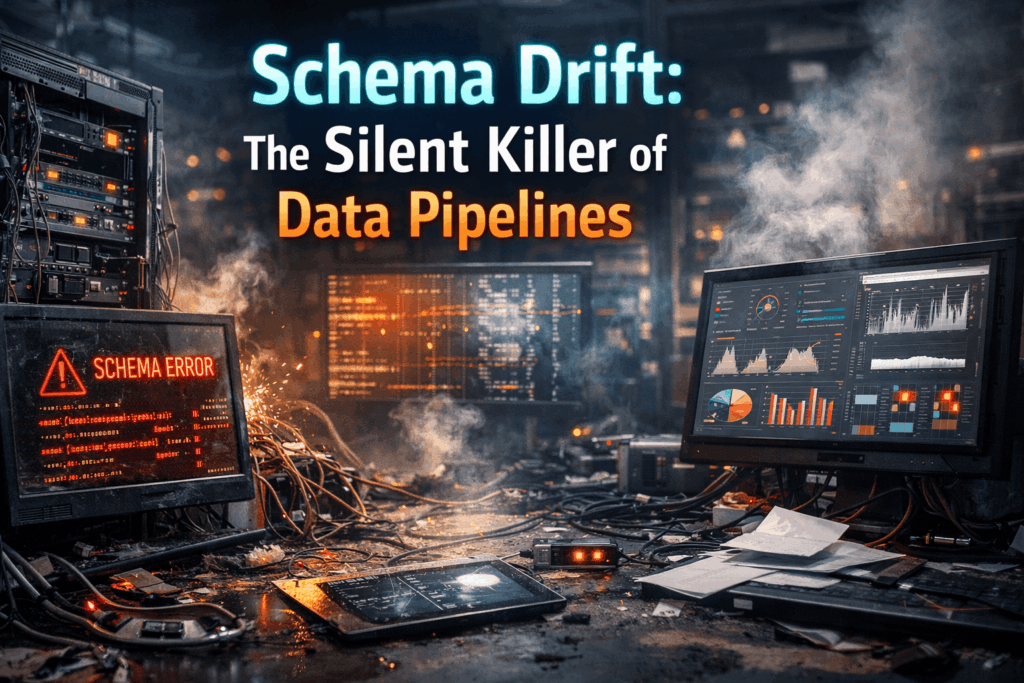
Schema Drift: The Silent Killer of Data Pipelines

schema-drift-handling-with-IOblend

The Silent Pipeline Killer: Surviving Schema Drift in the Wild 

📊 Did you know? In the early days of big data, a single column change in a source database could trigger a “data graveyard” effect, where downstream analytics remained broken for weeks. 

The silent pipeline killer 

Schema drift occurs when the structure of source data changes unexpectedly. Imagine your upstream CRM team adds a “region” field, renames “customer_id” to “uid”, or changes a currency format from an integer to a string. To a human, these are minor tweaks; to a rigid data pipeline, they are fatal errors. Without a flexible architecture, these changes cause ingestion processes to crash, resulting in partial data loads or, worse, “silent failures” where corrupted data flows into your dashboards unnoticed. 

The high cost of structural instability

For modern businesses, schema drift isn’t just a technical nuisance, it’s a commercial risk. When source systems evolve without warning, several critical issues emerge: 

  • Broken Downstream Analytics: If a field name changes, Every SQL join, BI dashboard, and ML model relying on that field instantly breaks. 
  • Engineering Toil: Data engineers spend up to 40% of their time on “break-fix” tasks. Manually updating ETL code every time a source API changes is a reactive, non-scalable way to work. 
  • Data Loss: In traditional rigid schemas, if an incoming record contains a new, undefined attribute, that data is often dropped entirely. This results in the loss of valuable business signals before they can even be analysed. 

Navigating the wild with IOblend 

IOblend provides a modern, “AI-forward” solution to the chaos of schema drift by moving away from brittle, hard-coded pipelines. Here is how the platform ensures you survive changing sources: 

  • Schema Evolution & Agility: IOblend is designed to handle structural changes dynamically. Instead of crashing, the platform can automatically detect new fields or data type changes, ensuring that your data flow remains consistent and reliable. AI agents can automatically analyse and act upon the changes based on your policies. 
  • Record-Level Lineage: Because IOblend tracks data at the record level, you can trace exactly when and where a schema change occurred. This provides full visibility into how your data has evolved over time, making audits and troubleshooting effortless. 
  • Real-Time Adaptability: Whether you are dealing with Spark-driven batch processing or real-time streaming, IOblend’s architecture abstracts the complexity of the underlying structure. This allows your team to focus on extracting value rather than rewriting ingestion logic. 
  • Unified Data Interface: By decoupling the source structure from the consumption layer, IOblend allows you to maintain a consistent “Golden Record” even as the “Wild” sources behind it continue to shift and change. 

Ensure your pipelines are future-proof by making IOblend the backbone of your data engineering strategy. 

IOblend: See more. Do more. Deliver better.

IOblend_Salesforce_CDC_sync_Snowflake
AI
admin

Real-Time Salesforce CDC to Snowflake

Real-Time CDC: Keep Salesforce and Snowflake in Perfect Sync 🔎 Did you know? While many businesses still rely on nightly batch windows to move CRM data, Salesforce generates millions of events every hour. The Concept: Real-Time CDC Real-Time Change Data Capture (CDC) is a software design pattern used to determine and track data that has

Read More »
Attachment Details IOblend_production_grade_data_pipelines_no_scala
AI
admin

Build Production Spark Pipelines—No Scala Needed

Democratising Spark: How IOblend enables Data Analysts to build production-grade Spark pipelines without writing Scala or Java   Did You Know? The average enterprise now manages over 350 different data sources, yet nearly 70% of data leaders report feeling “trapped” by their own infrastructure.    The Concept: Democratising the Spark Engine  At its core, Apache Spark is a lightning-fast, distributed computing

Read More »
IOblend-portable-JSON-SQL-and-Python
AI
admin

IOblend vs Vendor Lock-In: Portable JSON + Python + SQL

The End of Vendor Lock-in: Keeping your logic portable with IOblend’s JSON-based playbooks and Python/SQL  💾 Did you know? The average enterprise now uses over 350 different data sources, yet nearly 70% of data leaders feel “trapped” by their infrastructure. Recent industry reports suggest that migrating a legacy data warehouse to a new provider can

Read More »
AI
admin

IOblend JSON Playbooks: Keep Logic Portable, No Lock-In

The End of Vendor Lock-in: Keeping your logic portable with IOblend’s JSON-based playbooks and Python/SQL core 💾 Did you know? The average enterprise now uses over 350 different data sources, yet nearly 70% of data leaders feel “trapped” by their infrastructure. Recent industry reports suggest that migrating a legacy data warehouse to a new provider can

Read More »
AI
admin

Real-Time Defect Detection with Agentic AI + ETL

Smart Quality Control: Embedding Agentic AI into ETL pipelines to visually inspect and categorise production defects  🔩 Did you know? “visual drift” in manual quality control can lead to a 20% drop in defect detection accuracy over a single eight-hour shift  The Concept: Agentic AI in the ETL Stream Traditional ETL (Extract, Transform, Load) has long been the

Read More »
AI
admin

Agentic AI ETL for Real-Time Sentiment Pricing

Sentiment-Driven Pricing: Using Agentic AI ETL to scrape social sentiment and adjust prices dynamically within the data flow  🤖 Did you know? A single viral tweet or a trending TikTok “dupe” video can alter the perceived value of a product by over 40% in less than six hours. Traditional pricing engines, which rely on historical sales

Read More »
Scroll to Top