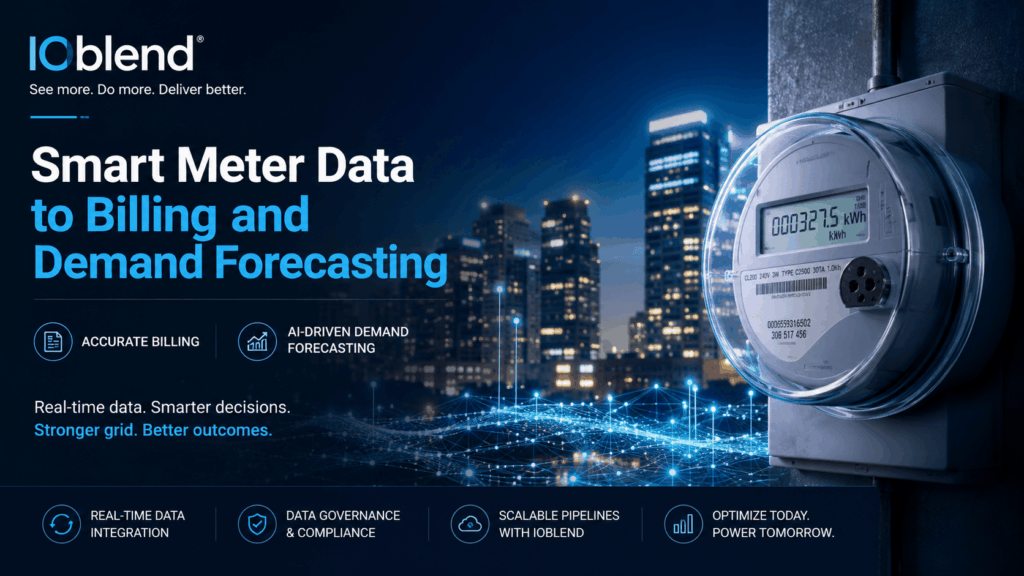

Utilities: Smart Meter Data to Billing and Demand Forecasting
📋 Did You Know? The global roll-out of smart meters generates more data in a single day than most utility companies used to collect in an entire decade. While traditional meters were read once a month, or even once a quarter, smart meters transmit data at intervals as frequent as every 15 minutes, creating a granular “digital heartbeat” of the power grid.
The Concept: From Pulse to Profit
Smart meter data integration is the process of transforming raw telemetric pulses into actionable financial and operational intelligence. At its core, this involves capturing high-frequency interval data, validating it for “missing” periods, and routing it into two critical streams. The first is Billing, where consumption data is mapped against complex tariff structures. The second is Demand Forecasting, which uses historical patterns and environmental variables to predict future load, ensuring grid stability and efficient energy procurement.
The Data Silo Trap
For data experts in the utility sector, the primary challenge is not the volume of data, but its velocity and variety. Legacy Meter Data Management (MDM) systems often struggle to sync with modern cloud-based billing platforms, leading to “data lag.” When billing engines receive delayed or corrupted data, it results in estimated bills, a leading cause of customer dissatisfaction and regulatory fines.
Furthermore, demand forecasting requires merging smart meter telemetry with external datasets like weather feeds and demographic shifts. Traditional ETL (Extract, Transform, Load) pipelines are often too rigid to handle these schema-on-read requirements, resulting in “stale” forecasts that fail to predict peak load events, costing utilities millions in emergency energy purchases.
Solving the Pipeline Crisis with IOblend
This is where IOblend redefines the utility data landscape. By moving away from brittle, code-heavy ETL and embracing a high-performance, metadata-driven approach, IOblend allows data engineers to build resilient, API-to-Spark pipelines in a fraction of the time.
- Automated Data Masking & Governance: IOblend ensures that sensitive customer consumption patterns are masked during the forecasting phase, maintaining strict GDPR and industry compliance without slowing down the data flow.
- Real-Time CDC: IOblend’s Change Data Capture capabilities allow utilities to sync their MDM systems with billing engines in real-time, eliminating estimated billing and ensuring financial accuracy.
- Low-Code Complexity: Using the IOblend Designer, experts can integrate disparate sources, from legacy SQL databases to modern IoT streams, into a unified data lake for advanced AI-driven forecasting.
Stop fighting your data and start fuelling your grid, supercharge your utility pipelines with the power of IOblend.

Data Automation: Investing Pennies to Save Pounds
Data automation is a critical enabler of efficiency, accuracy, and strategic insight. It also considerably lowers your business cost when producing said insight

Data Strategy: Taking a Business View
Data strategy aligns data-related activities with the strategic goals of an organisation. It’s about turning data into value.

Out with the Old ETL: Navigating the Upgrade Maze
Today, we have tools and experience to make digital transformation easy. Yet, most organisations cling to their antiquated data systems and analytics. Why?

Smart Data Integration: More $ for Your D&A Budget
Data integration is the heart of data engineering. The process is inherently complex and consumes the most of your D&A budget.

Data Pipelines: From Raw Data to Real Results
The primary purpose of data pipelines is to enable a smooth, automated flow of data. Data pipelines are at the core of informed decision-making.

Golden Record: Finding the Single Truth Source
A golden record of data is a consolidated dataset that serves as a single source of truth for all business data about a customer, employee, or product.