Utilities: Smart Meter Data to Billing and Demand Forecasting
📋 Did You Know? The global roll-out of smart meters generates more data in a single day than most utility companies used to collect in an entire decade. While traditional meters were read once a month, or even once a quarter, smart meters transmit data at intervals as frequent as every 15 minutes, creating a granular “digital heartbeat” of the power grid.
The Concept: From Pulse to Profit
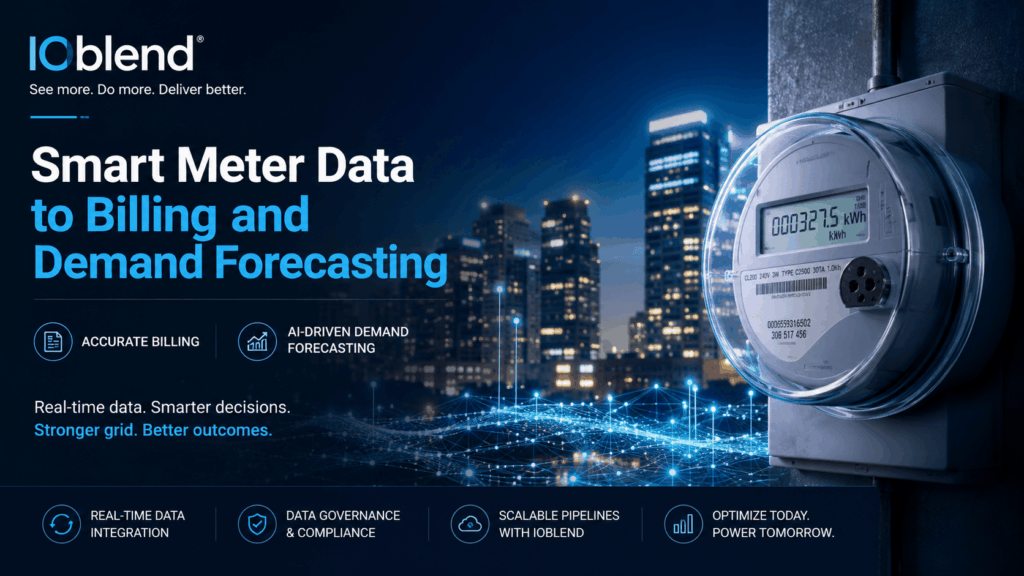
Smart meter data integration is the process of transforming raw telemetric pulses into actionable financial and operational intelligence. At its core, this involves capturing high-frequency interval data, validating it for “missing” periods, and routing it into two critical streams. The first is Billing, where consumption data is mapped against complex tariff structures. The second is Demand Forecasting, which uses historical patterns and environmental variables to predict future load, ensuring grid stability and efficient energy procurement.
The Data Silo Trap
For data experts in the utility sector, the primary challenge is not the volume of data, but its velocity and variety. Legacy Meter Data Management (MDM) systems often struggle to sync with modern cloud-based billing platforms, leading to “data lag.” When billing engines receive delayed or corrupted data, it results in estimated bills, a leading cause of customer dissatisfaction and regulatory fines.
Furthermore, demand forecasting requires merging smart meter telemetry with external datasets like weather feeds and demographic shifts. Traditional ETL (Extract, Transform, Load) pipelines are often too rigid to handle these schema-on-read requirements, resulting in “stale” forecasts that fail to predict peak load events, costing utilities millions in emergency energy purchases.
Solving the Pipeline Crisis with IOblend
This is where IOblend redefines the utility data landscape. By moving away from brittle, code-heavy ETL and embracing a high-performance, metadata-driven approach, IOblend allows data engineers to build resilient, API-to-Spark pipelines in a fraction of the time.
- Automated Data Masking & Governance: IOblend ensures that sensitive customer consumption patterns are masked during the forecasting phase, maintaining strict GDPR and industry compliance without slowing down the data flow.
- Real-Time CDC: IOblend’s Change Data Capture capabilities allow utilities to sync their MDM systems with billing engines in real-time, eliminating estimated billing and ensuring financial accuracy.
- Low-Code Complexity: Using the IOblend Designer, experts can integrate disparate sources, from legacy SQL databases to modern IoT streams, into a unified data lake for advanced AI-driven forecasting.
Stop fighting your data and start fuelling your grid, supercharge your utility pipelines with the power of IOblend.

Optimising Customer Experience Through Real Time Data Sync
Optimising Customer Experiences Through Real Time Data Sync 🧠 Fun Fact: Did you know that 90% of the world’s data has been created in just the past two years? That’s a lot of information to manage – and a massive opportunity for businesses that know how to use it wisely. Understanding your customers is the

How Poor Data Integration Drains Productivity & Profits
How Poor Data Integration Drains Productivity & Profits Data is one of the most valuable assets a company can possess. We all know that (and if you still do not, god help you). Businesses rely on data to make informed decisions, optimise operations, drive customer engagement, etc. Data is everywhere and it’s waiting for us

How To Unlock Better Data Analytics with AI Agents
How To Unlock Better Data Analytics with AI Agents The new year brings with it new use cases. The speed with which the data industry evolves is incredible. It seems that the LLMs only appeared on the wider scene just a year ago. But we already have a plethora of exciting applications for it across

Why IOblend is Your Fast-Track to the Cloud
From Grounded to Clouded: Why IOblend is Your Fast-Track to the Cloud Today, we talk about data migration. Data migration these days mainly means moving to the cloud. Basically, if a business wants to drastically improve their data capabilities, they have to be on the cloud. Data migration is the mechanism that gets you there.

Data Integration Challenge: Can We Tame the Chaos?
The Triple Threats to Data Integration: High Costs, Long Timelines and Quality Pitfalls-can we tame the chaos? Businesses today work with a ton of data. As such, getting the sense of that data is more important than ever. Which then means, integrating it into a cohesive shape is a must. Data integration acts as a

Tangled in the Data Web
Tangled in the Data Web Data is now one of the most valuable assets for companies across all industries, right up there with their biggest asset – people. Whether you’re in retail, healthcare, or financial services, the ability to analyse data effectively gives a competitive edge. You’d think making the most of data would have