Deduplicate Streaming Events: Exact-Once Outcomes in Real Life
📋 Did you know? In high-velocity streaming environments, network retries and transient worker failures cause up to 20% of event streams to contain duplicate payloads.
Understanding exact-once outcomes
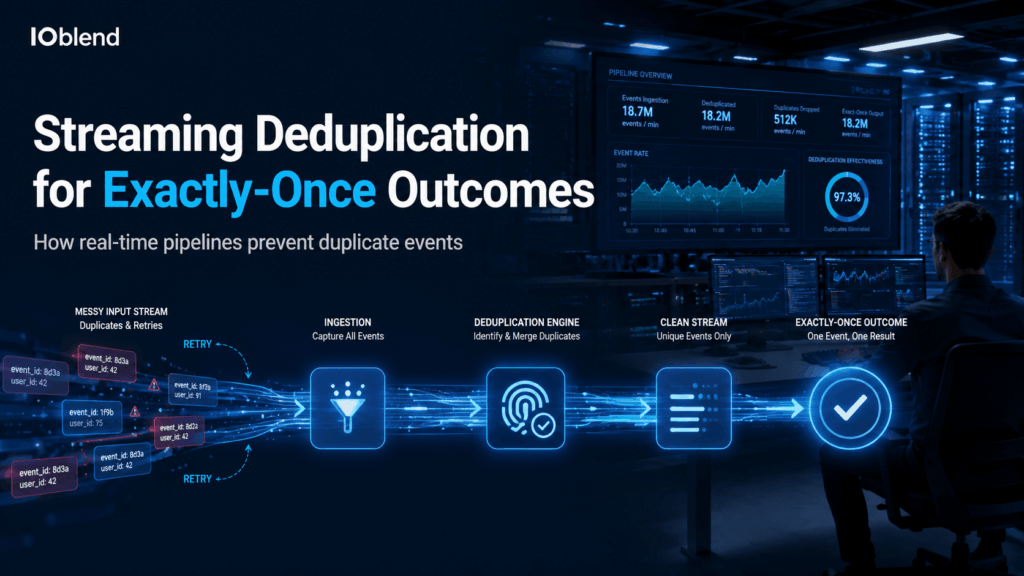
In real-time data engineering, achieving “exactly-once” outcomes does not mean a message is transported across the wire only once, distributed networks make physical delivery guarantees at the wire level impossible. Instead, it means that despite network timeouts, retries, and consumer restarts, the end result of processing a message is committed to your target system precisely once. Stateful deduplication is the engine behind idempotency, transforming an unruly “at-least-once” stream into crisp, deterministic data states.
The painful business cost of duplicate streams
When organisations rely on streaming architectures for real-time analytics or operational automation, duplicate records create severe operational friction:
- Financial and transactional distortion: Consider a fintech payment gateway processing thousands of transactions per second. If a network glitch triggers a producer retry and the pipeline lacks stateful deduplication, a payment event is processed twice, leading to duplicate debits, compliance breaches, and customer churn.
- Corrupted analytics and AI models: In IoT fleet management or airline logistics, duplicated telemetry events distort windowed aggregations. A safety monitoring system reading doubled sensor pings might falsely trigger emergency alerts or corrupt real-time ML feature stores, degrading decision quality.
- Engineering complexity and infrastructure bloat: Building custom deduplication logic in native Apache Spark or Flink requires managing state stores, handling late-arriving data, and writing complex windowing boilerplate.
Solved: Seamless deduplication with IOblend
To achieve true exactly-once processing without drowning in custom code, modern data teams rely on IOblend. Designed around a high-performance Kappa architecture powered by Apache Spark, IOblend abstracts away the heavy lifting of stateful streaming pipelines.
- In-built, zero-code deduplication: IOblend provides automated, record-level de-duping, full-spectrum Change Data Capture (CDC), and real-time upserts out of the box. Engineers no longer need to write complex Spark code or maintain custom state managers.
- Ultra-low latency at scale: Operating seamlessly in-memory on modest hardware or existing Spark infrastructure (such as Databricks or cloud EMR), IOblend processes over 1,000,000 transactions per second at P99 ultra-low latencies.
- Unified stream and batch DataOps: By defining portable playbooks, IOblend unifies streaming and batch workloads while managing schema drift and record-level lineage automatically.
Blend precision into your real-time data pipelines with IOblend.

BCBS 239 Compliance with Record-Level Lineage
Regulatory Compliance at Scale: Automating record-level lineage and audit trails for BCBS 239 📋 Did you know? In the wake of the 2008 financial crisis, the Basel Committee found that many global banks were unable to aggregate risk exposures accurately or quickly because their data landscapes were too complex. This led to the birth of BCBS

Real-Time Churn Agents with Closed-Loop MLOps
Churn Prevention: Building “closed-loop” MLOps systems that predict churn and trigger automated retention agents 🔗 Did you know? In the telecommunications and subscription-based sectors, a mere 5% increase in customer retention can lead to a staggering profit surge of more than 25%. Closed-Loop MLOps A “closed-loop” MLOps system is an advanced architectural pattern that transcends simple predictive analytics. While

Streaming Predictive MX: Drift-Aware Inference
Predictive Maintenance 2.0: Feeding real-time sensor drifts directly into inference models using streaming engine 🔩 Did you know? The cost of unplanned downtime for industrial manufacturers is estimated at nearly £400 billion annually. Predictive Maintenance 2.0: The Real-Time Evolution Predictive Maintenance 2.0 represents a paradigm shift from batch-processed diagnostics to live, autonomous synchronisation. In the traditional 1.0

Beyond Micro-Batching: Continuous Streaming for AI
Beyond Micro-batching: Why Continuous Streaming Engine is the Future of “Fresh Data” for AI 💻 Did you know? Most modern “real-time” AI applications are actually running on data that is already several minutes old. Traditional micro-batching collects data into small chunks before processing it, introducing a “latency tax” that can render predictive models obsolete before they

ERP Cloud Migration With Live Data Sync
Seamless Core System Migration: The Move of Large-Scale Banking and Insurance ERP Data to a Modern Cloud Architecture ⛅ Did you know that core system migrations in large financial institutions, which typically rely on manual data mapping and validation, often require parallel runs lasting over 18 months? The Core Challenge The migration of multi-terabyte ERP and

Legacy ERP Integration to Modern Data Fabric
Warehouse Automation Efficiency: Migrating and Integrating Legacy ERP Data into a Modern Big Data Ecosystem 📦 Did you know? Analysts estimate that warehouses leveraging robust, real-time data integration see inventory accuracy improvements of up to 99%. The Convergence of WMS and Big Data Data professionals in logistics face a profound challenge extracting mission-critical operational data such