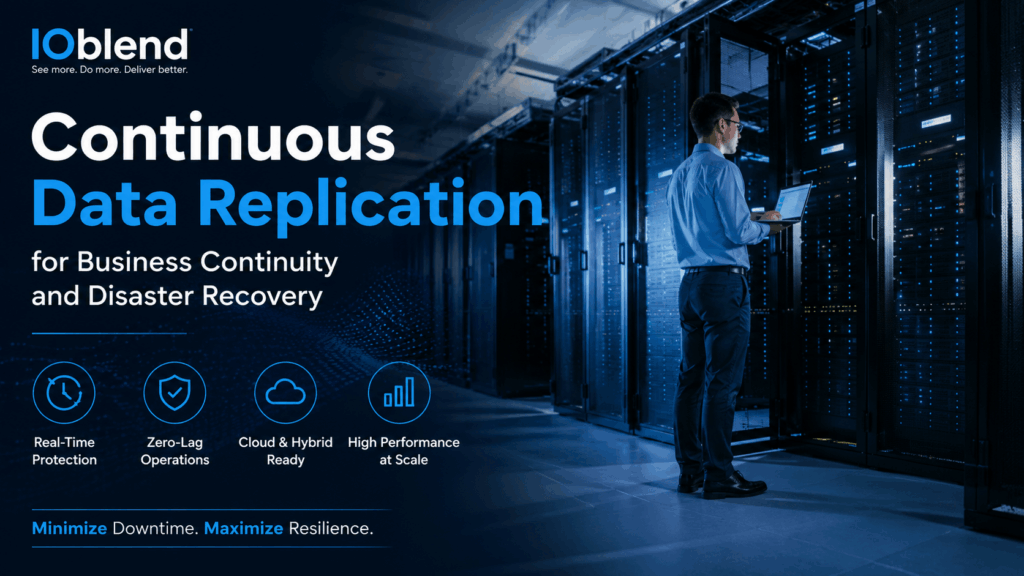

Continuous Data Replication: for Business Continuity and DR
📝 Did you know? According to industry studies, the average cost of IT downtime is approximately £4,500 per minute. For a large enterprise, a single hour of data loss or system unavailability can translate into millions in lost revenue, legal penalties, and irreparable brand damage.
The Pulse of Availability
Continuous Data Replication (CDR) is the practice of moving data between systems in real-time or near real-time, ensuring that a secondary environment always mirrors the primary one. Unlike traditional batch backups that create “snapshots” of data at specific intervals, CDR captures every change, every click, transaction, and update, as it happens. This creates a foundation for Business Continuity and Disaster Recovery (DR) where the Recovery Point Objective (RPO) is measured in seconds, not hours.
The High Cost of Stale Data
Businesses today face a mounting wall of technical debt and operational risk when managing data protection. The most common issues include:
- The “Gap” of Data Loss: With batch processing, any data generated between the last backup and the moment of failure is lost forever.
- Performance Degradation: Traditional replication often places a heavy load on production databases, causing “stun” or latency that frustrates end-users.
- Complexity and Vendor Lock-in: Managing disparate tools for different clouds and on-premises systems creates a fragmented architecture that is difficult to test and even harder to fail over during a crisis.
- Schema Drift: If the structure of your production data changes (e.g., a new column is added), many replication tools simply break, leaving the business unprotected until a manual fix is applied.
Transforming Resilience with IOblend
IOblend redefines the standards for continuous replication by moving away from brittle, code-heavy pipelines. It provides a “Swiss Army Knife” for data experts to build robust, production-grade pipelines that handle Disaster Recovery with ease.
- Real-Time CDC: IOblend utilises advanced Change Data Capture (CDC) to synchronise systems without the “5-tool stack” complexity.
- Zero-Lag Operations: Built on Apache Spark, IOblend offers massive throughput (over 1 million TPS), ensuring your DR site is always current without impacting production performance.
- Automated Integrity: Features like record-level lineage, de-duping, and automated schema drift handling ensure that your replicated data isn’t just there, it’s accurate and auditable.
- Portability: With JSON playbooks, your replication logic remains portable, preventing vendor lock-in and allowing for seamless cloud-to-cloud or hybrid-cloud migrations.
Don’t let a system failure become a business failure; secure your future and synchronise your world with IOblend.

Streaming Data Quality That Won’t Break Pipelines
Streaming Without the Sting: Data Quality Rules That Never Break the Flow 💻 Did you know? A single minute of downtime in a high-velocity streaming environment can result in the loss of millions of data points, potentially costing a business thousands of pounds in missed opportunities or regulatory fines. — Defining Resilient Streaming Quality Data quality in

Schema Drift: The Silent Killer of Data Pipelines
The Silent Pipeline Killer: Surviving Schema Drift in the Wild 📊 Did you know? In the early days of big data, a single column change in a source database could trigger a “data graveyard” effect, where downstream analytics remained broken for weeks. The silent pipeline killer Schema drift occurs when the structure of source data changes

Preventing Data Drift in Modern Data Systems
The Invisible Erosion: Detecting and Managing Data Drift in Modern Architectures 📊 Did you know? According to recent industry surveys, over 70% of organisations experience significant data drift within the first six months of deploying a production system. The Concept of Data Drift Data drift occurs when the statistical properties or the underlying structure of incoming data change

Stream Database Changes to Your Lakehouse with CDC
Zero-Lag Operations: Stream Database Changes to Your Lakehouse 💾 Did you know? The “data downtime” caused by traditional batch processing costs the average enterprise approximately £12,000 per minute. The Concept: Moving at the Speed of Change Zero-lag operations rely on a transition from periodic “snapshots” to continuous “streams.” Instead of moving massive blocks of data at

Real-Time Salesforce CDC to Snowflake
Real-Time CDC: Keep Salesforce and Snowflake in Perfect Sync 🔎 Did you know? While many businesses still rely on nightly batch windows to move CRM data, Salesforce generates millions of events every hour. The Concept: Real-Time CDC Real-Time Change Data Capture (CDC) is a software design pattern used to determine and track data that has

Build Production Spark Pipelines—No Scala Needed
Democratising Spark: How IOblend enables Data Analysts to build production-grade Spark pipelines without writing Scala or Java Did You Know? The average enterprise now manages over 350 different data sources, yet nearly 70% of data leaders report feeling “trapped” by their own infrastructure. The Concept: Democratising the Spark Engine At its core, Apache Spark is a lightning-fast, distributed computing