
Streaming Upserts Done Right: Deduping and Idempotency at Scale
💻 Did you know? In many high-velocity streaming environments, the “same” event can be sent or processed multiple times due to network retries or distributed system failures.
The Art of the Upsert
At its core, a streaming upsert (a portmanteau of “update” and “insert”) is the process of synchronising incoming data with an existing dataset in real time. If a record with a specific primary key already exists, it is updated; if not, it is created.
To do this “right” at scale, two concepts are non-negotiable:
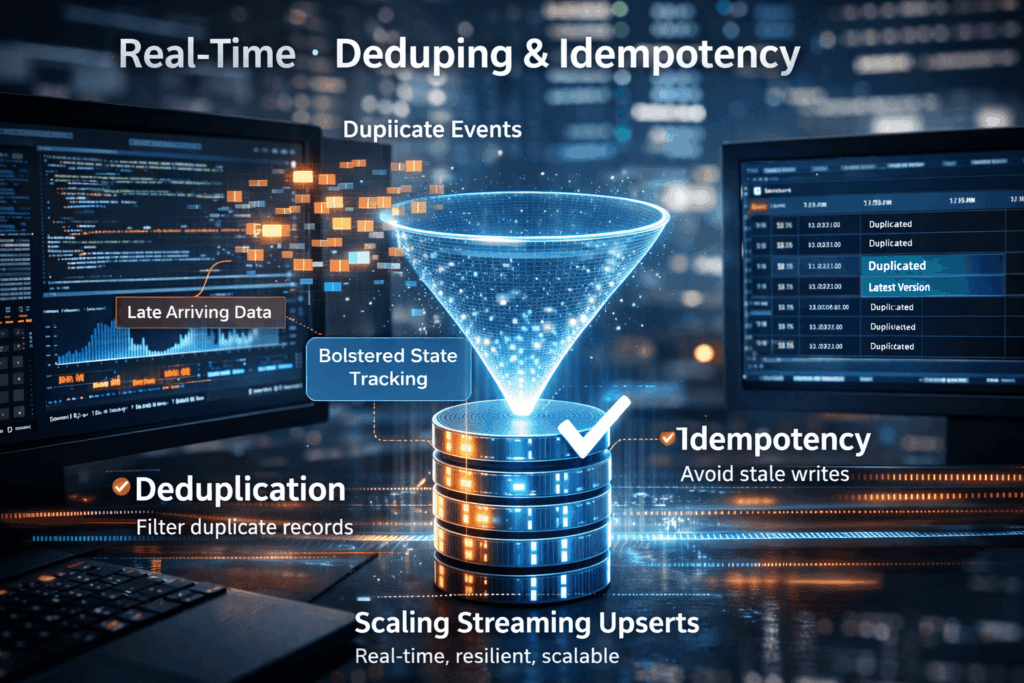
Deduplication: Removing identical redundant records before they hit the storage layer.
Idempotency: Ensuring that performing an operation multiple times has the same effect as performing it once.
The Scalability Wall: Why Businesses Struggle
Most businesses start with simple batch updates, but as they move toward real-time insights, they hit a wall. In a distributed stream (like Kafka or Kinesis), data rarely arrives in the correct order. This leads to several critical issues:
- Late-Arriving Data: An older version of a customer’s profile might arrive after a newer version. If the system blindly upserts, it “downgrades” the data to an incorrect, stale state.
- The “Double Bubble” Problem: During system spikes or restarts, producers often resend batches. Without a robust state store to track what has already been processed, the downstream database suffers from bloated storage and inaccurate analytics.
- Performance Bottlenecks: Checking for the existence of a record in a multi-terabyte table before every single write is computationally expensive. Traditional databases often crawl to a halt under the high-IOPS (Input/Output Operations Per Second) demand of a true streaming upsert.
Mastering the Stream with IOblend
IOblend solves the complexity of streaming upserts by shifting the heavy lifting away from the database and into a high-performance, “AI-Forward” data engineering tier.
Instead of writing complex, custom Spark or Flink scripts to manage state and watermarking, IOblend provides a unified interface to handle real-time data synchronisation. It natively manages:
- Automated Deduplication: Identifying and discarding redundant events at the ingestion point to save on downstream costs.
- Stateful Processing: Ensuring idempotency by keeping track of the latest version of every record, regardless of the order in which they arrive.
- Schema Evolution: Seamlessly handling changes in data structure without breaking the streaming pipeline.
By using IOblend’s advanced CDC (Change Data Capture) and streaming capabilities, businesses can move from fragile, “bolt-on” deduplication to a resilient, enterprise-grade data mesh that guarantees accuracy at any scale.
Don’t let duplicate data dilute your insights, streamline your future with IOblend.

Saving Cents on Data Sense: Less Cost, More Value
No company is immune from the pains of data integration. It is one of the top IT cost items. Companies must get on top of their integration effort.

Operational Analytics: Real-Time Insights That Matter
Operational analytics involves processing and analysing operational data in “real-time” to gain insights that inform immediate and actionable decisions.

Deciphering the True Cost of Your Data Investment
Many data teams aren’t aware of the concept of Total Ownership Cost or its importance. Getting it right in planning will save you a massive headache later.

When Data Science Meets Domain Expertise
In the modern days of GenAI and advanced analytics, businesses need to bring domain expertise and data knowledge together in an effective manner.

Keeping it Fresh: Don’t Let Your Data Go to Waste
Data must be fresh, i.e. readily available, relevant, trustworthy, and current to be of any practical use. Otherwise, it loses its value.

Behind Every Analysis Lies Great Data Wrangling
Most companies spend the vast majority of their resources doing data wrangling in a predominantly manual way. This is very costly and inhibits data analytics.