
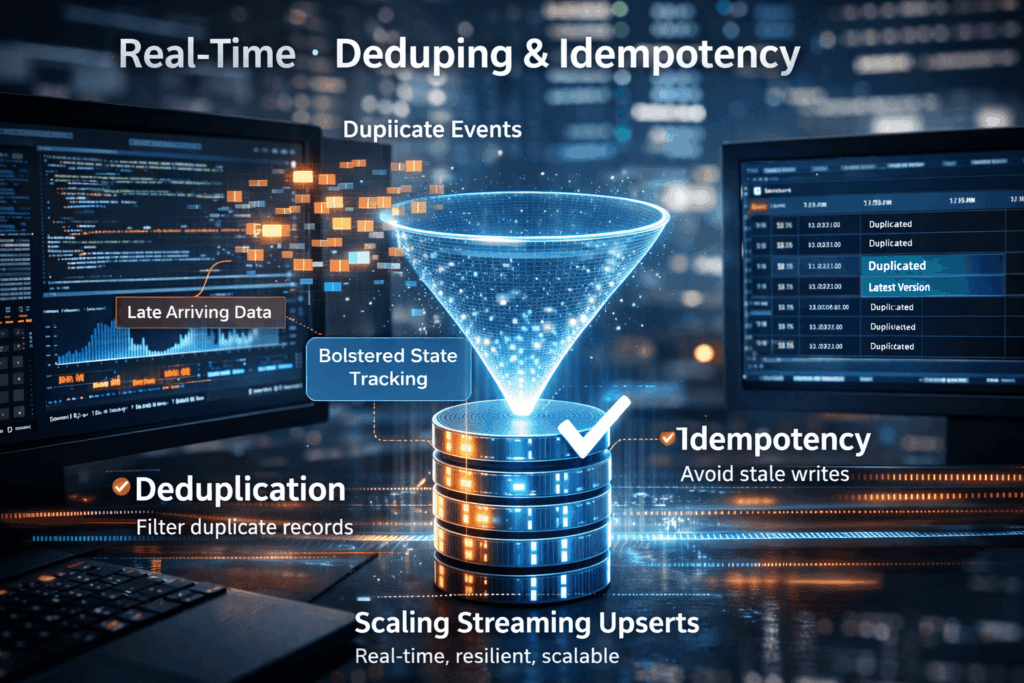

Real-Time Upserts: Deduping and Idempotency

Real-time-data-processing-with-deduplication

Streaming Upserts Done Right: Deduping and Idempotency at Scale 

💻 Did you know? In many high-velocity streaming environments, the “same” event can be sent or processed multiple times due to network retries or distributed system failures. 

The Art of the Upsert 

At its core, a streaming upsert (a portmanteau of “update” and “insert”) is the process of synchronising incoming data with an existing dataset in real time. If a record with a specific primary key already exists, it is updated; if not, it is created. 

To do this “right” at scale, two concepts are non-negotiable: 

Deduplication: Removing identical redundant records before they hit the storage layer. 

Idempotency: Ensuring that performing an operation multiple times has the same effect as performing it once. 

The Scalability Wall: Why Businesses Struggle 

Most businesses start with simple batch updates, but as they move toward real-time insights, they hit a wall. In a distributed stream (like Kafka or Kinesis), data rarely arrives in the correct order. This leads to several critical issues: 

  • Late-Arriving Data: An older version of a customer’s profile might arrive after a newer version. If the system blindly upserts, it “downgrades” the data to an incorrect, stale state. 
  • The “Double Bubble” Problem: During system spikes or restarts, producers often resend batches. Without a robust state store to track what has already been processed, the downstream database suffers from bloated storage and inaccurate analytics. 
  • Performance Bottlenecks: Checking for the existence of a record in a multi-terabyte table before every single write is computationally expensive. Traditional databases often crawl to a halt under the high-IOPS (Input/Output Operations Per Second) demand of a true streaming upsert. 

Mastering the Stream with IOblend 

IOblend solves the complexity of streaming upserts by shifting the heavy lifting away from the database and into a high-performance, “AI-Forward” data engineering tier.  

Instead of writing complex, custom Spark or Flink scripts to manage state and watermarking, IOblend provides a unified interface to handle real-time data synchronisation. It natively manages: 

  • Automated Deduplication: Identifying and discarding redundant events at the ingestion point to save on downstream costs. 
  • Stateful Processing: Ensuring idempotency by keeping track of the latest version of every record, regardless of the order in which they arrive. 
  • Schema Evolution: Seamlessly handling changes in data structure without breaking the streaming pipeline. 

By using IOblend’s advanced CDC (Change Data Capture) and streaming capabilities, businesses can move from fragile, “bolt-on” deduplication to a resilient, enterprise-grade data mesh that guarantees accuracy at any scale. 

Don’t let duplicate data dilute your insights, streamline your future with IOblend. 

IOblend: See more. Do more. Deliver better.

Airlines
admin

Better airport operations with real-time analytics

Good and bad Welcome to the next issue of our real-time analytics blog. Now that the summer holiday season is upon us, many of us will be using air travel to get to their destinations of choice. This means, we will be going through the airports. As passengers, we have love-hate relationships with airports. Some

Read More »
Airlines
admin

The making of a commercial flight

What makes a flight Welcome to the next leg of our airline data blog journey. In this article, we will be looking at what happens behind the scenes to make a single commercial flight, well, take flight. We will again consider how processes and data come together in (somewhat of a) harmony to bring your

Read More »
Airlines
admin

Enhance your airline’s analytics with a data mesh

Building a flying program In the last blog, I have covered how airlines plan their route networks using various strategies, data sources and analytical tools. Today, we will be covering how the network plan comes to life. Once the plans are developed, they are handed over to “production”. Putting a network plan into production is

Read More »
Airlines
admin

Planning an airline’s route network with deep data insights

What makes an airline Commercial airlines are complex beasts. They comprise of multiple intertwined (and siloed!) functions that make the business work. As passengers, we see a “tip of the iceberg” when we fly. A lot of work goes into making that flight happen, which starts well in advance. Let’s distil the complexity into something

Read More »
plane, flight, sunset-513641.jpg
Airlines
admin

Flying smarter with real-time analytics

Dynamic decisioning We continue exploring the topics of operational analytics (OA) in the aviation industry. Data plays a crucial role in flight performance analytics, operational decisioning and risk management. Real-time data enhances them. The aviation industry uses real-time data for a multitude of operational analytics cases: monitor operational systems, measure wear and tear of equipment,

Read More »
Airlines
admin

How Operational Analytics power Ground Handling

The Ground Handling journey – today and tomorrow In today’s blog we are discussing how Operational Analytics (OA) enables the aviation Ground Handling industry to deliver their services to airlines. Aviation is one of the most complex industries out there, so it offers a wealth of examples (plus it’s also close to our hearts). OA

Read More »
Scroll to Top