
Streaming Upserts Done Right: Deduping and Idempotency at Scale
💻 Did you know? In many high-velocity streaming environments, the “same” event can be sent or processed multiple times due to network retries or distributed system failures.
The Art of the Upsert
At its core, a streaming upsert (a portmanteau of “update” and “insert”) is the process of synchronising incoming data with an existing dataset in real time. If a record with a specific primary key already exists, it is updated; if not, it is created.
To do this “right” at scale, two concepts are non-negotiable:
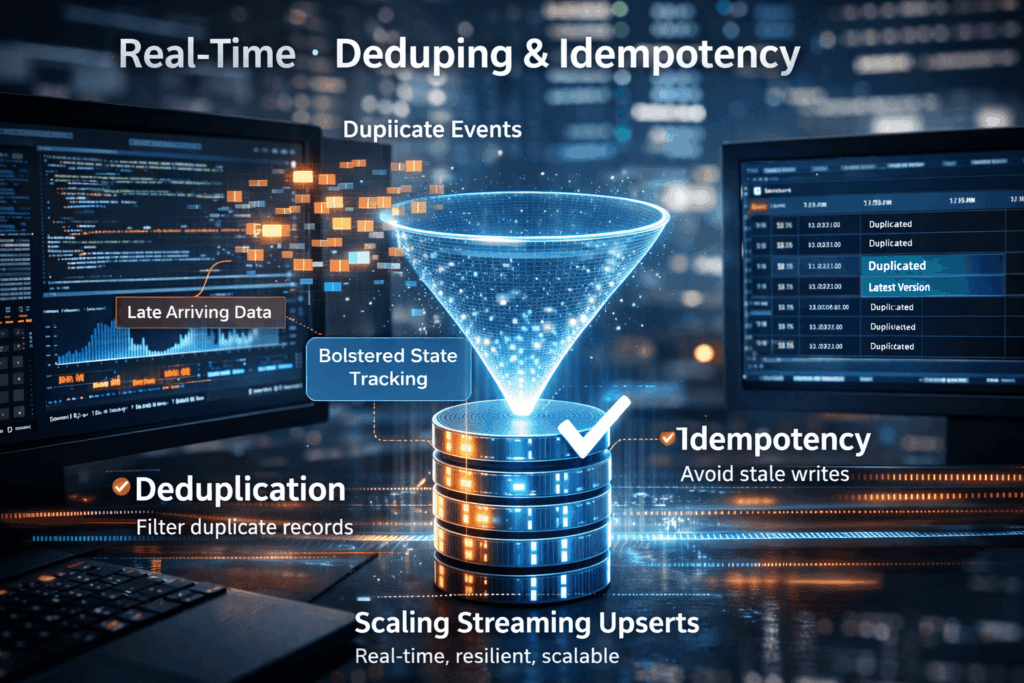
Deduplication: Removing identical redundant records before they hit the storage layer.
Idempotency: Ensuring that performing an operation multiple times has the same effect as performing it once.
The Scalability Wall: Why Businesses Struggle
Most businesses start with simple batch updates, but as they move toward real-time insights, they hit a wall. In a distributed stream (like Kafka or Kinesis), data rarely arrives in the correct order. This leads to several critical issues:
- Late-Arriving Data: An older version of a customer’s profile might arrive after a newer version. If the system blindly upserts, it “downgrades” the data to an incorrect, stale state.
- The “Double Bubble” Problem: During system spikes or restarts, producers often resend batches. Without a robust state store to track what has already been processed, the downstream database suffers from bloated storage and inaccurate analytics.
- Performance Bottlenecks: Checking for the existence of a record in a multi-terabyte table before every single write is computationally expensive. Traditional databases often crawl to a halt under the high-IOPS (Input/Output Operations Per Second) demand of a true streaming upsert.
Mastering the Stream with IOblend
IOblend solves the complexity of streaming upserts by shifting the heavy lifting away from the database and into a high-performance, “AI-Forward” data engineering tier.
Instead of writing complex, custom Spark or Flink scripts to manage state and watermarking, IOblend provides a unified interface to handle real-time data synchronisation. It natively manages:
- Automated Deduplication: Identifying and discarding redundant events at the ingestion point to save on downstream costs.
- Stateful Processing: Ensuring idempotency by keeping track of the latest version of every record, regardless of the order in which they arrive.
- Schema Evolution: Seamlessly handling changes in data structure without breaking the streaming pipeline.
By using IOblend’s advanced CDC (Change Data Capture) and streaming capabilities, businesses can move from fragile, “bolt-on” deduplication to a resilient, enterprise-grade data mesh that guarantees accuracy at any scale.
Don’t let duplicate data dilute your insights, streamline your future with IOblend.

Data Architecture: The Forever Quest for Data Perfection
Data architecture is a critical component of modern business strategy, enabling organisations to leverage their data assets effectively.

Mind the Gap: Bridging GenAI Promise and Practice
While the benefits of GenAI are promising, the path to adopting such technologies is not straightforward at all.

Data Automation: Investing Pennies to Save Pounds
Data automation is a critical enabler of efficiency, accuracy, and strategic insight. It also considerably lowers your business cost when producing said insight

Data Strategy: Taking a Business View
Data strategy aligns data-related activities with the strategic goals of an organisation. It’s about turning data into value.

Out with the Old ETL: Navigating the Upgrade Maze
Today, we have tools and experience to make digital transformation easy. Yet, most organisations cling to their antiquated data systems and analytics. Why?

Smart Data Integration: More $ for Your D&A Budget
Data integration is the heart of data engineering. The process is inherently complex and consumes the most of your D&A budget.