Real-Time Upserts: Deduping and Idempotency

Real-time-data-processing-with-deduplication

Streaming Upserts Done Right: Deduping and Idempotency at Scale 

💻 Did you know? In many high-velocity streaming environments, the “same” event can be sent or processed multiple times due to network retries or distributed system failures. 

The Art of the Upsert 

At its core, a streaming upsert (a portmanteau of “update” and “insert”) is the process of synchronising incoming data with an existing dataset in real time. If a record with a specific primary key already exists, it is updated; if not, it is created. 

To do this “right” at scale, two concepts are non-negotiable: 

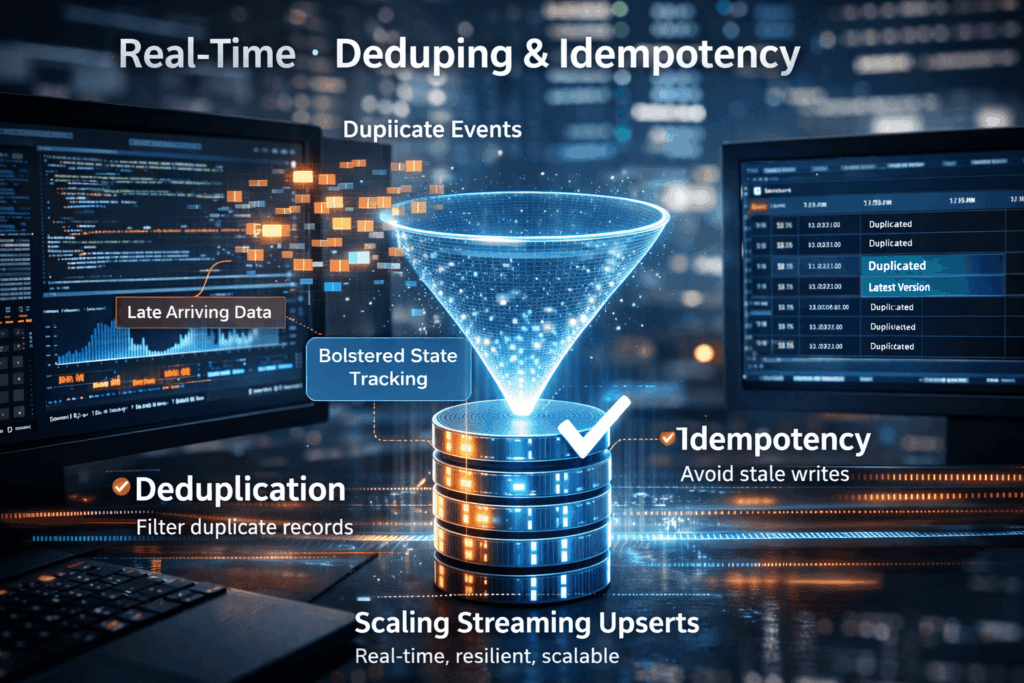
Deduplication: Removing identical redundant records before they hit the storage layer. 

Idempotency: Ensuring that performing an operation multiple times has the same effect as performing it once. 

The Scalability Wall: Why Businesses Struggle 

Most businesses start with simple batch updates, but as they move toward real-time insights, they hit a wall. In a distributed stream (like Kafka or Kinesis), data rarely arrives in the correct order. This leads to several critical issues: 

  • Late-Arriving Data: An older version of a customer’s profile might arrive after a newer version. If the system blindly upserts, it “downgrades” the data to an incorrect, stale state. 
  • The “Double Bubble” Problem: During system spikes or restarts, producers often resend batches. Without a robust state store to track what has already been processed, the downstream database suffers from bloated storage and inaccurate analytics. 
  • Performance Bottlenecks: Checking for the existence of a record in a multi-terabyte table before every single write is computationally expensive. Traditional databases often crawl to a halt under the high-IOPS (Input/Output Operations Per Second) demand of a true streaming upsert. 

Mastering the Stream with IOblend 

IOblend solves the complexity of streaming upserts by shifting the heavy lifting away from the database and into a high-performance, “AI-Forward” data engineering tier.  

Instead of writing complex, custom Spark or Flink scripts to manage state and watermarking, IOblend provides a unified interface to handle real-time data synchronisation. It natively manages: 

  • Automated Deduplication: Identifying and discarding redundant events at the ingestion point to save on downstream costs. 
  • Stateful Processing: Ensuring idempotency by keeping track of the latest version of every record, regardless of the order in which they arrive. 
  • Schema Evolution: Seamlessly handling changes in data structure without breaking the streaming pipeline. 

By using IOblend’s advanced CDC (Change Data Capture) and streaming capabilities, businesses can move from fragile, “bolt-on” deduplication to a resilient, enterprise-grade data mesh that guarantees accuracy at any scale. 

Don’t let duplicate data dilute your insights, streamline your future with IOblend. 

IOblend: See more. Do more. Deliver better.

real time CDC and SPARK IOblend
AI
admin

Real-Time Insurance Claims with CDC and Spark

From Batch to Real-Time: Accelerating Insurance Claims Processing with CDC and Spark 💼 Did you know? In the insurance sector, the move from overnight batch processing to real-time stream processing has been shown to reduce the average claims settlement time from several days to under an hour in highly automated systems. Real-Time Data and Insurance 

Read More »
AI
admin

Agentic AI: The New Standard for ETL Governance

Autonomous Finance: Agentic AI as the New Standard for ETL Governance and Resilience  📌 Did You Know? Autonomous data quality agents deployed by leading financial institutions have been shown to proactively detect and correct up to 95% of critical data quality issues.  The Agentic AI Concept Agentic Artificial Intelligence (AI) represents the progression beyond simple prompt-and-response

Read More »
feaute_store_mlops_ioblend
AI
admin

IOblend: Simplifying Feature Stores for Modern MLOps

IOblend: Simplifying Feature Stores for Modern MLOps Feature stores emerged to solve a real challenge in machine learning: managing features across models, maintaining consistency between training and inference, and ensuring proper governance. To meet this need, many solutions introduced new infrastructure layers—Redis, DynamoDB, Feast-style APIs, and others. While these tools provided powerful capabilities, they also

Read More »
feature_store_value_ioblend
AI
admin

Rethinking the Feature Store concept for MLOps

Rethinking the Feature Store concept for MLOps Today we talk about Feature Stores. The recent Databricks acquisition of Tecton raised an interesting question for us: can we make a feature store work with any infra just as easily as a dedicated system using IOblend? Let’s have a look. How a Feature Store Works Today Machine

Read More »
IOblend_ERP_CRM_data_integration
AI
admin

CRM + ERP: Powering Predictive Analytics

The Data-Driven Value Chain: Predictive Analytics with CRM and ERP  📊 Did you know? A study on real-time data integration platforms revealed that organisations can reduce their average response time to supply chain disruptions from 5.2 hours to just 37 minutes.  A Unified Data Landscape  The modern value chain is a complex ecosystem where every component is interconnected,

Read More »
agentic AI data migrations
AI
admin

Enhancing Data Migrations with IOblend Agentic AI ETL

LeanData Optimising Cloud Migration: for Telecoms with Agentic AI ETL  📡 Did you know? The global telecommunications industry is projected to create over £120 billion in value from agentic AI by 2026.  The Dawn of Agentic AI ETL  For data experts in the telecoms sector, the term ETL—Extract, Transform, Load—is a familiar, if often laborious, process. It’s

Read More »
Scroll to Top